
The HT Contact Form plugin allows you to connect your forms with Drip, the ecommerce CRM designed for building personal and profitable relationships with your customers at scale. With support for subscriber fields, custom fields, and dynamic tagging, you can create sophisticated marketing automation workflows.
Key Features
- Account Selection: Choose from multiple Drip accounts/workspaces
- Full Field Mapping: Map form data to all standard and custom subscriber fields
- Dynamic Tagging: Apply static and dynamic tags using smart tags
- Automatic Timezone: WordPress timezone automatically synced
- Rate Limit Handling: Automatic retry with backoff for API limits
- Duplicate Management: Updates existing subscribers seamlessly
Prerequisites
Before using the Drip integration, make sure you have a Drip Account, your Drip API Token, and at least one Drip account/workspace set up.
Getting Your API Token
- Log in to your Drip account
- Go to Settings → User Settings
- Find the API Token section
- Copy your API token
Note: Keep your API token secure and don’t share it publicly. This token grants access to your Drip account.
Step 1: Configure Global Settings
First, you need to configure the Drip API Token in the global settings.
- Go to HT Contact Form → Settings → Integrations
- Find Drip and click Configure
- Enter your API Token
- Click Verify and Save to test the connection
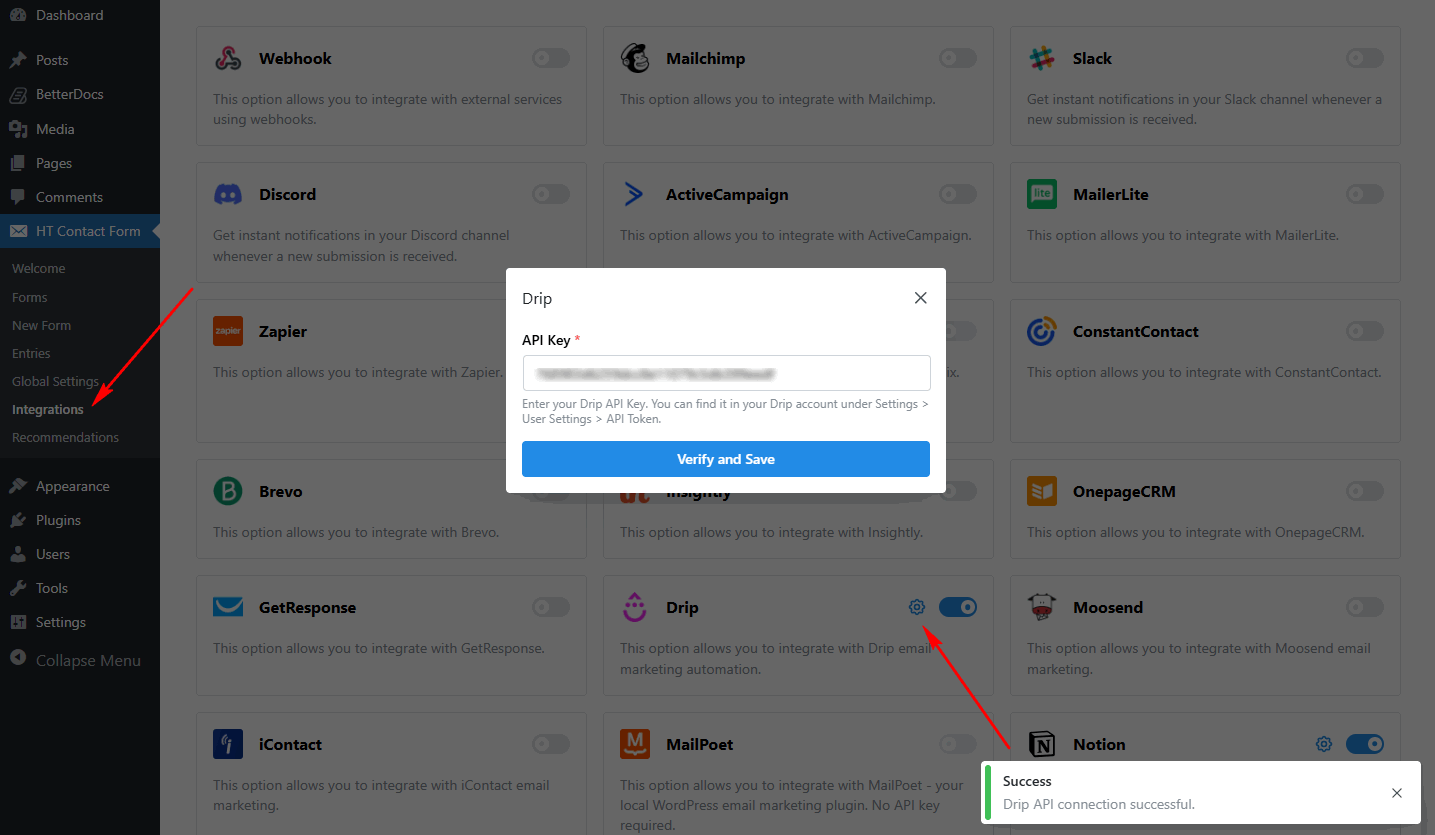
Step 2: Add Drip Integration to Your Form
Once the global settings are configured, you can add the Drip integration to any form.
- Edit your form
- Go to the Integrations tab
- Click Add New → Drip
- Select your Drip account
- Configure field mappings and tags
- Click Save Integration
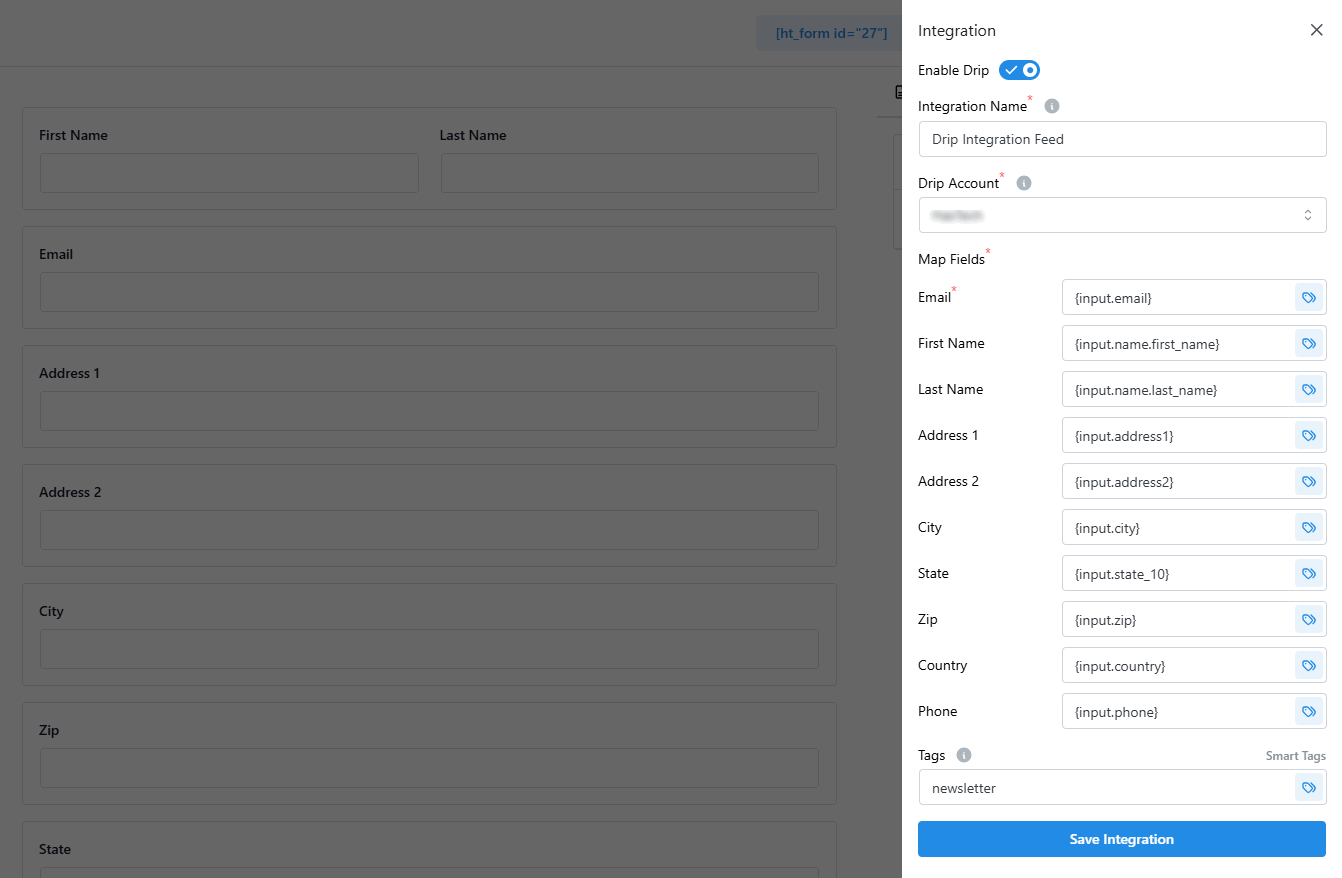
Integration Settings Overview
| Setting | Required | Description |
|---|---|---|
| Account | Yes | Select your Drip account/workspace |
| Field Mapping | Yes | Map form fields to Drip subscriber fields |
| Tags | No | Comma-separated tags to assign to subscribers |
Standard Subscriber Fields
Map your form fields to these standard Drip subscriber fields:
| Field | Description |
|---|---|
| Subscriber email (required) | |
| first_name | First name |
| last_name | Last name |
| address1 | Address line 1 |
| address2 | Address line 2 |
| city | City |
| state | State/Province |
| zip | Postal/ZIP code |
| country | Country |
| phone | Phone number |
Custom fields from your Drip account are loaded automatically and can be mapped using smart tags.
Tags Configuration
Tags help you segment and organize subscribers in Drip. You can use static tags, dynamic tags, or a combination of both.
Static Tags
Enter tags directly, separated by commas:
newsletter, lead, website-signupDynamic Tags with Smart Tags
Include form field values as tags:
newsletter, {input.interest}, {input.source}This allows automatic tagging based on user selections.
Tag Examples
| Scenario | Tags Configuration |
|---|---|
| Simple newsletter | newsletter, website |
| Interest-based | lead, {input.product_interest} |
| Source tracking | {input.utm_source}, {input.campaign} |
| Multi-purpose | subscriber, {input.interest}, webform |
Smart Tags Reference
Use {input.field_name} to include form values dynamically.
| Smart Tag | Description |
|---|---|
{input.email} | Email field value |
{input.first_name} | First name value |
{input.last_name} | Last name value |
{input.phone} | Phone number |
{input.company} | Company name |
{input.any_field} | Any custom form field |
Complete Configuration Example: B2B Lead Generation
Here’s an example of setting up Drip integration for B2B lead capture with qualification.
Form Fields: First Name, Last Name, Email, Company, Job Title, Interest (dropdown)
Integration Configuration
Account: B2B Sales
Field Mapping:
  email: {input.email}
  first_name: {input.first_name}
  last_name: {input.last_name}
  company: {input.company}
  job_title: {input.job_title}
Tags: lead, {input.interest}, website-inquiry
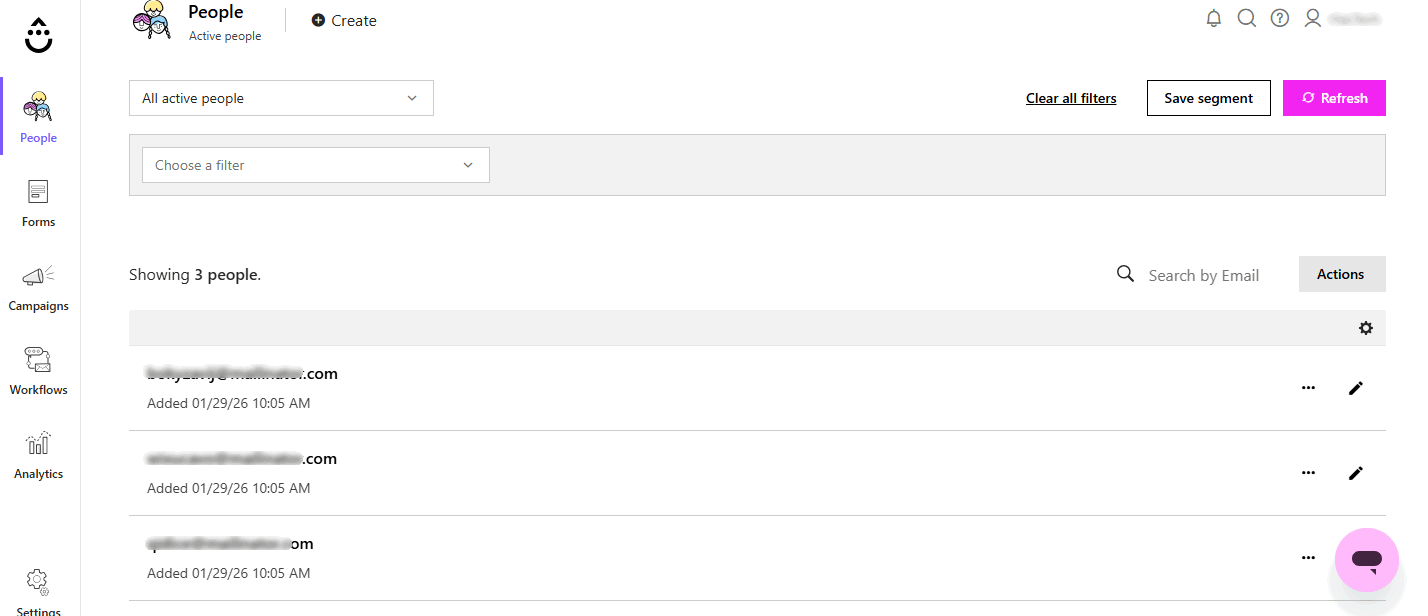
Result: Qualified leads with interest-based tagging for targeted follow-up sequences.
Common Use Cases
- Ecommerce Lead Capture: Collect shopper information before purchase and nurture them through personalized email sequences.
- Customer Onboarding: Add new customers to onboarding workflows with appropriate tags based on their purchase or signup source.
- Content Marketing: Build your subscriber base through lead magnets, blog subscriptions, and content upgrades.
- Segmentation by Interest: Use dynamic tags to automatically segment subscribers based on form responses.
- Reactivation Campaigns: Re-engage inactive subscribers with special offers using targeted tagging.
- Multi-Brand Management: Connect forms to different Drip accounts for separate brand audiences.
Duplicate Handling
When an email already exists in Drip, the integration handles it seamlessly:
- Subscriber custom fields are updated with new values
- New tags are added (existing tags are preserved)
- Automations can trigger on tag addition
- No duplicate subscribers are created
Troubleshooting
Subscribers Not Appearing
Problem: Form submits but subscriber doesn’t appear in Drip.
Solutions:
- Verify API key is correct
- Check account selection
- Confirm email field is mapped
- Look for rate limit errors in logs
Tags Not Applied
Problem: Subscriber created but tags are missing.
Solutions:
- Check tag syntax (comma-separated)
- Verify smart tag field names match form fields
- Test with static tags first
- Check for empty field values
Custom Fields Empty
Problem: Custom fields not populated in Drip.
Solutions:
- Ensure custom fields exist in Drip first
- Check smart tag syntax
- Verify field names match exactly
- Test with a sample submission
Rate Limit Errors
Problem: Getting HTTP 429 errors.
Solutions:
- The plugin automatically retries with backoff
- Reduce form submission frequency if persistent
- Contact Drip support for limit increases
Frequently Asked Questions
Q: Can I connect to multiple Drip accounts?
A: Yes, select the account when configuring each integration.
Q: What happens to existing subscribers?
A: Their information is updated and new tags are added. No duplicates are created.
Q: Can I trigger Drip workflows from form submissions?
A: Yes, use tags to trigger workflow rules in Drip.
Q: Is real-time sync supported?
A: Yes, subscribers are added immediately upon form submission.
Q: How do I remove tags via forms?
A: This integration only adds tags. Use Drip’s interface or API to remove tags.
Q: Can I use Drip for transactional emails?
A: Yes, though this integration is for subscriber management. Configure transactional emails in Drip separately.
Best Practices
Tagging Strategy
- Use meaningful tags – Create a tagging strategy for segmentation
- Be consistent – Use lowercase, hyphens for multi-word tags
- Don’t over-tag – Too many tags reduce effectiveness
- Document your tags – Maintain a tag glossary
Field Mapping
- Map essential fields only – Don’t over-map fields you won’t use
- Use appropriate field types – Match Drip field types to form data
- Test with real data – Verify data appears correctly in Drip
Automation Setup
- Tag-triggered workflows – Use tags to start automations
- Test thoroughly – Send test submissions before going live
- Monitor performance – Track open/click rates
That’s it! Thank you for choosing HT Contact Form to enhance your email marketing workflow. If you need additional assistance, feel free to contact our support team. Our dedicated support team would be more than happy to assist you.