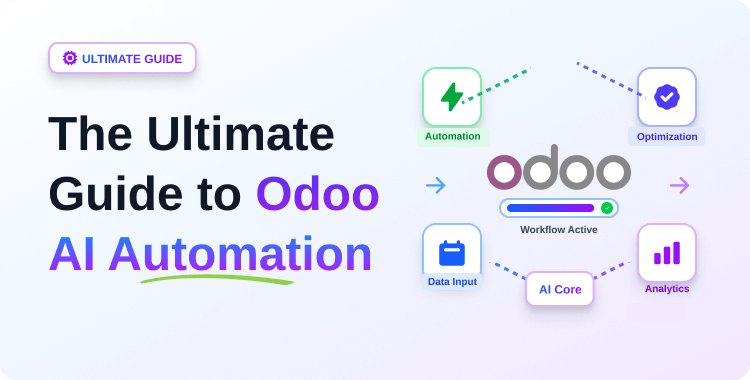
The Ultimate Guide to Odoo AI Automation: Workflow Intelligence & Predictive Features

The business landscape in 2026 demands more than transaction recording—organizations need systems that predict outcomes, optimize workflows autonomously, and empower teams with actionable intelligence. 
Odoo AI Automation delivers exactly this by embedding artificial intelligence directly into enterprise resource planning operations.
Odoo AI Automation represents a fundamental shift from reactive reporting to proactive business management. According to recent industry data, companies leveraging intelligent automation report a 40% increase in productivity and a 20% reduction in operational costs.
For organizations managing complex operations across sales, finance, inventory, and human resources, AI-powered automation has become essential rather than optional.
Unlike legacy ERP systems, where AI feels bolted on, Odoo’s intelligent automation threads natively through every module. Routine tasks execute automatically. Bottlenecks surface before impacting operations.
Predictions guide strategic decisions with confidence intervals rather than guesswork. This comprehensive guide explores how Odoo AI Automation transforms workflows, the specific features driving efficiency gains, real-world implementation strategies, and the financial ROI that justifies investment.
Key Takeaways
- Odoo AI Automation reduces manual data entry by 80% through intelligent document processing
- Predictive analytics improve forecast accuracy by 15-25%, enabling data-driven decisions
- Workflow intelligence identifies bottlenecks automatically and routes approvals intelligently
- ROI benchmark: 3x-5x return within the first year with average annual savings of $46,000
- Early adopters of AI-powered automation report 40% productivity gains and 20% cost reduction
What Is Odoo AI Automation?
Odoo AI Automation is an embedded artificial intelligence integrated throughout Odoo’s ERP platform that automatically executes tasks, predicts business outcomes, and optimizes workflows without manual intervention. Unlike legacy systems with bolted-on AI, Odoo’s intelligent automation threads through sales, finance, inventory, and HR modules natively.
Three Pillars of Odoo AI Automation
1. Predictive Intelligence: Machine learning analyzes historical data to forecast sales, demand, cash flow, and resource needs with statistical confidence.
2. Intelligent Automation: Workflows execute automatically—approvals route based on amount/category, invoices process without data entry, reorders generate at optimal inventory levels, and email follow-ups trigger based on customer engagement.
3. Contextual Assistance: AI agents understand business context and user roles, providing intelligent answers to questions like “Show our top 10 customers by revenue” or “What’s our pipeline value this quarter?”
Workflow intelligence in Odoo AI Automation operates differently from traditional reporting. Rather than waiting for monthly reports, the system continuously monitors processes, identifies inefficiencies, and automatically suggests or implements improvements.
Core Features of Odoo AI Automation
Intelligent Document Processing with AI-Powered OCR
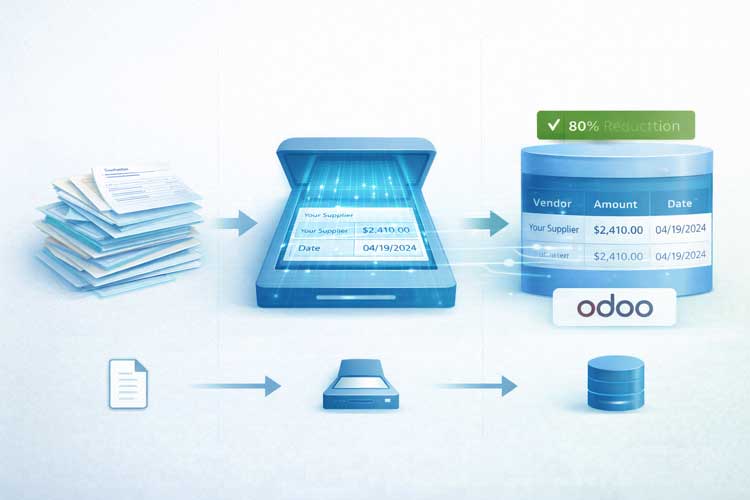
The Challenge: Invoice processing consumes hundreds of administrative hours annually. Manual data entry creates errors downstream.
The Solution: Odoo’s enhanced optical character recognition automatically extracts information from invoices, receipts, and purchase orders. Intelligent automation learns business-specific formatting, improving accuracy over time.
Impact:
- Up to 80% faster document processing
- 88% error reduction through automated extraction
- $15,000-$25,000 annual labor savings per company
Real Example: Manufacturing company processing 2,000 purchase orders monthly saves 745 hours annually—labor cost of $20,000+ recovered through AI-powered automation of document handling.
Predictive Analytics & Forecasting for Business Planning

The Challenge: Sales forecasts miss by 15-30%. Inventory planning creates stockouts or excess stock. Cash flow remains uncertain.
The Solution: Odoo’s predictive analytics analyzes historical sales, seasonality, customer behavior, and market trends to forecast revenue, inventory demand, and cash flow with confidence intervals.
Capabilities:
- Sales forecasting projects revenue with ±5% accuracy (vs. ±15-20% traditional estimates)
- Demand forecasting reduces inventory costs while improving service levels by 15-25%
- Cash flow prediction enables confident quarterly planning
- Resource forecasting identifies hiring needs before capacity crunches
Impact: Organizations using AI-driven forecasting report 30-200% first-year ROI and significantly improved planning accuracy.
Real Example: B2B SaaS company with $5M ARR now forecasts quarterly revenue within ±5%, enabling confident hiring and investment decisions.
Automated Workflow Optimization & Process Intelligence
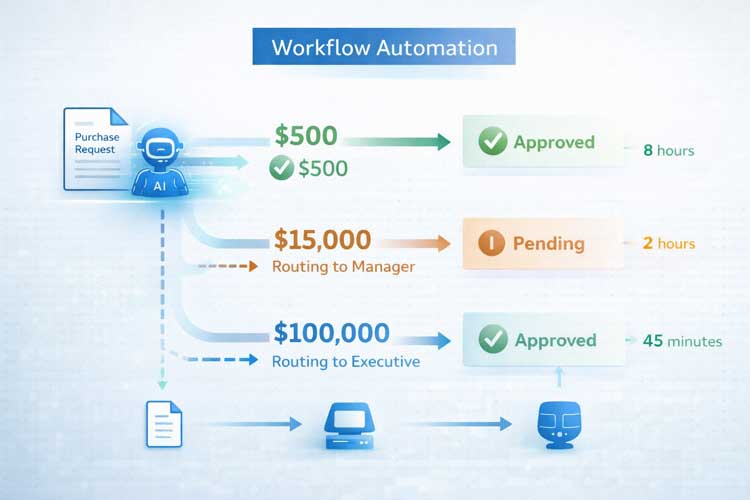
The Challenge: Business processes contain hidden inefficiencies. Routine tasks consume staff time. Approval bottlenecks delay decisions.
The Solution: Odoo’s workflow intelligence continuously monitors processes and automatically optimizes:
- Intelligent approval routing: Requests route based on amount, department, and authority rules. $500 office supplies auto-approve. $50,000 capital requests go to CFO. Rush orders from critical vendors bypass normal procedures.
- Routine task automation: Purchase orders are generated automatically when inventory dips below the threshold. Invoices are processed when shipments match POs. Follow-up emails are triggered based on customer engagement patterns.
- Bottleneck identification: Intelligent automation surfaces approval queue lengths, processing delays, and task backlogs.
Impact:
- 45% reduction in data entry time
- Approvals accelerate from days to hours through AI-powered automation
- Consistent policy enforcement across all transactions
- Scalability without proportional staff increases
Real Example: Retail company with 50 locations processes 200 reorders daily. Routine reorders under $1,000 auto-approve. Complex requests route based on queue length. Result: approval time drops from 8 hours to 45 minutes through workflow intelligence.
AI Agents & Natural Language Interaction
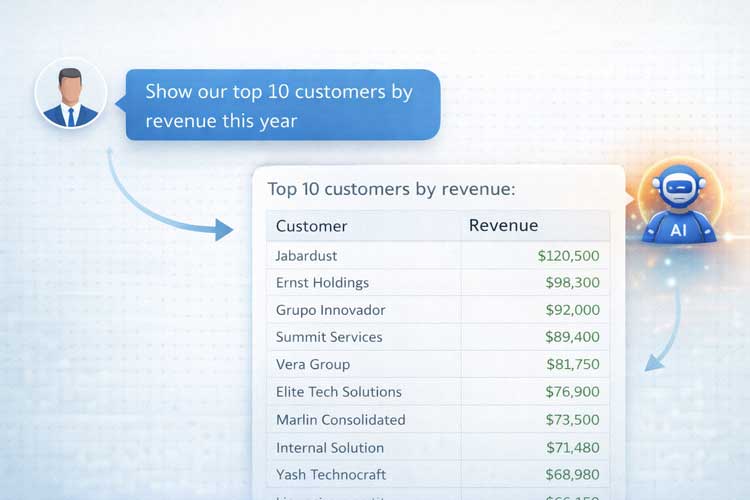
The Challenge: Users navigate complex menus. Creating reports requires technical expertise.
The Solution: AI agents understand natural business language and interact with Odoo conversationally:
- “Show top 10 customers by revenue this year”.
- “What’s our pipeline value for Q1?”
- “Create a purchase order for 1,000 units of SKU-4521”.
- “How many employees took leave last month?”
Impact: Non-technical users access business workflow AI insights instantly without navigating system interfaces.
AI-Powered Text Generation
The Challenge: Sales teams draft proposals. Marketing creates descriptions. HR writes communications. This administrative work delays customer engagement.
The Solution: Generative AI creates business content automatically:
- Sales proposals draft from opportunity data
- Customer communications generate follow-up emails
- Marketing content creates product descriptions
- HR communications draft offer letters
Impact: Sales teams increase selling time from 60% to 80% of day. Marketing produces content volume previously impossible.
Smart Customer Service & Support Automation
The Challenge: High support volumes require proportional staffing. Customer wait times frustrate buyers.
The Solution: AI-powered chatbots handle routine inquiries 24/7 and route complex issues to specialists with full context.
Impact:
- 24/7 support availability without staffing increases
- Instant responses to routine questions
- Support staff focus on complex, high-value issues
- Proactive outreach reduces churn
Recommended Blogs for You:
👉 Odoo vs SAP: Manufacturing Feature Comparison & Cost Analysis
👉 The 5 Hidden Costs of Legacy ERP Systems: Why Businesses Migrate to Odoo
👉 Top Inventory and Supply Chain Problems That Odoo Solves Guide for Growing Businesses
👉 10 Best Business Website Development Companies
Real-World ROI: Implementation Results Across Industries
Manufacturing: Predictive Maintenance & Demand Optimization
Setup: Mid-sized manufacturer, $50M revenue, 200 employees
Implementation:
- Predictive maintenance models analyze equipment sensors
- Odoo AI Automation triggers purchase orders based on demand forecasts
- Intelligent supplier selection routes to optimal vendors
Results After 12 Months:
- Equipment downtime: 15 hours → 4 hours monthly (73% reduction)
- Demand forecast accuracy: ±22% → ±8%
- Excess inventory reduced 35%, freeing $2.1M working capital
- Stockouts decreased from 8-10 to 1-2 monthly
ROI: $2.1M working capital recovery + $180K labor savings vs. $240K investment = 8.5x first-year ROI
B2B Sales: AI-Powered Pipeline & Proposal Acceleration
Setup: Software company, $8M ARR, 25-person sales team
Implementation:
- Lead scoring prioritizes high-conversion prospects
- AI-powered automation generates proposals in minutes vs. hours
- Sales forecasting provides reliable pipeline visibility
Results After 8 Months:
- Sales cycle: 120 days → 85 days (29% reduction)
- Proposal creation: 4 hours → 30 minutes
- Win rate improved 12%
- Sales productivity increased 28%
ROI: Payback in 4.2 months on $95K investment
Finance: Invoice Processing & Compliance Automation
Setup: $200M revenue company, 150 suppliers, 10,000 monthly invoices
Implementation:
- Intelligent document processing extracts invoice data automatically
- Three-way matching validates PO-Receipt-Invoice automatically
- Automated approvals route based on amount and vendor
- Fraud detection flags suspicious patterns
Results After 6 Months:
- Invoice processing: 21 days → 5 days
- Accounts payable staff optimized: 12 → 8 (4 redeployed)
- Cost per invoice: $12 → $3
- Fraud prevention: Stopped 12 fraudulent invoices totaling $340K
- Compliance violations decreased 95%
ROI: $360K labor savings + $340K fraud prevention vs. $190K investment = 6x first-year ROI.
Key Benefits of Odoo AI Automation
1. Dramatic Efficiency & Productivity Gains
Odoo AI Automation delivers 55% higher operational efficiency with companies reporting 40% productivity increases. For $10M payroll, this equals ~$1M recovered capacity annually.
Efficiency improvements span:
- Finance: 45% reduction in data entry time
- Sales: 35-40% less administrative work
- Operations: 50% faster task completion
- HR: 30% less manual administrative work
2. Significant Cost Reduction
Average savings: $46,000 annually per company. Cost reductions come from:
- Labor optimization: Automation without equivalent staffing increases
- Error reduction: 40-75% fewer errors eliminate rework and corrections
- Inventory optimization: 20% stockout reduction and optimized holding
- Operational efficiency: Eliminated bottlenecks improve throughput
3. Data-Driven Decision Making
Predictive business features in Odoo AI Automation replace gut instinct with confidence-interval predictions, pattern identification, scenario modeling, and real-time performance dashboards.
4. Competitive Speed Advantage
- Sales: Faster proposal cycles capture deals before competitors
- Operations: Rapid issue identification and resolution
- Innovation: Teams freed from routine work focus on strategy
- Customer Service: Real-time responsiveness improves satisfaction
5. Scalability Without Cost Increases
Organizations growing 20-30% annually can handle 2x transaction volume without doubling headcount through intelligent automation.
6. Improved Compliance & Audit Readiness
Automated processes enforce policies uniformly, create detailed audit trails, and flag violations automatically, reducing compliance risk significantly.
7. Enhanced Employee Satisfaction
Staff freed from repetitive work report higher satisfaction and engagement, focusing on problem-solving rather than data entry.
Implementation Strategies for Success
Phase 1: Quick Wins (Months 1-3)
Start with high-impact, lower-complexity processes:
- Implement intelligent document processing in Finance
- Deploy AI agent for common CRM questions
- Activate automated reorder workflows
Phase 2: Core Optimization (Months 4-6)
Expand to core business processes:
- Launch demand forecasting models
- Implement sales proposal automation
- Deploy intelligent approval routing
Phase 3: Advanced Intelligence (Months 7-12)
Advanced capabilities:
- Activate predictive maintenance (if applicable)
- Deploy cash flow and resource forecasting
- Implement sentiment analysis and proactive outreach
Data Quality Foundation
Before expecting results, ensure:
- Complete master data (customer, vendor, product records)
- Consistent formatting (addresses, names, codes)
- 3+ years of clean transaction history
- Regular data maintenance
Clear Governance & Change Management
Define which decisions Odoo AI Automation makes autonomously vs. requiring human review. Establish override procedures and audit mechanisms. Train teams thoroughly on new workflows.
Partner with Certified Implementation Experts

Hastech IT Ltd, a certified Odoo partner in Bangladesh, brings expertise in:
- Odoo configuration optimized for your industry and business model
- Integration services connecting Odoo to existing systems
- Data migration properly prepares historical data for AI models
- Change management helps teams adopt new workflows
- Ongoing optimization ensuring sustained value realization
Hastech’s local expertise in the Bangladesh regulatory environment (NBR compliance, VAT automation, local payment gateways), combined with global best practices, makes implementation more efficient and compliant.
Common Pitfalls
Pitfall 1: Expecting Immediate Perfect Results
Reality: AI models require training data. Months 1-3 may show modest improvements as algorithms learn.
Solution: Set realistic 3-6 month ramp-up expectations with stakeholders.
Pitfall 2: Poor Data Quality Sabotaging Models
Reality: Inaccurate historical data produces unreliable forecasts.
Solution: Invest in data cleansing before Odoo AI Automation deployment.
Pitfall 3: Automation Creating New Bottlenecks
Reality: Automating one process can shift bottlenecks elsewhere.
Solution: Use end-to-end process mapping before automating individual steps.
Pitfall 4: Insufficient Change Management
Reality: Automation eliminates some jobs. Without proper management, staff resist implementation.
Solution: Involve employees early, explain augmentation rather than replacement, provide retraining.
Advanced Strategies
Advanced Strategy 1: Custom AI Model Development
Work with partners like Hastech to develop custom models trained on proprietary business data, creating competitive advantage beyond standard implementations.
Advanced Strategy 2: Cross-Functional AI Orchestration
Orchestrate AI-powered automation across functions: demand forecasting → inventory automation → supplier communication → payment automation for unified business outcomes.
Advanced Strategy 3: AI-Powered Business Model Innovation
Use Odoo’s intelligent automation to identify high-value segments, predict churn, and enable new pricing models or service offerings.
ROI Analysis: Financial Impact of Odoo AI Automation
Quantified Benefits
Direct Savings:
- Labor reduction: $50K-$500K annually
- Inventory optimization: 15-35% working capital reduction
- Fraud prevention: 0.5-2% of transaction volume
- Operational efficiency: 10-15% resource utilization improvement
Indirect Benefits:
- Revenue improvement: 104% increase in automated nurture conversions
- Customer retention: 5-15% churn reduction
- Faster decision cycles: More transactions/year possible
- Employee retention: Reduced hiring/training costs
Industry ROI Benchmarks
| Industry | First-Year ROI | Primary Benefit |
| Manufacturing | 8-12x | Predictive maintenance + forecasting |
| Finance/Accounting | 6-8x | Invoice processing + compliance |
| Sales/B2B | 4-6x | Proposal automation + lead scoring |
| Retail | 5-7x | Inventory optimization + analytics |
| HR | 3-5x | Recruitment + employee analytics |
Key Metric: 92% of organizations achieve positive ROI within 12-24 months, with average $1.41 value per dollar spent.
Implementation Investment Guide
| Component | Cost Range |
| Odoo Enterprise licensing (Year 1) | $40K-$200K |
| Implementation services | $80K-$300K |
| Data migration & integration | $20K-$150K |
| Staff training | $15K-$75K |
| Total Year 1 | $155K-$725K |
| Annual ongoing | $50K-$250K |
Mid-market businesses ($50-100M revenue) typically invest $200K-$400K total, achieving 4-12 month payback periods.
Frequently Asked Questions
Q: What is Odoo AI Automation exactly?
A: Odoo AI Automation is artificial intelligence embedded throughout Odoo ERP that automatically executes tasks (intelligent document processing, approval routing), predicts business outcomes (sales forecasts, demand projections), and optimizes workflows (bottleneck identification, process improvement suggestions). Unlike standalone AI tools, Odoo’s AI-powered automation integrates directly into business processes.
Q: How does Odoo AI improve workflow efficiency?
A: Workflow intelligence in Odoo AI Automation operates through automation of routine tasks, intelligent routing of decisions, bottleneck identification, predictive optimization, and natural language interaction. These combine to reduce processing time 35-45% while improving consistency and compliance.
Q: What are the main predictive features in Odoo AI Automation?
A: Odoo’s predictive business features include sales forecasting, demand forecasting, cash flow projection, resource forecasting, customer churn prediction, and predictive maintenance (manufacturing). Organizations using these report 15-25% forecast accuracy improvements and 30-200% first-year ROI.
Q: How much does Odoo AI Automation implementation cost?
A: First-year costs range $155K-$725K including Odoo licensing ($40K-$200K), implementation ($80K-$300K), integration ($20K-$150K), and training ($15K-$75K). Mid-market businesses typically invest $200K-$400K with 4-12 month payback periods.
Q: Why partner with Hastech IT Ltd for Odoo AI Automation?
A: Hastech IT Ltd is a certified Odoo partner specializing in implementation across South Asia. Hastech provides Odoo configuration expertise, custom module development, integration services, data migration, staff training, and ongoing support.
With a deep understanding of Bangladesh regulatory requirements (NBR compliance, VAT automation, local payment gateways) combined with global best practices, Hastech transforms Odoo AI Automation projects from risky in-house efforts to professionally managed implementations, ensuring sustained value realization.
Conclusion
Odoo AI Automation represents the evolution of enterprise resource planning from transaction recording to intelligent business operations. Organizations implementing AI-powered automation today gain structural advantages that compound over time, faster decisions, lower costs, higher efficiency, and better employee engagement, which become systemic advantages rather than temporary improvements.
The financial case is compelling: 3x-5x first-year ROI, $46,000 average annual savings, 40% productivity improvements, and 35% cost reductions are typical across diverse industries.
Beyond numbers, intelligent automation fundamentally shifts how teams work. Staff spend less time on repetitive tasks and more time on strategic initiatives. Decisions rely on data rather than intuition. Processes execute consistently rather than variably.
The technology is mature and accessible. The business case is proven. Organizations that implement Odoo AI Automation today will operate with significant competitive advantages throughout the next decade.
The path forward involves deploying a thoughtful, phased implementation strategy and partnering with experienced providers like Hastech IT Ltd, a certified Odoo partner with deep expertise in configuration, integration, and change management.
For Odoo customers exploring AI capabilities and businesses evaluating ERP solutions, the question is no longer whether to implement Odoo AI Automation, it’s when and how to execute effectively.