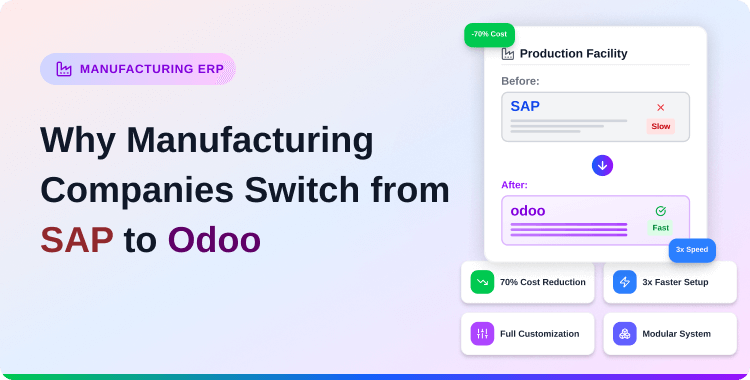
Why Manufacturing Companies Switch from SAP to Odoo: Cost, Speed, and Flexibility That Actually Matter

Quick answer: Manufacturing companies switch from SAP to Odoo when SAP’s cost and complexity outpace what the business actually needs, typically mid-market manufacturers (50–500 employees) seeking faster deployment, lower long-term cost, and more flexible customisation. Odoo may not the right fit for every manufacturer; complex global enterprises with deep SAP integrations often find migration risk outweighs the benefit. This guide gives you the evidence to decide.
Manufacturing companies rarely replace an ERP on impulse. The decision to move from SAP to Odoo comes from accumulated frustration: costs that keep growing, implementations that take longer than planned, and a system that forces the business to fit around it rather than the other way around.
This guide covers what’s actually driving the shift, what the numbers look like with proper context, how to validate whether Odoo fits your manufacturing operation, and how to structure a migration that doesn’t fail at go-live.
Table of Contents
Key Takeaways
- Cost: Odoo’s five-year total cost is generally lower than SAP for a comparable mid-market scope — but the actual gap depends on customization, integrations, and hosting. Build a full TCO model; don’t rely on percentages.
- Speed: A single-site Odoo pilot can go live in weeks. SAP S/4HANA transformations run 30% longer than planned on average, with 60% exceeding both budget and schedule (Horváth & Partners, 2025).
- Flexibility: Odoo’s open-source, modular architecture lets manufacturers customize without per-module licensing fees, but custom code still requires testing and maintenance.
- 2027 deadline: SAP mainstream maintenance for Business Suite 7 ends December 31, 2027. The evaluation window is now.
- Local expertise: HasTech IT Ltd is a certified Odoo partner in Dhaka with manufacturing experience across Bangladesh and South Asia.
Why Manufacturers Are Evaluating Alternatives to SAP
Manufacturers review their ERP strategy when the current system stops supporting how the business actually needs to work.
Common triggers include:
- An upcoming SAP ECC or Business Suite transition forcing a “stay or migrate” decision.
- Customizations that are expensive to maintain and break with each upgrade.
- High dependency on specialist consultants for routine changes.
- Slow delivery of new workflows, reports, or integrations.
- Disconnected shop-floor, warehouse, sales, and finance systems.
- Production reporting delays from manual reconciliation.
- A need to standardize processes after growth, acquisition, or expansion into new facilities.
- Pressure to reduce administrative overhead in inventory, costing, and compliance.
SAP has confirmed that mainstream maintenance for core SAP Business Suite 7 applications ends December 31, 2027, with optional extended maintenance available through 2030.
This doesn’t mean SAP ECC stops working in 2027; it means affected customers need a clear plan for maintenance, modernization, or migration. For many mid-market manufacturers, this deadline is prompting a wider question: is SAP S/4HANA the right next step, or is this the right time to evaluate a different path?
SAP vs. Odoo for Manufacturing: A Practical Overview
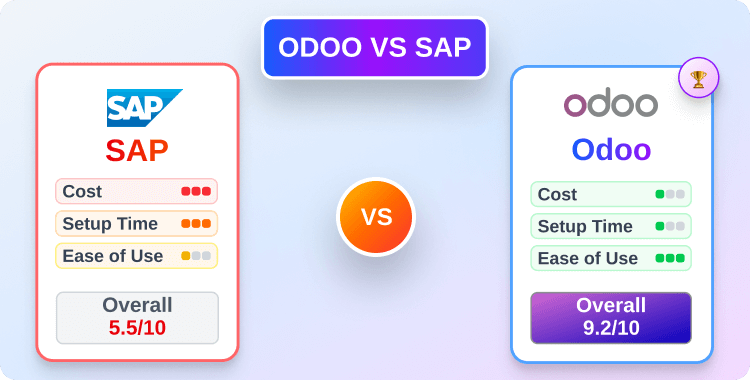
This comparison is a starting point, not a universal verdict. Every manufacturing operation is different.Decision factor SAP Odoo What to validate Typical fit Complex enterprises, multinational groups, regulated and industry-heavy operations Small and mid-sized manufacturers, growing groups, and selected larger operations Company size alone does not determine fit Manufacturing scope Broad enterprise manufacturing and supply-chain capabilities MRP, inventory, quality, maintenance, PLM, purchasing, shop-floor tools, and IoT integrations Validate every critical process with a proof of concept Implementation approach Structured global transformation; standardized templates Often suited to phased, module-by-module rollout Timeline depends on scope, data, integrations, and change readiness Customization Extensive, but requires specialist skills and governance Configuration, Odoo Studio, custom modules, and APIs — options depend on plan and hosting Excessive customization creates risk in either platform Pricing model Typically quotation and contract based Subscription pricing is published; implementation and custom work are separate Compare full five-year TCO, not only license cost Ecosystem Large global partner and consulting ecosystem Growing global partner and developer ecosystem Regional manufacturing expertise matters more than ecosystem size AI capabilities SAP Joule: active copilot for summarization, smart filtering, and resource matching Odoo 17/18: AI-assisted features; Odoo 20 (roadmap, September 2026): autonomous manufacturing AI Validate current capabilities, not roadmap promises
SAP S/4HANA Cloud Public Edition is described by SAP as modular, extensible, continuously updated, and integrated through APIs. It is not accurate to describe every modern SAP deployment as monolithic or inherently slow. A credible comparison must recognize where both platforms are genuinely strong.
Why Manufacturing Companies Switch from SAP to Odoo
1. They want a more manageable ERP scope
Many manufacturers have accumulated years of SAP configurations, custom code, interfaces, and workarounds. The environment may be powerful but slow to change. A move to Odoo creates an opportunity to simplify approval levels, product structures, warehouse routes, cost-center hierarchies, and reporting layers.
The value doesn’t come from replacing every old SAP process with an identical Odoo process. It comes from deciding which processes still serve the business and which exist only because of historical system constraints.
2. They prefer a phased rollout
Odoo’s integrated applications support a phased rollout. A manufacturer might begin with inventory and purchasing, then add manufacturing and shop-floor control, followed by quality, maintenance, accounting, and then additional facilities or eCommerce. This approach reduces the initial change scope and makes training more focused.
A phased rollout is not automatically low-risk. Dependencies between accounting, production, inventory valuation, procurement, quality, and external systems must still be mapped before the first go-live. See how Odoo ERP implementation works in practice.
3. They need more accessible customization
Manufacturers often have competitive processes that require system support — make-to-order or engineer-to-order production, customer-specific packaging, batch and serial traceability, machine or operator data collection, local tax reporting, supplier portals, or connections to CAD, MES, weighing, or barcode systems.
Odoo provides several extension paths: configuration, Odoo Studio, external APIs, custom modules, and third-party applications. The options depend on the selected plan and hosting model. “Open and customizable” does not mean customization is free or maintenance-free — every custom module adds testing, documentation, and upgrade responsibility.
4. They want clearer subscription pricing
Odoo publishes subscription pricing, which makes early budgeting more straightforward than a quote-based enterprise software process. However, subscription cost is only one component of total cost of ownership. Implementation, data migration, integrations, hosting, training, change management, ongoing support, and custom-code maintenance all add to the real cost.
5. They want one integrated platform
Odoo’s value proposition extends beyond manufacturing resource planning. The suite also includes inventory, purchasing, sales, CRM, accounting, quality, maintenance, PLM, HR, eCommerce, and other applications.
For manufacturers currently using multiple disconnected systems, consolidation can reduce duplicate master data, manual imports, reconciliation work, and reporting delays. The benefit is strongest when the organization agrees on data ownership and process governance.
Is Odoo Actually Cheaper Than SAP?
No responsible ERP comparison can promise that Odoo will always cost a fixed percentage less than SAP. The actual difference depends on what you are comparing.
Odoo typically has more transparent and accessible subscription pricing, particularly for organizations that can use standard functionality with limited custom development. SAP projects often involve a larger consulting, transformation, and integration scope, especially in complex enterprises.
A valid comparison must use equivalent scope. Compare both options across:
- Number and type of users
- Legal entities, plants, and countries
- Production models and traceability requirements
- Integrations with existing systems
- Data migration complexity
- Regulatory and compliance requirements
- Five-year upgrade and custom-code maintenance costs
- Internal project team time
A practical TCO framework
Instead of relying on published percentage savings, build a five-year model for your specific situation:
Five-Year TCO =
+ Software subscriptions or licenses
+ Implementation services
+ Data migration and cleansing
+ Integrations
+ Custom development
+ Hosting and infrastructure
+ Training and change management
+ Internal project resources
+ Ongoing support
+ Upgrade and custom-code maintenance
+ Contingency
Then calculate expected operational benefits separately: reduced manual work, lower inventory variance, faster planning and reporting, improved on-time delivery, and use conservative, base, and optimistic scenarios. Avoid treating expected benefits as guaranteed savings.
What we can say with confidence: Odoo’s per-user subscription pricing is published and starts significantly lower than enterprise SAP licensing. For mid-market manufacturers who can deploy Odoo with limited custom development, the five-year cost difference is typically meaningful. For complex operations requiring extensive customization and integrations, the gap narrows significantly.
Can Odoo Be Implemented Faster Than SAP?
It can be particularly when the Odoo scope is limited, processes are redesigned, and the rollout is phased.
A 2025 study by Horváth & Partners of 100 SAP S/4HANA transformation projects found that 60% exceeded both budget and schedule, and two-thirds of organizations were dissatisfied with the result. SAP S/4HANA transformations run an average of 30% longer than planned.
For Odoo, a single-site pilot with standard workflows and limited integrations can go live in weeks. A full multi-company manufacturing rollout involving years of data, critical integrations, and multiple facilities will take several months regardless of platform.
Comparing a six-week Odoo minimum viable product with a global SAP transformation is not a fair comparison. A realistic manufacturing ERP timeline depends on:
- Number of plants and legal entities
- Complexity of bills of materials, routings, and costing
- Data quality and volume
- Number and complexity of integrations
- Regulatory and localization requirements
- Custom development scope
- User availability for testing and training
- Cutover and rollback planning
The goal is not the shortest timeline. It is the shortest timeline that still allows safe data migration, process validation, user adoption, and operational continuity.
When Should You Switch and When Should You Stay on SAP?
Strong reasons to consider switching to Odoo
Odoo may be worth serious consideration when:
- Your current SAP environment is more complex than your business actually requires
- You want to introduce ERP functionality in manageable phases
- Your manufacturing processes fit Odoo’s standard capabilities with manageable extensions
- You want an integrated suite covering more than production alone
- You are prepared to redesign processes rather than reproduce every legacy workflow
- You have clear ownership for data, testing, and change management
- You can validate local accounting, tax, and compliance requirements
- You have an implementation partner with relevant manufacturing experience in your region
For manufacturers in Bangladesh and South Asia, HasTech IT Ltd provides local expertise including NBR compliance, VAT automation, and Bengali language support requirements that generic ERP consultants often miss.
Reasons to stay on SAP (or migrate to S/4HANA)
A switch may not make business sense when:
- Your organization relies on SAP-specific industry functionality that has not been validated in Odoo
- Multiple countries, plants, and business units use a stable global SAP template with mature integrations
- You require highly complex consolidation, transfer pricing, or regulatory capabilities
- Your internal teams, suppliers, customers, and partners are deeply integrated with SAP processes
- The current platform performs well, and the core issue can be solved through process improvement
- Migration would disrupt critical operations without a clear, measurable financial or strategic return
Bottom line: For mid-market manufacturers with 50–500 employees who need speed, cost efficiency, and flexibility, Odoo is worth a serious evaluation. SAP makes more sense when you need what SAP specifically does best: global multi-subsidiary ERP depth, complex compliance structures, and mature Fortune 500 industry content.
Manufacturing Capabilities to Validate Before Switching
Do not select an ERP from a generic feature checklist. Build process scenarios using your own products, data, exceptions, and controls. Odoo’s official manufacturing offering covers production planning, bills of materials, capacity planning, shop-floor workflows, traceability, subcontracting, quality processes, maintenance, PLM, barcode operations, and IoT integrations. Whether those capabilities are sufficient depends on your actual requirements.
Production planning and execution validate:
- Bills of materials including multi-level BOMs
- Routings and work centers; production capacity
- Make-to-stock, make-to-order, and engineer-to-order flows
- By-products, co-products, and subcontracting
- Work-order sequencing, scrap, and rework
- Shop-floor data collection and production costing
Learn more about the Odoo Manufacturing MRP module and how it handles production planning in practice.
Inventory and traceability validation:
- Multiple warehouses and storage locations
- Lot, serial, and expiration-date tracking
- Barcode operations and cycle counts
- Replenishment, safety stock, and reservations
- Intercompany or inter-warehouse movements
- Recall and genealogy reporting
Quality and maintenance validation:
- Incoming, in-process, and final inspection
- Nonconformance and corrective actions
- Equipment records, preventive and breakdown maintenance
- Spare parts, maintenance scheduling, and downtime reporting
Finance and costing validation:
- Inventory valuation method (standard, average, FIFO)
- Work-in-progress, landed costs, labor and overhead allocation
- Multicurrency, local tax, and localization requirements
- Intercompany transactions, consolidation, and audit trail
Integrations validate:
- MES, machine interfaces, CAD/PLM connections
- Weighing and barcode devices, eCommerce
- Shipping, logistics, banking, and payroll
- Tax platforms and identity management
See how Odoo eCommerce ERP integration connects manufacturing with sales operations, and how Odoo AI automation extends workflow intelligence across production and procurement.
A successful proof of concept should demonstrate complete business scenarios — not isolated screens.
SAP to Odoo Migration: A 6-Phase Checklist
Phase 1: Business Case and Fit Assessment
- Define why the company is considering change and which specific problems migration must solve
- Identify which SAP capabilities are critical vs. negotiable
- Quantify expected benefits conservatively — cost savings, time savings, error reduction
- Assess migration risk and organizational change readiness
- Produce a decision document, not a sales proposal
Phase 2: Process and Data Discovery
Map current state across: plan-to-produce, procure-to-pay, order-to-cash, inventory operations, quality, maintenance, finance and costing, compliance, and integrations. Identify workarounds, duplicate entry, reconciliation steps, and controls that must be preserved.
Separate SAP data into:
- Active master data to migrate
- Open transactions to migrate
- Historical data required in the new ERP
- Historical data that can stay in a secure archive
- Data to be cleaned or retired before migration
Phase 3: Proof of Concept
Use a representative product and run complete manufacturing scenarios:
- Create or import demand
- Plan material and capacity requirements
- Purchase missing components
- Receive and inspect incoming materials
- Produce using work orders with real labor and consumption
- Record scrap and complete quality checks
- Deliver finished product
- Post accounting entries and review cost and margin
Include exceptions and failure cases — not only the happy path.
Phase 4: Solution Design and TCO Model
Define the selected Odoo edition and hosting, standard modules, configuration requirements, custom development scope, integrations, data migration plan, security model, localization, support approach, upgrade strategy, and a five-year cost model. Compare this with the realistic cost and risk of the SAP alternative.
Phase 5: Pilot Rollout
Choose a manageable scope: one plant, one company, one product family, or one warehouse. Set measurable success criteria before launch — inventory transactions recorded correctly, production orders completed without spreadsheet workarounds, financial postings reconciled, quality records completed, critical integrations stable.
Phase 6: Stabilization and Expansion
After go-live: track incidents and root causes, measure user adoption, monitor data quality, compare operational metrics against baseline, and fix critical gaps before expanding. Add modules and locations only when the first phase is stable.
What the Numbers Look Like: Manufacturing Outcomes
The following outcomes are from Odoo manufacturing implementations led by HasTech IT Ltd in Bangladesh and South Asia. Results reflect specific company contexts and are not guaranteed for every implementation.
Bangladesh food manufacturer – labor cost transparency
Context: 520 employees, packaged food production (biscuits, confectionery) across two facilities. Running a legacy ERP with manual spreadsheet-based labor costing. Core problems: labor costs estimated rather than actual, 48-hour production reporting lag, manual compliance reporting.
Odoo scope (5 weeks, 2 facilities): Manufacturing MRP with multi-facility support, real-time labor tracking by operator ID at each work center, waste tracking and batch-level cost allocation, automated compliance reporting with Bengali language support.Metric Before After Labor cost tracking Estimated weekly 100% actual, real-time Weekly reconciliation effort 16 hours 4 hours Production cost per unit Baseline −10.2% Compliance audit preparation 40 hours 8 hours Production reporting lag 48 hours Real-time
Note: These outcomes reflect this specific implementation. Results vary based on starting conditions, scope, data quality, and change management execution.
ASEAN precision components manufacturer – inventory accuracy
Context: 280 employees, precision components for industrial machinery. Previously on SAP ECC with a recurring inventory accuracy problem: 72% accuracy against a 95%+ target, monthly reconciliation showing significant unreconciled differences.
Odoo scope (4 weeks): Inventory module with barcode scanning across receiving, storage, production, and shipping; real-time stock visibility by location, serial number, and batch; automated reorder calculations; integration with quality module.Metric Before After Inventory accuracy 72% 97.3% Production delays from inventory issues 15–18% of orders/month 2–3% of orders/month Monthly stock count effort 120 hours 8 hours
Note: These figures represent outcomes in this specific context and should be used for benchmarking, not as guaranteed results.
The 2027 SAP ECC Deadline
SAP has confirmed that mainstream maintenance for core SAP Business Suite 7 applications ends December 31, 2027. Optional extended maintenance is available through December 2030. This does not mean SAP ECC stops working in 2027. It means affected customers need a clear plan.
For many manufacturers, the decision is between three paths:
- Migrate to SAP S/4HANA — significant investment, 12–24 months for a mid-complexity scope, but stays within the SAP ecosystem
- Pay for extended SAP maintenance through 2030 — higher ongoing cost, no new features, defers the decision
- Evaluate Odoo as an alternative — requires a structured fit assessment and proof of concept, but exits SAP’s cost structure permanently if successful
The 2027 deadline makes the evaluation window real. The right question is not “Is Odoo better than SAP?” It is: “Does our manufacturing operation still need what SAP specifically provides, or has our business outgrown that complexity model?”
Odoo 20 and AI for Manufacturing (Upcoming Roadmap)
According to Odoo’s published roadmap, Odoo 20 is scheduled for release in September 2026 and is planned to introduce agentic AI capabilities for manufacturing, meaning the system would take autonomous operational actions, not just respond to queries.
Planned capabilities include production rerouting when equipment breaks down, autonomous procurement when inventory drops below reorder points, predictive maintenance triggered by IoT sensor data, and quality management responses to detected defect patterns.
These are roadmap features, not yet shipped. Validate actual capabilities against current official Odoo documentation before making purchasing decisions based on them.
SAP’s current AI offering, Joule, is an active copilot that provides summarization, smart filtering, and resource matching within S/4HANA Cloud. SAP describes autonomous operations capabilities as part of its ongoing AI development roadmap.
For a practical look at what Odoo AI can do for workflows today, see Odoo AI automation for workflow intelligence.
Common Migration Mistakes
- Reproducing the old SAP setup in Odoo: A migration that blindly recreates every legacy SAP process transfers complexity rather than removing it. Use the transition to question which processes still serve the business and which exist only because of historical system constraints.
- Underestimating change management: A fast implementation doesn’t reduce the need for change management, it compresses it. Involve production supervisors, inventory managers, and finance staff from discovery onward. Build a super-user group trained before go-live. Plan intensive support for the first two weeks post-launch.
- Over-customizing before seeing real usage: Odoo’s flexibility is genuinely useful, but every custom module adds maintenance responsibility. Follow this order: standard Odoo process → configuration → low-code customization → integration → custom module only when the business value is clear and ownership is assigned.
- Underestimating integration complexity: Odoo integrates with, but does not replace: MES systems, IoT platforms, CAD/PLM tools, and legacy financial systems. Map all inbound and outbound data flows before setting a go-live date. Prioritize only business-critical integrations for the first phase.
- Choosing a partner based on certification alone: Certification indicates Odoo knowledge. It does not prove manufacturing domain expertise, data migration competence, or local compliance capability. Evaluate implementation partners on manufacturing references, process knowledge, localization experience, testing methodology, and transparency about limitations.
Frequently Asked Questions
1. Can Odoo replace SAP for manufacturing
Odoo can replace SAP for some manufacturers — particularly mid-market operations where production complexity, integration requirements, and regulatory needs fall within what Odoo’s standard modules and reasonable extensions can support. It should not be treated as a universal SAP replacement.
The decision requires a proof of concept using your real production, costing, traceability, integration, and compliance scenarios. Odoo’s official manufacturing module covers MRP, BOMs, routings, shop-floor control, quality, maintenance, PLM, and IoT integrations.
2. Is Odoo cheaper than SAP?
Odoo typically has more accessible subscription pricing, and for an appropriately scoped project with limited custom development, the five-year total cost is generally lower than a comparable SAP engagement. However, actual savings depend on scope, customization, integrations, hosting, and support requirements. Build a full TCO model using equivalent scope before drawing conclusions.
3. How long does a SAP to Odoo migration take for a manufacturing company?
There is no universal answer. A single-site pilot using mostly standard Odoo workflows can go live relatively quickly — weeks for a minimal viable scope. A multi-company migration with years of SAP data, critical integrations, and multiple facilities will take months. For context, a 2025 Horváth & Partners study found that SAP S/4HANA transformations run an average of 30% longer than planned. Odoo implementations vary equally depending on scope and readiness.
4. What are the biggest risks when switching from SAP to Odoo?
The main risks are: data migration complexity (especially when SAP data is heavily customized or inconsistent), process gaps discovered late in testing, over-customization creating maintenance debt, insufficient change management, and choosing an implementation partner without relevant manufacturing experience. All of these are manageable with proper discovery, proof of concept, and phased rollout.
5. Does SAP ECC support really end in 2027?
SAP has confirmed mainstream maintenance for SAP Business Suite 7 ends December 31, 2027. Optional extended maintenance is available through 2030, followed by customer-specific maintenance options. Review your specific contracts and product scope with SAP — 2027 is not a system shutdown date, but it is a genuine planning deadline.
6. Is Odoo fully open source?
Odoo has Community and Enterprise editions with different licensing. The Community edition uses an open-source license. Enterprise components use Odoo’s proprietary enterprise license. Review the edition, hosting model, custom module licenses, and third-party application terms before implementation.
What is the biggest mistake when moving from SAP to Odoo?
The most common mistake is trying to duplicate the existing SAP environment without questioning legacy processes. A successful migration simplifies where possible, validates critical requirements against real scenarios, controls customization scope, cleans data systematically, and rolls out in manageable phases with clear success criteria.
How should manufacturers evaluate Odoo implementation partners?
Evaluate partners on manufacturing process knowledge, local compliance capability (especially for Bangladesh: NBR, VAT, Bengali reporting), data migration methodology, testing and QA approach, references from comparable manufacturing implementations, post-go-live support model, and transparency about risks and limitations. Certification alone does not prove fit for a specific manufacturing operation. HasTech IT Ltd is a certified Odoo partner with documented manufacturing implementations across Bangladesh and South Asia.
Conclusion
Manufacturing companies switch from SAP to Odoo because they want to simplify operations, deploy faster, reduce long-term cost, and gain direct control over their ERP workflows. Those advantages are real, but they are not automatic.
Odoo still requires disciplined process design, clean data, realistic scope, thorough testing, proper change management, and a governance plan for custom code.
SAP remains the stronger choice for organizations that rely on complex global processes, mature integrations, and industry-specific enterprise capabilities that have not been validated in Odoo.
The best ERP decision is based on evidence:
- Does the platform support your critical manufacturing scenarios?
- Can it integrate with the systems you must keep?
- Can your team implement and govern it successfully?
- Is the five-year business case realistic?
A structured fit assessment and proof of concept will answer these questions far more reliably than a generic feature comparison or a published cost percentage.
If you’re in Bangladesh or South Asia and want to evaluate whether Odoo fits your manufacturing operation, HasTech IT Ltd offers an honest assessment — covering where Odoo fits, where gaps exist, and what a realistic migration would involve for your specific operation.