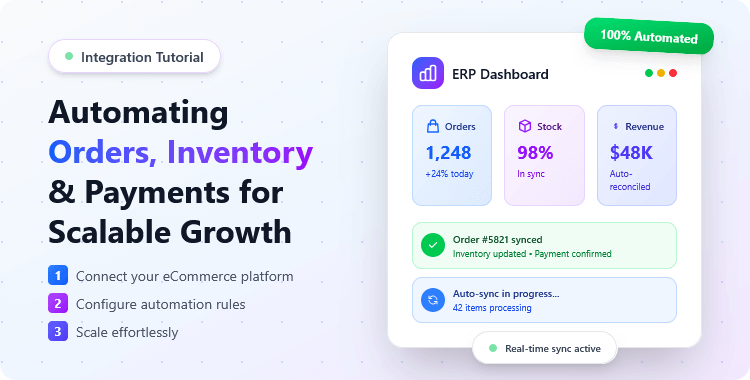
Odoo eCommerce ERP Integration: Automating Orders, Inventory, and Payments for Scalable

Most growing e-commerce businesses operate across multiple platforms, such as Shopify, Amazon, WooCommerce, and custom sites, creating operational chaos. Without a unified system, inventory quantities become inconsistent, orders sit in limbo waiting for manual entry, and payment reconciliation becomes a monthly nightmare.
Manual data entry introduces errors that damage profitability: oversold products trigger refunds and negative reviews, while late invoices harm cash flow.
The solution is elegantly simple: connect your entire operation to Odoo eCommerce ERP Integration. When your storefront talks to inventory, which talks to accounting, work that once consumed three team members’ schedules becomes automatic.
Retailers with unified inventory systems experience 23% higher inventory turnover and 22% lower customer acquisition costs. Companies implementing Odoo payment gateway integration alongside inventory automation report 67% higher revenue, 21% faster conversion rates, and 16% fewer order errors.
This guide walks you through exactly how Odoo eCommerce ERP integration works and how to implement it strategically.
Key Takeaways
- Connect multiple online stores to unified Odoo ERP system in minutes
- Eliminate manual order entry through automating orders Odoo features
- Achieve real-time stock synchronization across all Odoo multi-channel eCommerce platforms
- Reduce operational errors by up to 95% with Odoo eCommerce automation
- Enable Odoo for scalable growth with intelligent inventory and payment workflows
What Is Odoo eCommerce ERP Integration?
Odoo eCommerce ERP integration means connecting your online sales channels to the Odoo ERP system—a unified business platform managing Sales, Inventory, Purchasing, and Accounting. Think of your e-commerce platform as the storefront window where customers shop; Odoo is the warehouse, office, and accounting department behind that window. 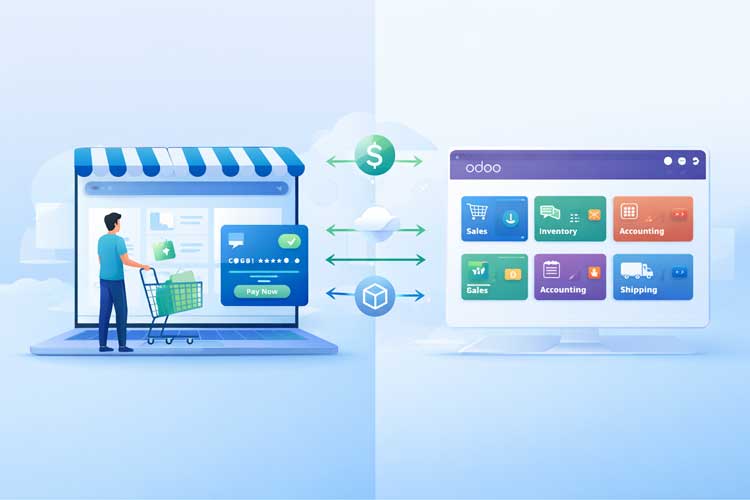
Without integration, you manually carry information between these worlds. With integration, they speak the same language and share data automatically. The integration relies on Odoo API integration or specialized Odoo eCommerce apps that establish a two-way data bridge.
When a customer places an order on Shopify, that order simultaneously appears in Odoo as a sales order, triggering inventory reservations and accounting entries. When you restock inventory, those updated quantities automatically sync back to your storefront, preventing overselling.
Key components of Odoo eCommerce ERP integration include:
- Product Master Data: Descriptions, images, pricing, and Odoo product variants (sizes, colors, SKUs) sync across all channels
- Order Fulfillment: Automating orders Odoo captures, validates, and routes them for picking, packing, and shipping
- Inventory Synchronization: Odoo inventory automation maintains real-time stock accuracy across warehouses and sales channels
- Financial Reconciliation: Odoo accounting for eCommerce automatically records revenue, taxes, and payment status
- Payment Processing: Odoo payment solutions integrate with gateways (Stripe, PayPal, Adyen) to capture and reconcile payments
This unified architecture works because Odoo was designed with this workflow in mind. Unlike bolting third-party tools together, Odoo ERP for eCommerce creates a native ecosystem where data flows naturally.
For modern eCommerce design patterns that integrate seamlessly with ERP systems, explore the best eCommerce bootstrap templates and resources on building successful online stores.
Mapping Your eCommerce Stack to the Odoo ERP System
The first step in Odoo eCommerce ERP integration success is understanding your current technology landscape. Most growing e-commerce businesses operate on one of three stacks:
- Shopify-Based Model: Direct-to-consumer (D2C) brands selling primarily through Shopify with potential marketplace presence
- Multi-Marketplace Model: Businesses selling on Amazon FBA, eBay, Etsy, and other marketplaces alongside their own website
- Headless/Custom Platform Model: Brands with custom-built storefronts using their own backend and exposing data via REST APIs
For each model, three primary approaches exist:
(1) Native Odoo eCommerce Platform, use Odoo’s built-in website module;
(2) Official Marketplace Connectors, Odoo partners maintain connectors for Shopify, WooCommerce, and Magento;
(3) Custom API Integration, hire developers to build workflows for unique requirements.
Product data is the nervous system of integration.
If product information is wrong, everything downstream breaks. Odoo inventory management begins with establishing a master product catalog where each product lives as a template with optional variants.
A template might be “Cotton T-Shirt,” while variants are “Cotton T-Shirt in Blue, Size M” and “Cotton T-Shirt in Red, Size L.” Each variant has its own SKU, stock level, and potentially different pricing and barcodes.
You’ll create attributes (Color, Size, Material) and attribute values (Red, Blue, Medium, Large, Cotton). When you create a product, you specify which attribute combinations create valid variants. Once your product catalog is properly structured, pricing becomes manageable.
You set a base price in Odoo, and it applies across all connected sales channels. When prices update in Odoo, Odoo eCommerce automation pushes those changes to Shopify, your website, and marketplaces.
Odoo product lifecycle management tracks when products launch, when they’re in their sales prime, when they’re being phased out, and when they’re discontinued—critical for forecasting and promotional planning.
Automating Orders and Inventory in Real-Time
Odoo order management automation captures web transactions and converts them into internal sales orders without human touch.
Here’s the flow with Odoo order management automation:
- Order Capture: Customer places order on Shopify; via webhook or scheduled sync, it appears instantly in Odoo as a draft sales order.
- Auto-Validation: Odoo automatically confirms orders that pass risk checks (payment received, customer verified, items in stock).
- Inventory Reservation: Once confirmed, the sales order automatically reserves inventory, preventing overselling.
- Picking List Generation: Odoo automatically creates warehouse picking instructions with barcode scanning capabilities.
- Auto-Shipping: Once packed, a shipping integration automatically generates a label and uploads it to carriers (DHL, UPS, FedEx).
- Invoice Generation: After shipment, Odoo automatically generates invoices with correct tax calculations.
- Payment Sync: Payment status updates automatically, with invoice reminders sent to customers as needed.
This entire workflow that might otherwise require 10 minutes of manual work per order becomes nearly automatic. For businesses processing 100+ orders daily, automating orders Odoo becomes a force multiplier.
Odoo inventory automation changes the game from monthly guesses to real-time accuracy. Instead of running a physical count once monthly, inventory quantities update in real-time as transactions occur.
Odoo stock management works through:
(1) Physical Warehouse Structure: Model your actual warehouse locations (aisles, shelves, bins).
(2) Automatic Inventory Moves: Every sales order creates an inventory move from “Stock” to “Customer Shipment”;
(3) Multi-Location Inventory: Track inventory by location when operating multiple warehouses.
(4) Inventory Forecasting: Odoo can automatically generate purchase orders when inventory falls below thresholds.
(5) Barcode/RFID Integration: Warehouse staff scan barcodes; Odoo automatically updates quantities instantly.
Real-world impact: A fashion retailer integrating Odoo inventory management across 500 stores reduced overstock from 30% to 18%, improved inventory turnover by 40%, and saved KRW 250 million annually.
Payment Processing, Shipping, and Financial Integration
Odoo shipping integration connects your eCommerce store to major carriers. When a customer orders, they see real-time shipping estimates based on zip code, package weight, and destination.
Once an order ships, Odoo automatically generates shipping labels from UPS, FedEx, DHL, or USPS; uploads tracking numbers back to your customer; and routes orders to the closest fulfillment center if you operate multiple warehouses.
Odoo payment gateway integration handles the critical task of secure payment processing. When a customer enters their credit card, payment must be captured via an Odoo payment gateway (never storing card data in your own system), reconciled so Odoo knows the transaction succeeded, trigger accounting entries for correct revenue recognition, and link to the sales order for automatic invoicing.
Odoo payment solutions support all major gateways:Payment Provider Supported Methods Features Stripe Credit cards, digital wallets, SEPA transfers Subscriptions, 3D Secure, local payment methods PayPal PayPal balance, cards, bank transfers, PayLater Instant settlement, buyer protection, low fees Adyen 200+ payment methods, cards, wallets, bank transfers Affordable, recurring billing, and fraud detection Authorize.Net Cards, eChecks, ACH transfers Affordable, recurring billing, fraud detection
When you set up Odoo payment gateway integration, you redirect customers to the payment provider’s secure form. The provider processes the payment and notifies Odoo of the result. This approach complies with PCI-DSS standards and eliminates liability.
Learn more about optimizing checkout experiences by exploring best WooCommerce email marketing plugins and how to customize WooCommerce checkout pages.
The real magic happens in reconciliation. When Stripe charges a customer $100, Odoo receives a webhook notification, automatically creates an accounting entry, and matches the payment to the invoice.
Days later, when money hits your bank account, you can reconcile actual deposits against recorded transactions. Odoo payment processing also handles partial payments, refunds, failed payments with automatic retry logic, and multi-currency transactions.
Odoo accounting for eCommerce ensures that the moment a customer pays, your accounting team has all the needed data. When a sales order is confirmed, Odoo automatically creates a journal entry debiting Accounts Receivable and crediting Sales Revenue.
When you pick and ship products, Odoo simultaneously records Cost of Goods Sold, meaning your profit margin is automatically calculated correctly.
If you operate in multiple tax jurisdictions, Odoo automatically detects customer location via billing/shipping address, applies the correct tax rates, and generates tax reports by jurisdiction for filing.
By consolidating sales and inventory data in one accounting system, you gain real-time visibility into daily cash inflow, Days Sales Outstanding (DSO), Days Inventory Outstanding (DIO), and your Cash Conversion Cycle.
Most growing eCommerce businesses improve cash flow by 20-30% simply by eliminating delays that happen when accounting, sales, and inventory operate separately.
Recommended Blogs for You:
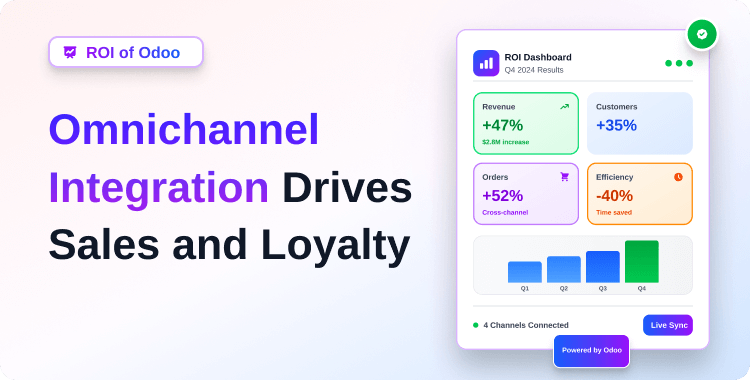
👉 The ROI of Odoo for Retail: Real Numbers on How Omnichannel Integration Drives Sales and Loyalty
👉 Project Management With Capacity Planning in Odoo ERP: Delivering On Time, On Budget, Every Time
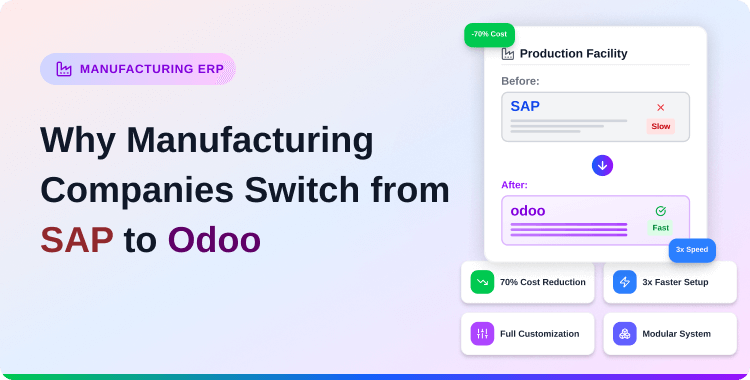
👉 The 5 Hidden Costs of Legacy ERP Systems: Why Businesses Migrate to Odoo
👉 Top 10 Software Development Companies in Bangladesh 2026: Complete Guide
Scaling With Multi-Channel Integration and APIs
As your business grows from one sales channel to five to twenty, manual integrations become impossible. Odoo API integration is the answer.
Odoo exposes a comprehensive REST API allowing you to push product catalogs to new marketplaces automatically, pull orders from multiple sources into a single Odoo instance, sync inventory quantities across all channels in near-real-time, trigger custom workflows based on events, and build custom mobile apps on top of Odoo data.
Odoo eCommerce apps from the Odoo App Store provide pre-built integrations for Salla, Shopify, WooCommerce, Amazon, eBay, Alibaba, and 150+ other platforms. These aren’t generic integrations, they’re built by Odoo partners who understand the specific quirks and requirements of each platform.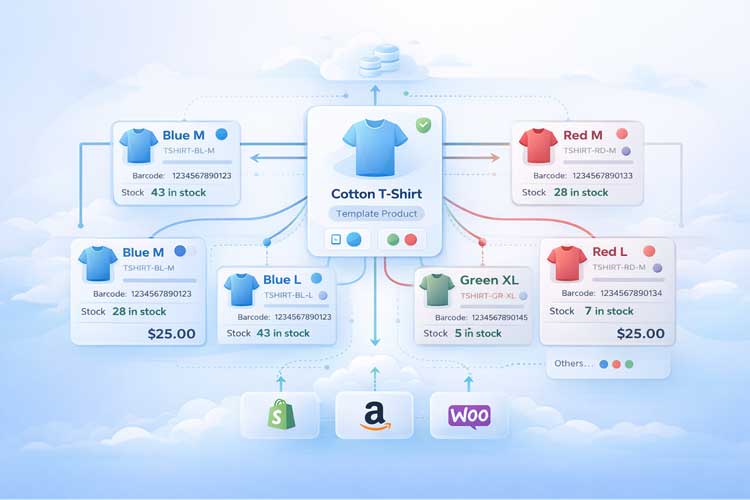
Enhance your multi-channel approach by examining React eCommerce templates and Laravel eCommerce solutions for modern technical implementations.
When synchronizing products and orders across multiple channels, performance matters. Modern Odoo eCommerce apps scale using:
(1) Webhooks: Marketplaces push notifications to Odoo when events occur rather than constantly polling.
(2) Job Queues: Heavy operations run asynchronously in background jobs.
(3) Batch Operations: Systems batch-process updates in groups of 100 or 1,000.
(4) Caching: Frequently-accessed data is cached to reduce database queries.
Properly configured, Odoo eCommerce automation can handle millions of orders annually without performance degradation.
Advanced Strategies and Common Pitfalls
Demand-Driven Supply Chain: Most businesses operate with supply-driven logic (“We think we need 100 units”). Demand-driven logic is different: “Customers bought 15 units last week, 12 the week before, trending up 8% month-over-month. We maintain 2 weeks of safety stock. Therefore, we need to order 50 units now.” Odoo eCommerce integration enables demand-driven supply, resulting in lower safety stock, fewer stockouts, and better supplier relationships.
1. Common Pitfall:
Batch Syncing Inventory: Many businesses batch-sync inventory once per hour or once per day, causing overselling and customer refunds. Real-time Odoo inventory automation means every warehouse transaction immediately updates every sales channel.
Fix: Implement webhook-based sync where possible; if unavailable, sync every 15 minutes maximum.
2. Common Pitfall:
Incomplete Payment Integration: Many implementations fail to handle refunds, chargebacks, and failures properly.
Fix: Implement full Odoo payment processing, including capturing initial payments, processing refunds (full and partial), handling failed payments with retry logic, and recording chargeback disputes in accounting.
3. Common Pitfall:
Separate Systems of Record: If you update a price in Shopify but it’s different in Odoo, which is correct?
Fix: Establish clear governance. Odoo is the master. All sales channels are read-only consumers of Odoo data.
Frequently Asked Questions
Q: How long does it take to implement Odoo eCommerce integration?
A: Simple integrations (single Shopify store to Odoo) typically take 2-4 weeks. Complex implementations (multiple marketplaces, custom warehouses, international shipping) take 2-4 months.
Q: Can Odoo handle multi-channel eCommerce inventory across Amazon, eBay, and Shopify?
A: Yes. Odoo multi-channel eCommerce is designed for this. Connect each marketplace via official connectors or custom APIs. All inventory data flows to Odoo, which becomes the source of truth.
Q: Which payment gateways work with Odoo eCommerce?
A: Odoo supports Stripe, PayPal, Adyen, Authorize.Net, and 20+ others. You can enable multiple gateways, and customers choose their preferred method at checkout.
Q: Is Odoo suitable for scaling from 100 to 10,000 orders per month?
A: Absolutely. Odoo is built for scalability. Many implementations handle millions of orders annually. The key is proper configuration (job queues for heavy operations, appropriate database sizing) and webhook-based sync for real-time accuracy.
Q: Who should I contact to implement Odoo eCommerce integration?
Certified Odoo partners bring proven expertise, local market knowledge, and professional support throughout implementation. HasTech IT Limited, a certified Odoo partner headquartered in Dhaka, specializes in helping e-commerce businesses implement Odoo with comprehensive support from requirements analysis through post-launch optimization.
With 45+ certified consultants, 1,700+ completed projects, and 10+ years of experience, HasTech transforms eCommerce complexity into operational excellence. Services include end-to-end Odoo ERP implementation, module customization, Bangladesh-specific compliance (VAT, tax automation), payment gateway integration (Stripe, PayPal, bKash, Nagad), and multi-channel marketplace connectivity. Verify any partner’s official Odoo certification through the Odoo Partner Directory.
Conclusion
Odoo eCommerce ERP integration represents a fundamental shift in how growing e-commerce businesses operate. Instead of cobbling together incompatible tools and manually shepherding data between systems, you create a unified platform that automatically synchronizes orders, inventory, payments, and accounting.
The business impact is concrete: 67% higher revenue, 95% fewer errors, 20-30% better cash flow, and faster order processing.
The implementation path is straightforward:
(1) Map your current tech stack to Odoo’s modules;
(2) Choose your integration approach;
(3) Set up product master data with proper variants and pricing;
(4) Configure order workflows for automatic confirmation, picking, shipping, and invoicing;
(5) Implement real-time inventory sync;
(6) Integrate payment gateways;
(7) Monitor and optimize using Odoo dashboards.
For e-commerce operators in any market, Odoo eCommerce ERP integration is no longer a nice-to-have. It’s the operational foundation that separates scaled, profitable businesses from those perpetually fighting fires.
Ready to Transform Your eCommerce Operations?
Start by auditing your current systems: How much time do you spend manually syncing inventory? How many orders get delayed due to data entry errors? How much cash is trapped in excess inventory? For most growing businesses, the answer is “too much.”
Schedule a Free Consultation With a Certified Odoo Partner
HasTech IT Limited, a certified Odoo implementation partner in Bangladesh, specializes in helping eCommerce businesses transform operations through comprehensive ERP integration.
With 10+ years of experience, a dedicated team of 45+ certified consultants, and 1,700+ completed projects, HasTech delivers solutions tailored to your unique business requirements.
The company’s expertise spans end-to-end implementation, local regulatory compliance (VAT automation, NBR compliance), integration with local payment gateways (bKash, Nagad), and multi-channel marketplace management (Shopify, Amazon, eBay, WooCommerce, and custom platforms).
Why Choose HasTech for Your Odoo Implementation?
- Certified Odoo partner with a proven track record.
- Deep expertise in Bangladesh’s eCommerce ecosystem.
- Comprehensive support from requirements gathering through post-launch optimization.
- 45+ certified consultants and business analysts.
- Proven methodology ensuring smooth deployment and faster ROI.
Get Started Today:
- Website: hastechit.com
- Services: Odoo ERP Implementation, eCommerce Development, Business Automation, Integration Services
- Odoo Partner Profile: View Certification & Services
The ROI almost always justifies the implementation cost within the first six months. Your customers—and your operations team will thank you.