Free Trials vs Paid Subscriptions: What Converts Better for Your WooCommerce Store

WooCommerce has evolved beyond one-time sales. Over 32% of ecommerce merchants now offer subscription products, driving predictable recurring revenue. Yet store owners face a fundamental choice: should they lower barriers with free trials, or qualify customers upfront with paid subscriptions?
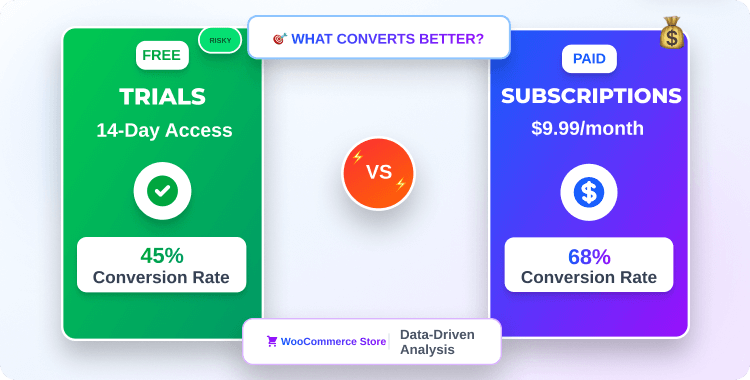
The stakes are high. A free trial might generate 8.5% signup conversion, but only 18% of those convert to paid. A paid subscription converts fewer initial signups (2-4%), but those who pay are 2-3x more committed to retention. The right choice determines revenue trajectory, customer quality, and operational burden.
This guide compares free trials vs paid subscriptions using real conversion data, helping you decide which model maximizes revenue for your WooCommerce store based on product type, pricing, and customer maturity.
Key Takeaways
- Free trials convert 18-25% when no credit card is required; opt-out trials reach 49-51% with upfront payment
- Paid subscriptions qualify customers earlier but face initial conversion resistance of 2-4% at signup
- Trial-to-paid varies by trial length: 7-day trials convert at 40.4% vs. 30.6% for 60+ day trials
- Freemium models attract volume (13.3% signup) but convert to paid at only 2.6%, sacrificing revenue for reach
- WooCommerce supports both models with Recurio’s flexible trial and subscription configurations
- Conversion quality matters more than volume—opt-out trials convert more users but with higher churn risk
Understanding Subscription Models in WooCommerce
Free Trial Subscriptions
A free trial gives customers full or limited feature access for a fixed duration (typically 7-30 days) before charging. Two types exist:
- Opt-In Trials: No credit card required. Lower friction (~8.5% signup conversion) but only 18-25% trial-to-paid conversion because users can simply disappear
- Opt-Out Trials: Credit card required upfront. Lower signup rates (~2.5%) but 49-51% conversion because payment is automatic at trial end
WooCommerce plugins like Recurio allow configurable trial periods (in days, weeks, or months) with optional one-time sign-up fees, supporting both opt-in and opt-out models.
Paid Subscription Models
Customers pay immediately to access the service. No trial period. Conversion barriers are higher (2-4% at signup) but customers are pre-qualified and less likely to churn. WooCommerce supports multiple billing cycles (daily, weekly, monthly, yearly, custom intervals), enabling flexible pricing architectures.
Freemium Model (Alternative)
Unlimited free access to core features, with upgrades to paid for premium features. Converts 13.3% of visitors to free users but only 2.6% to paid, making it a volume-play strategy. Best for network-effect products where free users generate value.
Free Trials vs Paid Subscriptions: Conversion Comparison
The data reveals a clear trade-off between signup volume and conversion quality. Which model converts better depends on how you measure “conversion.”
How Free Trials Work in WooCommerce
- Customer discovers product → clicks “Start Free Trial”
- Opt-in model: No payment info required; signup is instant
- Opt-out model: Credit card collected upfront; trial begins immediately
- Trial runs: Customer accesses full/limited features for 7-30 days
- Trial end options:
- Opt-in: Manual upgrade required (many don’t) → ~18-25% convert
- Opt-out: Automatic charge unless customer cancels → ~49-51% convert
- Post-trial: Active paying subscription begins
WooCommerce implementation: Recurio supports configurable trial periods with optional sign-up fees, email reminders (3 and 1 day before trial end), and failed payment recovery to maximize conversions.
Once you’ve decided on free trials, implementing them properly requires understanding the broader context of recurring billing.
Check out proven strategies for implementing recurring billing to ensure your billing infrastructure is optimized for both trial and paid models.
How Paid Subscriptions Work in WooCommerce
- Customer discovers product → clicks “Subscribe Now”
- Payment info required: Credit card collected before access
- Immediate charge: First payment processed at signup
- Access granted: Customer gains immediate subscription access
- Recurring billing: Automatic renewal on schedule (monthly, yearly, custom)
- Payment failures: Intelligent retry logic recovers 70% of declined cards with dunning campaigns
WooCommerce advantage: No trial friction means no users who abandon mid-trial. Every signup is committed and generates revenue immediately.
Conversion Rate Differences: The Data
Opt-In Free Trials vs Paid Subscriptions:
- Free trial signup: 8.5% of visitors
- Free trial to paid: 18-25% of trial users
- Combined conversion: ~1.5-2.1% of visitors become paying customers
Paid Subscriptions:
- Paid signup: 2-4% of visitors (lower barrier perception)
- Conversion: 100% at signup
- Combined conversion: 2-4% of visitors become paying customers
The Pattern: Free trials attract 2-4x more trial signups but lose most during the trial. Paid subscriptions have lower signup volume but zero trial abandonment. Net result: similar total conversion (1.5-4%), but paid subscriptions deliver revenue immediately while free trials require 18-25 days to monetize.
Customer Intent and Buyer Psychology
Why Free Trials Underconvert
- Status quo bias: Users default to “do nothing” after trial if not reminded
- Competing solutions: Trial period gives users time to evaluate alternatives
- No commitment device: Lack of payment info = easy exit
- Decision fatigue: After testing, “Should I pay?” becomes one more decision
- Price shock: Users are surprised by the conversion cost after trial
Result: 75-82% of opt-in trial users never convert despite testing the product.
Why Paid Subscriptions Convert
- Pre-commitment: Payment info and first charge create psychological ownership
- Urgency: No trial buffer forces immediate value demonstration
- Self-selection: Only serious prospects pay upfront
- Sunk cost effect: Users justify continued use after initial payment
- Less comparison: Paying customers don’t shop competitors mid-subscription
Result: Paid subscribers are 2-3x less likely to churn than trial users.
Churn Risk and Revenue Predictability
Free Trial Churn Patterns
- Opt-in trials: 75-82% churn (don’t convert)
- Opt-out trials: 49-51% initial conversion but higher post-conversion churn (forgot to cancel)
- Time to value critical: Users who achieve a key milestone in the first 3 days convert at 40%+; after day 7, conversion drops 30%
- Cost: CAC spent on trial users who never pay is a sunk cost
Revenue predictability: Low. Free trial signups don’t translate to reliable recurring revenue.
Paid Subscription Churn Patterns
- Involuntary churn: 5-10% monthly (failed payments, card expiration)
- Voluntary churn: 2-5% monthly for quality products
- Combined churn: 7-15% monthly is normal; elite performers maintain 3-5% churn
- Revenue predictability: High. Paying subscriptions creates month-to-month recurring revenue visibility
Revenue advantage: Paid subscriptions generate predictable MRR (Monthly Recurring Revenue) from day one.
Understanding churn patterns is crucial when deciding between models. Free trial users churn 2-3x faster than paid subscribers, but there are specific tactics to recover at-risk customers regardless of model.
Learn actionable churn reduction strategies that help both trial and paid subscription models improve retention.
Impact on Customer Lifetime Value (CLV)
Free Trial Path
Visitor → Trial Signup (8.5%)
→ Trial Completes & Converts (18-25%)
→ Paying Subscriber (1.5-2.1% overall)
→ Higher churn risk (7-15% monthly)
→ Lower CLV (unpredictable renewal)
Average CLV impact: Trial users who convert are worth 20-30% less than paid subscribers due to higher churn.
Paid Subscription Path
Visitor → Paid Signup (2-4%)
→ Immediate Revenue (100% at signup)
→ Lower churn (3-5% vs. 7-15% for trial users)
→ Predictable CLV (stable renewals)
Average CLV impact: Paid subscribers are worth 2-3x more long-term due to lower churn and stable retention.
Winner: Despite lower signup volume, paid subscriptions drive higher CLV and more predictable revenue.
For a deeper dive into how subscriptions transform overall business operations, including self-service portals and analytics integration, read how WooCommerce subscriptions can transform your store. This covers both models’ operational advantages.
Operational Complexity and Support Load
Free Trial Complexity
- Onboarding burden: Trial users need more education; they haven’t committed
- Support tickets: High questions/assistance requests (trial users exploring all features)
- Email sequences: Trial reminders, engagement nudges, conversion emails required
- Data management: Trial expiration, auto-conversion, and payment failures need automation
- Churn analysis: Higher trial abandonment requires investigation and optimization
- Operational cost: High. Free trials demand significant support and automation infrastructure.
Paid Subscription Complexity
- Onboarding is streamlined: Paying customers are motivated to succeed
- Support tickets: Lower volume; users only contact with real problems
- Email sequences: Onboarding, renewal reminders, retention campaigns (simpler)
- Data management: Straightforward billing and renewal cycles
- Churn analysis: Lower churn means less fire-fighting, more optimization
Operational cost: Lower. Paid subscriptions have simpler automation and support requirements.
Recommended Blogs for You:
👉 The Best Subscription Plugins Compared: Which Is Right for Your WooCommerce Store
👉 The Power of Recurring Revenue: How WooCommerce Subscriptions Can Transform Your Store
👉 6 Email Subscription Popup Examples to Increase Conversions
👉 How to Create a Subscription Popup on WordPress: The Beginner’s Guide
Payment Friction and Trust
Free Trials
Friction advantage: No upfront payment = lower barrier
Trust impact: “Why do they need my card for a free trial?” creates hesitation in opt-out models
Compliance risk: ROSCA (Restore Online Shoppers Confidence Act) requires clear opt-out disclosures
Best practice: Opt-in trials build trust; opt-out trials maximize conversions but risk brand damage if auto-charges surprise users.
Paid Subscriptions
Friction challenge: Immediate payment creates friction
Trust advantage: Customers know exactly what they’re paying and when
Compliance: Transparent billing reduces chargebacks and refunds
Best practice: Clear value communication at checkout reduces friction and builds trust.
Paid subscriptions eliminate trial abandonment but face involuntary churn from failed payments.
Recovery is critical: understand why subscription payments fail and how intelligent retry logic recovers 45-70% of declined charges. This recovery mechanism is more relevant for paid subscriptions since trial users haven’t yet provided payment.
When Hybrid Models Work Better
Freemium + Paid Conversion Strategy
Many successful WooCommerce stores use hybrid approaches:
- Freemium foundation: Free tier attracts users (13.3% signup) and builds trust
- Paid upsell: Premium features convert 2.6% of free users, but ata higher LTV (they’ve tested and committed)
- Win: Volume acquisition + quality monetization
Example: Email marketing tools offer a free tier (limited emails/month) and premium tiers for unlimited. Low barrier attracts SMBs; premium tier monetizes growing businesses.
Free Trial + Paid Option
Offer both:
- Free trial (7-14 days): For price-sensitive or uncertain prospects
- Paid subscription option (pay now, full features): For decision-ready customers
Example: Project management tools let users “start free trial” OR “subscribe now for immediate access.” Some customers skip trial and pay directly.
Conversion Rate Comparison Table
| Metric | Free Trial (Opt-In) | Free Trial (Opt-Out) | Paid Subscription | Freemium |
| Visitor to Signup Rate | 8.5% | 2.5% | 2-4% | 13.3% |
| Signup to Paid Rate | 18-25% | 49-51% | 100% (at signup) | 2.6% |
| Overall Conversion (Visitor → Paid) | 1.5-2.1% | 1.2-1.3% | 2-4% | 0.35% |
| Revenue Predictability | Low (churn risk) | Moderate (early churn) | High (committed) | Very Low |
| Customer Quality | Good (self-qualified) | Medium (auto-convert) | Excellent (committed) | Poor (tire-kickers) |
Key Insight: Paid subscriptions convert the fewest initial signups, but every signup is a paying customer. Free opt-in trials convert more signups but lose 75-82% during trial.
Common Mistakes Store Owners Make
1. Offering Free Trials Without Qualification
The Mistake: Long (30-60 day) free trials with opt-in signup
Why It Fails: 75%+ of users disappear without converting; you burn support costs with low payoff
Solution: Cap trial length to 7-14 days; implement opt-out (credit card required) model for higher conversion
2. Choosing Paid Subscriptions Without Value Clarity
The Mistake: Immediate payment is required before customers understand the product
Why It Fails: High friction; 70-90% bounce from pricing page without trial
Solution: Lead with clear value prop, customer testimonials, and feature highlights before asking for payment
3. Ignoring Onboarding and Activation
The Mistake: Trial or paid subscription starts; customer gets access, and nothing else
Why It Fails: Users don’t achieve value within critical first 3 days; churn skyrockets
Solution: Automated onboarding email sequence, in-app tutorial, and check-in at day 3 asking “What’s missing?”
4. Not Tracking Conversion Quality Metrics
The Mistake: Focusing on signup numbers instead of trial-to-paid and churn rates
Why It Fails: You can’t optimize; paying attention only to vanity metrics
Solution: Track:
- Trial signup rate (% of visitors)
- Trial-to-paid conversion (% of trial users)
- Post-conversion churn (% of customers at 30, 60, 90 days)
- CAC (Customer Acquisition Cost) vs. CLV (Customer Lifetime Value)
These mistakes are just the tip of the iceberg.
For a comprehensive list of 10 costly WooCommerce subscription mistakes—many directly related to trial vs paid decisions: see the top subscription mistakes that quietly lose revenue. Many of these mistakes could have been prevented by choosing the right subscription model upfront.
How to Choose the Right Model for Your Store
Use This Decision Framework
| Factor | Free Trial Better | Paid Subscription Better |
| Product Complexity | High (needs testing) | Low (clear value) |
| Pricing Level | Premium ($99+/mo) | Low-mid ($9-49/mo) |
| Target Customer | Enterprise, uncertain | SMB, price-sensitive |
| Support Capacity | High | Moderate |
| Onboarding Needs | High (education-heavy) | Moderate |
| Industry | SaaS, complex tools | Simple subscriptions, boxes |
| Goal | Volume acquisition | Revenue certainty |
By Product Type
Free Trial Best For:
- B2B SaaS tools ($99-499/month)
- Complex software with learning curve
- Enterprise sales (trials reduce objections)
- High-touch support products
Paid Subscription Best For:
- Ecommerce subscriptions (meal kits, boxes, digital products)
- Membership sites
- Simple recurring services
- B2C products under $50/month
Testing and Optimization Path
- Month 1-2: Run one model; establish baseline metrics (signup, conversion, churn)
- Month 3: A/B test secondary model (e.g., if running paid, test opt-in trial against it)
- Month 4+: Double down on higher CLV model; optimize the winner
Once you’ve decided which model fits your business, implementation is the next critical step.
Follow a complete setup guide for WooCommerce subscriptions that covers both trial and paid configurations, pricing strategies, and customer retention tactics from day one.
Frequently Asked Questions
Do free trials convert better than paid subscriptions?
It depends on how you measure conversion. Free opt-in trials generate 8.5% signup conversion but only 18% trial-to-paid conversion (1.5% overall). Paid subscriptions generate 2-4% direct signup conversion with 100% conversion at signup. Measured by visitor-to-paid conversion, both perform similarly (1.5-4%). However, paid subscriptions create higher quality customers with 2-3x lower churn and better CLV.
Are free trials good for WooCommerce subscriptions?
Free trials work well for complex, high-price products ($99+/month) where customers need to test value before committing. For simple ecommerce subscriptions (boxes, memberships, digital products under $50/month), paid subscriptions typically outperform trials. Opt-out trials (credit card required) convert 49-51% vs. opt-in (18-25%), but risk higher churn if customers forget they’re paying.
When should I charge upfront for subscriptions?
You can charge upfront when:
(1) Your value is immediately obvious (content, digital product),
(2) Your pricing is low ($9-49/month—no risk perception),
(3) Your product has strong social proof, or
(4) Your target customer is price-sensitive and expects direct access.
It offers a trial if the upfront conversion is below 2% at checkout.
Can WooCommerce support both trial and paid models?
Yes. Recurio and other WooCommerce subscription plugins support flexible trial configurations, allowing you to:
(1) Offer free trials (opt-in or opt-out) for some products,
(2) Require direct payment for others, or
(3) A/B test both models within the same store.
This hybrid approach lets you optimize per product type and customer segment.
Conclusion
Free trials and paid subscriptions solve different problems. Free trials attract volume and reduce buyer hesitation; they convert 18-25% of trial users to paid. Paid subscriptions qualify customers upfront, generate immediate revenue, and create loyal customers with 2-3x lower churn. The best choice depends on product complexity, pricing, and your support capacity.
Key decision rule: High-complexity, expensive products ($99+/month) benefit from trials. Simple, affordable subscriptions ($9-49/month) typically maximize revenue with paid-only models. For maximum growth, hybrid approaches (offer both) let customers choose, improving overall conversion and satisfaction.
Measure the metrics that matter: visitor-to-paid conversion, trial-to-paid conversion, post-conversion churn, and CLV. Optimize based on data, not assumptions. WooCommerce plugins like Recurio support both models with flexible trial configurations, payment recovery, and analytics to measure what works for your store.