Odoo ERP Implementation Service Company in Bangladesh: Complete Guide to Choosing the Right Partner in 2026

Bangladesh’s business landscape is undergoing rapid digital transformation. The country’s ICT market reached USD 8.88 billion in 2025 and is projected to grow to USD 12.07 billion by 2030 at a 6.33% CAGR.
With IT sector export earnings reaching $458.18 million (growing 12.99% year-on-year), more companies recognize that manual processes are no longer viable for competitive growth.
The garment industry, which accounts for 85% of Bangladesh’s exports, increasingly demands sophisticated inventory management and financial oversight that spreadsheets cannot provide.
Nearly 40% of Bangladeshi SMEs have either implemented or are actively considering ERP solutions. Among the available options, Odoo has emerged as a frontrunner due to its modular flexibility, cost-effectiveness, and robust feature set specifically designed to address the unique challenges of businesses operating in Bangladesh.
However, research from Gartner indicates that 55% to 75% of ERP implementations fail to meet their objectives, often due to poor planning or inadequate vendor support. This underscores the critical importance of selecting the right Odoo ERP implementation service company in Bangladesh.
This comprehensive guide walks you through selecting an Odoo implementation partner, understanding the implementation process, avoiding common pitfalls, and ensuring your investment delivers measurable returns.
Key Takeaways
- Odoo ERP transforms Bangladeshi business operations efficiently with local compliance support.
- Implementation costs vary from BDT 3-5 lakhs (small) to BDT 20-50+ lakhs (large enterprises) based on customization needs.
- Certified Odoo partners ensure smoother deployment and superior ongoing support quality.
- Local expertise accelerates adoption, reduces downtime, and ensures regulatory compliance.
- Post-implementation support determines long-term ERP success and sustained ROI realization.
- Cloud vs on-premise deployment significantly impacts infrastructure costs and accessibility.
ShopLentor- WooCommerce Builder for Elementor & Gutenberg
A versatile page builder to build modern and excellent online stores with more than 100k+ Active Installations.
What is Odoo ERP, and Why Bangladeshi Businesses Need It
Odoo is an integrated, open-source business management software suite that brings together all core business functions into a single, unified platform. Unlike traditional enterprise software that forces you to purchase separate systems for accounting, inventory, customer relationship management, and human resources, Odoo offers a modular ecosystem where you select and activate only the applications your business needs.
The platform includes over 30 main applications and thousands of community-developed modules covering virtually every business process:
- Financial accounting and multi-currency management
- Inventory and warehouse management with barcode/RFID integration
- Manufacturing and production planning
- Sales, CRM, and marketing automation
- Human resources and payroll with Bangladesh-specific compliance
- Project management and timesheet tracking
- E-commerce and point-of-sale systems
- Purchasing and vendor management
What makes Odoo particularly compelling for Bangladeshi businesses is its unique combination of affordability, flexibility, and localization capabilities. Unlike heavyweight solutions like SAP or Oracle that require massive upfront investments (typically BDT 50 crore+), Odoo scales with your business, allowing you to start with essential modules and expand as you grow.
Why Odoo Resonates with the Bangladesh Market
Bangladesh presents specific operational challenges that make Odoo an ideal fit:
- Export-Oriented Operations: With the ready-made garment sector dominating exports, businesses need robust multi-currency support, letter of credit management, and international shipping integration. Odoo handles these requirements seamlessly while maintaining compliance with Bangladesh Bank regulations.
- Regulatory Compliance: The National Board of Revenue (NBR) has implemented increasingly sophisticated VAT and tax tracking requirements. An experienced Odoo ERP implementation service company in Bangladesh can configure Mushak forms, automated VAT calculations (15% on goods and services), and audit-ready reporting that keeps you compliant without manual intervention.
- Cost Sensitivity: Bangladeshi businesses, particularly in the SME sector, need enterprise-grade functionality without enterprise-level pricing. Odoo’s open-source foundation means lower licensing costs and the freedom to customize without vendor lock-in.
- Rapid Business Growth: Bangladesh’s economy has maintained strong growth trajectories. Growing companies need systems that scale efficiently. Odoo’s modular architecture allows you to add users, locations, and functionality without replacing your entire system.
- Local Integration Needs: From bKash and Nagad payment gateways to local banks’ APIs and regional logistics providers, Odoo’s extensibility allows seamless integration with Bangladesh’s unique business ecosystem.
The question isn’t whether Odoo can serve Bangladeshi businesses; it’s whether you choose the right implementation approach to unlock its full potential.
The Complete Odoo ERP Implementation Process: What Every Bangladesh Business Should Expect
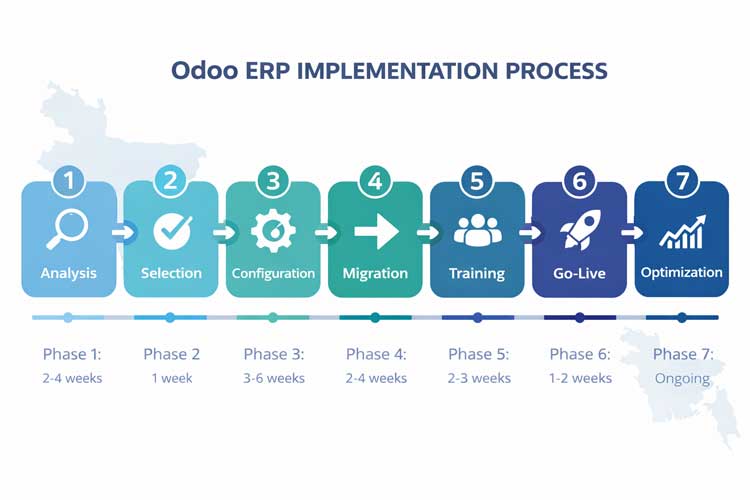
Understanding the implementation journey helps you set realistic expectations, allocate appropriate resources, and evaluate potential service providers effectively. Here’s the comprehensive process that a professional Odoo ERP implementation service company in Bangladesh should follow:
Phase 1: Initial Business Requirements Analysis and ERP Readiness Assessment
Before any software configuration begins, thorough discovery work lays the foundation for success. This phase typically takes 2-4 weeks and involves:
- Comprehensive Needs Evaluation: Your implementation partner should conduct stakeholder interviews across all departments, including finance, operations, sales, procurement, and management. They need to understand not just what you do, but why you do it, and what pain points exist in current workflows.
- Current System Audit: Document all existing software, manual processes, spreadsheets, and data sources. This includes understanding your Tally accounting setup, Excel-based inventory tracking, email-based order management, and any other tools currently in use.
- Process Mapping: Experienced consultants map your as-is processes visually, identifying bottlenecks, redundancies, and opportunities for optimization. This reveals where Odoo can automate tasks, reduce errors, and accelerate workflows.
- Gap Analysis: Compare your requirements against Odoo’s standard functionality. Identify which needs can be met with core modules, which require third-party apps, and which demand custom development.
- ROI Projections: Calculate expected benefits in terms of time savings, error reduction, improved inventory turnover, faster order processing, and better decision-making capabilities. Realistic projections show payback periods between 12-24 months for properly implemented systems.
Quality implementation partners in Bangladesh document these findings in a detailed Business Requirements Document that becomes the blueprint for your entire project.
Phase 2: Choosing Between Odoo Community vs Enterprise Edition for Your Bangladesh Business
One of your first decisions involves selecting the right Odoo version. Understanding the differences is crucial for budget planning and long-term success.
Odoo Community Edition is the free, open-source version maintained by the global Odoo community. It includes core functionality for accounting, inventory, sales, CRM, and other essential modules. Community Edition works well for:
- Startups and small businesses with limited budgets (under BDT 5 lakh for implementation)
- Companies with in-house technical resources to manage updates and troubleshooting
- Organizations comfortable with community-driven support forums
- Businesses needing basic functionality without advanced features
Odoo Enterprise Edition is the commercial version with enhanced features, official support, and regular updates directly from Odoo SA. Enterprise advantages include:
- Advanced Features: Studio app for no-code customization, IoT box for hardware integration, advanced analytics, and dashboards
- Mobile Applications: Native iOS and Android apps for on-the-go access
- Dedicated Support: Access to Odoo’s official support team with guaranteed response times
- Automatic Updates: Regular security patches and feature enhancements
- Hosting Options: Odoo.sh platform-as-a-service for simplified infrastructure management
Cost Implications for Bangladesh: Enterprise Edition pricing starts at approximately BDT 1,000-1,500 per user monthly. For a 20-user system, annual licensing runs around BDT 2.4-3.6 lakh, plus implementation costs.
Most growing Bangladeshi businesses find Enterprise Edition worthwhile for the reduced technical overhead and official support, particularly when considering the total cost of ownership over 3-5 years. However, budget-conscious startups can begin with Community and migrate to Enterprise as they scale.
Phase 3: Module Selection and Customization Planning Strategy
Odoo’s modular nature means you’re not forced into an all-or-nothing implementation. Strategic module selection keeps initial costs manageable while establishing a foundation for growth.
Core Modules for Bangladesh Businesses:
Accounting and Finance are essential for receivables, payables, bank reconciliation, and financial reporting. The localized Bangladesh accounting module ensures compliance with NBR requirements and generates mushak forms automatically.
Sales and CRM modules track customer interactions, manage quotations, process orders, and generate invoices. Integration with your accounting eliminates duplicate data entry and provides real-time revenue visibility.
Inventory Management becomes critical for businesses handling physical products. Track stock levels across multiple warehouses, automate reorder points, manage serial numbers and lot tracking, and optimize stock turnover.
Industry-Specific Modules:
Ready-made garment manufacturers need the Manufacturing module with bill-of-materials management, production planning, work orders, and quality control integration.
IT services companies and consulting firms benefit from Project Management with task tracking, timesheets, milestone billing, and resource allocation.
Retail businesses require Point of Sale for offline-capable sales processing, inventory synchronization, and customer loyalty programs.
Customization Considerations:
While Odoo offers extensive functionality out-of-the-box, Bangladesh businesses often need specific adaptations:
- Custom report formats matching company letterheads and branding
- Integration with local payment gateways like bKash, Nagad, and Rocket
- Specialized workflows for LC management and export documentation
- Industry-specific fields and processes not covered by standard modules
A capable Odoo ERP implementation service company in Bangladesh helps you distinguish between essential customizations that add real value and nice-to-have features that inflate costs without proportional benefits.
Phase 4: Data Migration Strategy and Legacy System Integration
Moving from your existing systems to Odoo without losing critical historical data requires meticulous planning and execution.
Data Migration Best Practices:
Begin with a comprehensive data audit. Identify all sources: Tally accounting files, Excel spreadsheets, customer databases, product catalogs, and vendor records. Assess data quality, looking for duplicates, inconsistencies, and incomplete records.
Data Cleaning: This unglamorous but crucial phase involves standardizing formats, removing duplicates, correcting errors, and filling gaps. For example, ensuring all customer records include complete contact information, all products have consistent naming conventions, and all financial transactions balance properly.
Migration from Common Systems:
Bangladesh businesses often migrate from Tally, which requires specialized tools to extract chart of accounts, customer and vendor ledgers, and opening balances. Excel-based systems need careful mapping to Odoo’s data structures, ensuring formulas become database relationships and manual calculations become automated workflows.
Historical Data Decisions:
Determine how much history to migrate. Complete historical data provides continuity but increases migration complexity and cost. Many businesses migrate 1-3 years of transactional history for reporting purposes while archiving older records separately.
Testing and Validation:
After initial migration, reconcile totals between old and new systems. Verify that opening balances match, transaction totals align, and critical reports produce consistent results. Run parallel operations for 2-4 weeks to catch discrepancies before full cutover.
Integration with Existing Systems:
Complete replacement isn’t always immediately feasible. Your Odoo system might need to integrate with:
- E-commerce platforms (WooCommerce, Shopify, custom websites)
- Existing CRM systems are being retained temporarily
- Logistics provider APIs for automated shipment tracking
- Banking systems for electronic fund transfers and reconciliation
- Manufacturing equipment for IoT-based production monitoring
Professional implementation partners build these integrations using Odoo’s API, ensuring seamless data flow between systems without manual data entry.
Phase 5: User Training and Change Management for Bangladeshi Teams
Even the most perfectly configured system fails without proper user adoption. This is where many implementations stumble—underestimating the human element.
Structured Training Programs:
Training should follow a tiered approach:
- System Administrators (1-2 people) receive comprehensive training covering system configuration, user management, basic troubleshooting, and report generation. This typically requires 5-7 days of intensive instruction.
- Power Users (5-10 people) from each department learn their specific modules in depth, become internal experts, and support end users after go-live. They need 3-5 days of focused training.
- End Users receive role-specific training covering only the functions they’ll perform daily. Sales staff learn quotation and order processing, warehouse staff master inventory transactions, and accounting staff focus on financial entries. Training sessions of 2-3 days prove sufficient for most users.
Language Considerations:
While Odoo’s interface supports Bangla translation, most business terminology remains in English. Quality training programs use a bilingual approach, explaining concepts in Bangla while teaching English system terminology. This ensures understanding without creating language barriers.
Creating Internal Champions:
Identify enthusiastic, influential employees who embrace the new system early. These champions demonstrate benefits to skeptical colleagues, answer questions informally, and build positive momentum. Their peer influence often proves more effective than top-down mandates.
Resistance Management:
Expect resistance, particularly from long-tenured employees comfortable with existing processes. Address concerns empathetically, demonstrate how the new system makes their work easier rather than harder, and provide extra support during the transition period.
Documentation and Knowledge Transfer:
Comprehensive documentation in both English and Bangla ensures users can self-serve for common questions. Include standard operating procedures, troubleshooting guides, and quick reference cards. Video tutorials addressing Bangladesh-specific workflows provide valuable ongoing resources.
Phase 6: Go-Live Strategy and Phased Rollout Planning
The transition from testing to production operation requires careful choreography to minimize business disruption.
Pilot Department Selection:
Rather than implementing company-wide simultaneously, many businesses begin with a pilot department. Sales or accounting often work well as they’re central to operations but manageable in scope. Successful pilot implementation builds confidence and reveals issues before wider rollout.
Parallel Running vs Big Bang Approach:
- Parallel running means operating both old and new systems simultaneously for 2-4 weeks. This provides a safety net; if Odoo encounters issues, the business continues uninterrupted. However, it requires double data entry and additional effort during the transition period.
- The Big Bang approach means switching entirely on a specific date. This works well for smaller businesses or when replacing particularly problematic legacy systems. The key is thorough testing beforehand and strong support availability during initial operation.
Go-Live Timing:
Schedule go-live during naturally slower business periods. For Bangladesh businesses, this might mean avoiding peak production seasons, major festivals like Eid, or month-end/year-end financial closing periods. Weekend implementations allow troubleshooting before Monday morning operations resume.
Go-Live Checklist:
A professional Odoo ERP implementation service company in Bangladesh provides comprehensive checklists covering:
- Complete user access provisioning and permission verification
- Final data migration and reconciliation confirmation
- Backup and rollback procedures established
- Support team availability confirmed with clear escalation paths
- Communication plan ensuring all stakeholders understand the transition
- System performance testing under production load conditions
Emergency Response Protocols:
Despite thorough preparation, issues may emerge. Establish clear protocols for reporting problems, prioritizing critical vs minor issues, and escalating show-stoppers to implementation partners immediately. Having consultants on-call or on-site during the first week prevents minor hiccups from becoming major crises.
Phase 7: Post-Implementation Support and Continuous Optimization
The go-live date isn’t the finish line—it’s the starting line for your ERP journey. Ongoing support and optimization determine whether your system delivers sustained value or gradually degrades into frustration.
Warranty and Support SLA Expectations:
Standard implementation contracts include 3-6 months of warranty coverage for bugs and issues directly related to implementation work. This doesn’t cover new feature requests or issues arising from user error, but ensures the delivered system functions as specified.
Beyond warranty, establish support level agreements defining:
- Response times for critical vs non-critical issues (e.g., 2 hours for system-down scenarios, 24 hours for non-urgent questions)
- Available support channels (phone, email, WhatsApp, ticketing system)
- Coverage hours (business hours only vs 24/7 support)
- Included vs billable support activities
Annual Maintenance and Upgrade Costs:
Budget for ongoing expenses beyond initial implementation:
- Enterprise Edition licensing: BDT 1,000-1,500 per user monthly
- Hosting and infrastructure: BDT 15,000-50,000 monthly
- Annual support retainer: BDT 1-3 lakh, depending on complexity
- Periodic version upgrades: BDT 50,000-2 lakh every 12-18 months
Performance Monitoring and Optimization:
Regular health checks identify performance bottlenecks before they impact operations. This includes:
- Database optimization and indexing
- Workflow efficiency analysis
- Report performance tuning
- User adoption metrics review
Adding New Modules as Business Grows:
One of Odoo’s greatest strengths is evolutionary expansion. As your business matures, you might add:
- E-commerce modules when launching online sales channels
- Marketing automation as the customer base expands
- Advanced manufacturing features when production becomes more complex
- Business intelligence dashboards for sophisticated analytics
Version Upgrade Management:
Odoo releases new versions annually with enhanced features and security improvements. Upgrading requires testing, potential customization adjustments, and user training on new capabilities. Plan for version upgrades every 12-24 months to stay current with improvements and security patches.
Odoo 18, released in October 2024, introduced advanced AI capabilities and improved automation features. Staying current with these releases ensures access to cutting-edge features that enhance operational efficiency.
Cost Structure and Investment Planning for Odoo Implementation in Bangladesh
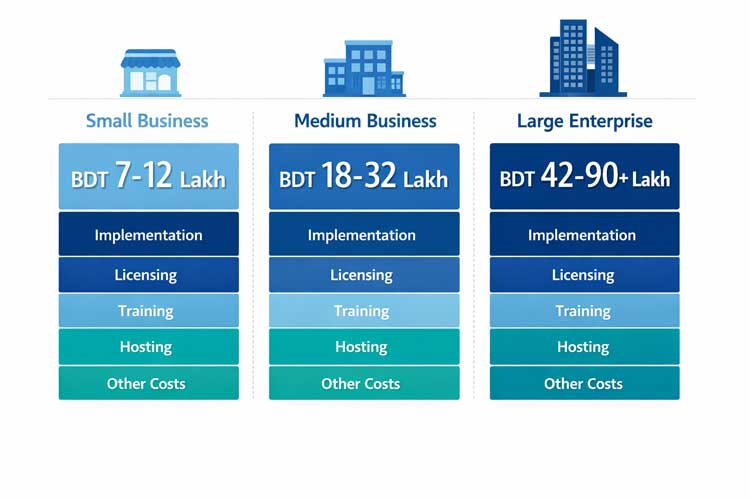
Understanding the complete financial picture helps you budget appropriately and compare vendors fairly.
Small Business Implementation (5-15 users):
- Software licensing (Enterprise): BDT 60,000-1.8 lakh annually
- Implementation services: BDT 3-6 lakh one-time
- Basic customization: BDT 1-2 lakh
- Training: BDT 50,000-1 lakh
- Cloud hosting: BDT 15,000-25,000 monthly
- Total first-year investment: BDT 7-12 lakh
Medium Business Implementation (20-50 users):
- Software licensing (Enterprise): BDT 2.4-6 lakh annually
- Implementation services: BDT 8-15 lakh one-time
- Moderate customization: BDT 3-5 lakh
- Training and change management: BDT 1.5-2.5 lakh
- Cloud hosting: BDT 25,000-40,000 monthly
- Total first-year investment: BDT 18-32 lakh
Large Enterprise Implementation (50+ users):
- Software licensing (Enterprise): BDT 6-15+ lakh annually
- Implementation services: BDT 20-50+ lakh one-time
- Extensive customization and integration: BDT 8-15 lakh
- Comprehensive training program: BDT 3-5 lakh
- Dedicated hosting or on-premise infrastructure: BDT 40,000-1 lakh monthly
- Total first-year investment: BDT 42-90+ lakh
Hidden Costs to Anticipate:
Many businesses underestimate:
- Internal resource time: Your team dedicates significant hours to requirements gathering, testing, and training
- Process re-engineering: Sometimes existing processes need redesign to leverage ERP capabilities fully
- Data quality remediation: Cleaning and preparing data for migration takes longer than expected
- Additional integration work: Connecting third-party systems often reveals unanticipated complexity
- Extended support: Post-implementation hand-holding frequently exceeds initial estimates
ROI Timeline Expectations:
Well-implemented systems typically show measurable returns within 12-18 months through:
- Reduced manual data entry, saving 10-15 hours weekly per department
- Improved inventory turnover, reducing carrying costs by 15-25%
- Faster order processing increases sales capacity by 20-30%
- Better financial visibility improves cash flow management
- Reduced errors, cutting rework and waste by 30-40%
Critical Mistakes to Avoid When Selecting an Odoo ERP Implementation Service Company in Bangladesh
The vendor selection process determines implementation success more than any other single factor. Avoid these common pitfalls:
Choosing Based on Price Alone Without Evaluating Expertise
The lowest bid often comes from inexperienced providers lacking certified consultants, proven methodologies, or adequate resources. What appears as savings during procurement becomes costly when projects overrun timelines, deliverables fall short, or systems require complete re-implementation.
A provider charging 20% more but delivering on-time, on-budget implementation with comprehensive training ultimately costs significantly less than rock-bottom pricing with poor execution.
Ignoring Certification and Partnership Status
Odoo offers official partnership tiers (Ready, Silver, Gold) based on certification levels, project track records, and customer satisfaction. Partners must maintain certified consultants who’ve completed Odoo’s training programs and examinations.
When evaluating an Odoo ERP implementation service company in Bangladesh, verify:
- Official Odoo partner status and tier level (check Partner List).
- Number of certified functional and technical consultants on staff.
- Years of Odoo-specific experience (not just general IT services).
- Successful implementations in similar industries and company sizes.
Inadequate Change Management Planning
Technology implementation is fundamentally a people challenge. Vendors focusing exclusively on technical configuration while ignoring organizational change management deliver systems that technically work but practically fail due to poor user adoption.
Quality partners allocate 20-30% of implementation effort to training, communication, and change management activities.
Over-Customization Beyond Core Business Needs
Every business believes its processes are unique and require extensive customization. While some customization proves necessary, excessive modifications create technical debt, complicating future upgrades, increasing maintenance costs, and introducing bugs.
Experienced consultants distinguish between must-have customizations delivering genuine competitive advantage, and nice-to-have features not worth the complexity cost.
Skipping the Discovery and Planning Phase
Rushing into configuration without thorough requirements gathering leads to costly mid-project changes, missed functionality, and disappointed expectations. The most successful implementations invest 15-20% of total project effort in upfront planning, requirements documentation, and stakeholder alignment.
Not Verifying Local Industry Experience and References
Odoo principles apply universally, but industry-specific knowledge accelerates value delivery. Consultants understanding RMG manufacturing workflows, letter of credit processes, or pharmaceutical regulatory requirements configure more relevant solutions faster than generalists learning your industry during the project. Request case studies from similar businesses and speak directly with references.
Key Odoo Implementation Partners in Bangladesh
When selecting an Odoo ERP implementation service company in Bangladesh, it’s crucial to partner with certified, experienced providers who understand both global best practices and local market dynamics. Several established companies have earned recognition for their expertise in Odoo implementation and enterprise resource planning solutions.
Featured Implementation Partners
HasTech IT Limited stands out as a prominent digital solutions provider specializing in enterprise resource planning and business process automation. Founded in 2015 and headquartered in Dhaka, HasTech brings substantial expertise to Odoo implementation projects. The company maintains a focused team dedicated to understanding client business requirements and delivering customized Odoo solutions aligned with Bangladesh’s unique regulatory environment and business ecosystem.
HasTech’s service offerings encompass Odoo implementation, system customization, integration with local business systems, and ongoing technical support. The company demonstrates proficiency in configuring Odoo modules for various industry verticals and understands the critical importance of NBR compliance, VAT automation, and Bangladesh-specific business workflows. Their portfolio reflects successful implementations across diverse sectors, including manufacturing, retail, and service-based enterprises.
Key Considerations When Evaluating Implementation Partners:
When assessing any Odoo ERP implementation service company in Bangladesh, whether HasTech or alternative providers, prioritize the following criteria:
- Certification Status: Verify official Odoo partnership tier (Ready, Silver, or Gold) on the official Odoo partner directory at odoo partner.
- Local Expertise: Confirm experience with Bangladesh-specific requirements, including:
- NBR (National Board of Revenue) compliance and mushak form generation
- VAT calculations (15% on goods and services)
- Tax withholding and payroll regulations
- Import/export documentation automation
- Integration with local payment gateways (bKash, Nagad, Rocket)
- Project Track Record: Request verifiable evidence of:
- Number of successful Odoo implementations completed
- Project success rate (on-time, on-budget delivery)
- Customer retention rate and testimonials
- Industry-specific case studies
- Team Composition: Evaluate:
- Certified Odoo functional and technical consultants
- Years of Odoo-specific experience (minimum 3-5 years recommended)
- Dedicated implementation managers
- Ongoing support and training capabilities
- Support Infrastructure: Assess:
- Post-implementation warranty coverage (typically 3-6 months)
- Annual Maintenance Contract (AMC) options
- Response times for critical issues
- Escalation procedures and support channels
- 24/7 availability during critical deployment phases
- Communication and Collaboration: Ensure:
- Clear communication in English and Bangla
- Regular progress updates and milestone reporting
- Structured change management approach
- Responsive to client feedback and adaptation needs
ShopLentor – WooCommerce Builder for Elementor & Gutenberg
A versatile page builder to build modern and excellent online stores with more than 100k Active Installations.
Frequently Asked Questions
How long does Odoo ERP implementation take in Bangladesh?
Typically 2-6 months, depending on business size, customization needs, and data complexity. Small businesses may complete in 6-8 weeks, while enterprises need 4-6 months for full deployment. This aligns with industry standards, showing implementation timelines of 4-6 weeks for small projects and 8-12 weeks for medium-sized implementations.
What is the cost of Odoo implementation in Bangladesh?
Implementation costs range from BDT 3-5 lakhs for small businesses to BDT 20-50+ lakhs for large enterprises, depending on modules, users, and customization requirements. Additional ongoing costs include licensing (BDT 1,000-1,500 per user/month), hosting (BDT 15,000-50,000 monthly), and annual support (BDT 1-3 lakhs).
Do I need Odoo Enterprise or Community Edition?
Community Edition suits startups with basic needs and technical resources. Enterprise Edition provides official support, advanced features, and regular updates, ideal for growing businesses. Most expanding Bangladeshi companies find Enterprise Edition’s reduced technical overhead justifies the cost.
Can Odoo integrate with Bangladesh’s VAT and tax systems?
Yes, certified Odoo partners in Bangladesh provide localization modules that ensure compliance with NBR regulations, mushak forms, and automated VAT calculations. Pre-built Bangladesh-specific modules eliminate costly custom coding.
What ongoing support should I expect after implementation?
Reputable companies offer 24/7 support during critical phases, regular system health checks, version upgrades, bug fixes, and continuous optimization. Standard support includes defined SLAs and response times. Most providers offer Annual Maintenance Contracts (AMC) at 15-20% of the initial implementation cost.
Conclusion
Selecting the right Odoo ERP implementation service company in Bangladesh represents one of your most important technology decisions.
As Bangladesh’s ICT market reaches USD 8.88 billion in 2025 and continues growing 6.33% annually through 2030, businesses face increasing pressure to modernize operations and compete globally.
Success depends on thorough planning, documenting requirements, and aligning stakeholders. It also relies on certified partners who combine technical expertise with deep industry knowledge.
Appropriate customization is essential, carefully balancing standard functionality with unique business needs. Comprehensive change management ensures teams understand the system and actively adopt it. Ongoing support is equally critical, treating go-live as the beginning rather than the end.
By approaching vendor selection methodically, asking tough questions, verifying claims through client references, and prioritizing partnership quality over initial price, your business positions itself for ERP success.
The investment in choosing the right implementation partner pays dividends through smoother deployment, faster time-to-value, higher user adoption, and sustained long-term benefits.
Ready to transform your business with Odoo ERP? Contact certified implementation partners today for a free consultation and customized proposal.
Verify partnership credentials through the official Odoo partner directory, speak directly with client references about their experience, and make your decision based on demonstrated expertise and cultural fit rather than price alone.
Your business deserves an ERP partner committed to your success for years to come, not just a vendor executing a project.