Shopify Success Rate 2026: Why Most Stores Fail & How to Win

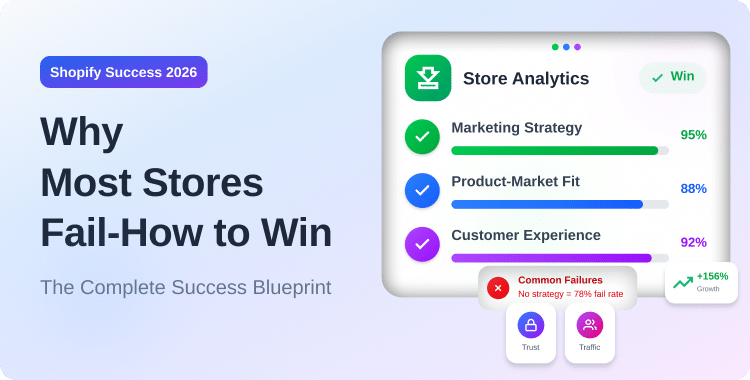
In 2026, launching a Shopify store is easier than ever — but building a profitable one is still rare. With only 5–10% of merchants reaching long-term success, most stores fail within their first 12–18 months. The problem isn’t Shopify itself; it’s the mistakes merchants make: weak niches, poor marketing, slow websites, and ignoring the data that actually drives growth.
This article breaks down the real Shopify success rate, why so many stores struggle, and the exact strategies top performers use to beat the odds — from conversion optimization and mobile-first design to the newest opportunities in AI, social, and voice commerce.
- The Real Shopify Success Rate: What the Data Shows
- Why Most Shopify Stores Fail: The Root Causes
- Critical Metrics That Separate Winners From Losers
- 7 Actionable Strategies to Join the Successful 5–10%
- Organize Your Shopify Store with Tags
- Common Shopify Mistakes and How to Avoid Them
- Building a Profitable Store: Step-by-Step Roadmap
- The Future of Shopify: Trends to Exploit in 2026
- Freequently Asked Questions
- Final Thoughts: Your Path to Shopify Success
Key Takeaways
- 5–10% of Shopify stores achieve long-term profitability, while 90% struggle or fail within the first 12–18 months—but failure is preventable, not inevitable.
- The top reasons stores fail: no clear niche, weak marketing, poor product-market fit, slow load times, confusing checkout, and ignoring analytics.
- Success requires focusing on core metrics (conversion rate, AOV, CAC, repeat customer rate) and implementing conversion optimization strategies from day one.
- Shopify merchants with data-driven approaches, mobile-first design, and strategic app integration significantly outperform industry averages.
The success rate for Shopify merchants is 5–10%, meaning most stores don’t reach profitability. However, this isn’t a platform limitation—it reflects merchant mistakes like poor niche selection, ineffective marketing, slow sites, and weak checkout experiences. Stores that optimize conversion rates, track key metrics, and implement mobile-first strategies dramatically improve their odds.
The Real Shopify Success Rate: What the Data Shows
Understanding the 5–10% Success Rate
The widely cited 5–10% success rate for Shopify stores often shocks new entrepreneurs. But before you worry, understand what this means: out of every 100 Shopify stores launched, roughly 5 to 10 will reach sustainable profitability. The rest either fail outright, get abandoned, or limp along without meaningful revenue.
This statistic isn’t unique to Shopify. According to broader business research, nearly half of all new businesses fail within five years, with an average failure rate of 12.1% annually. Shopify merchants, however, have an advantage: they’re operating on a platform that handles payment processing, hosting, and compliance—removing friction that crushes brick-and-mortar startups.
The real question isn’t whether Shopify works (it obviously does). The question is: Do you have what successful merchants have?
Platform Scale: The Massive Opportunity
The Shopify ecosystem is undeniably massive. As of November 2025, Shopify powered 6.5 million active stores globally. These merchants processed $1 trillion in cumulative gross merchandise volume (GMV) and generated $1.4 trillion in total revenue. In 2024 alone, Shopify merchants sold to 875 million shoppers, with a new entrepreneur making their first sale every 26 seconds.
Shopify commands 30% of all U.S. ecommerce businesses, making it the dominant player in the direct-to-consumer space. During Black Friday 2024, Shopify merchants generated $11.5 billion in global sales in a single day—a 60% year-over-year increase.
The point: Opportunity abounds. But platform scale doesn’t guarantee individual success.
Conversion Rate Reality Check
If you’re running a Shopify store, your baseline conversion rate matters. The average Shopify store converts 1.4% to 2.5% of visitors into customers. Top-performing stores, by contrast, consistently hit 3% to 5% conversion rates.
This gap—just 1.5 to 2.5 percentage points—often separates stores making $5,000/month from those making $50,000/month. Conversion optimization, therefore, isn’t optional; it’s foundational to profitability.
🚀 Ready to skyrocket your Shopify store to success?
🚀 Unlock the secrets to success and boost your sales 📈 with ShopiBuffet’s expert services. Don’t miss out, get started now!
Why Most Shopify Stores Fail: The Root Causes
Failure doesn’t happen overnight. It’s the result of accumulated strategic mistakes made before and after launch. Here are the primary culprits:
1. No Clear Niche or Unique Selling Proposition (USP)
Many new store owners begin with a fatal flaw: they try to sell everything to everyone. “Skincare, home decor, gadgets, clothing—we have it all!” This approach virtually guarantees failure because:
- Customers can’t quickly understand what you’re about. Without clarity, they bounce.
- Marketing becomes impossibly expensive. Targeting “everyone” means advertising to people who don’t need your products.
- Inventory and fulfillment become complex nightmares. You’re managing multiple supply chains without economies of scale.
- Brand trust erodes. A store selling everything looks like a generic dropshipping warehouse, not a credible brand.
Successful stores pick a specific niche: minimalist home decor, eco-friendly pet products, luxury coffee accessories, fitness supplements for women over 40. This clarity lets them dominate a smaller market instead of competing weakly in a massive one.
2. Poor Marketing and Traffic Generation
A beautiful store with zero visitors is worthless. Yet many merchants build their site and expect organic traffic to flood in. It won’t.
Common mistakes include:
- Running unfocused ads with no clear target audience or offer.
- Ignoring SEO entirely. Relying solely on paid ads means perpetual high customer acquisition costs.
- Missing influencer partnerships or user-generated content opportunities.
The harsh reality: paid traffic is expensive and becoming more so. Stores that don’t build organic channels (SEO, email, social) or nurture customer relationships face an impossible math problem.
3. Weak Product-Market Fit
Before you launch, ask: Does my product genuinely solve a problem people are willing to pay for?
Signs of weak product-market fit:
- Low repeat purchase rates (customers buy once and never return).
- High bounce rates on product pages (visitors leave without exploring).
- Heavy reliance on discounts to drive sales (no inherent demand).
- No clear use case or benefit in your product descriptions.
You can’t convert your way out of a product nobody wants. Testing product-market fit before you invest heavily in inventory or ads is critical.
4. Slow Site Speed and Poor Mobile Optimization
Mobile commerce accounts for 60%+ of all ecommerce sales. Yet many merchants treat mobile as an afterthought.
The data is brutal: 53% of mobile users abandon sites that take longer than 3 seconds to load. Even worse, for every additional second of load time, conversion rates drop by 7%.
On Shopify, common speed killers are:
- Unoptimized, high-resolution images.
- Too many unused apps running JavaScript in the background.
- Bloated themes with poor coding.
- Third-party fonts and external tracking pixels blocking page render.
Mobile optimization extends beyond speed. It includes thumb-friendly navigation, vertical product images, one-click checkout, and clear calls-to-action above the fold.
5. Confusing Navigation and Poor Product Page Design
Customers should be able to answer three questions within 5 seconds of landing on your homepage:
- What do you sell?
- Why should I trust you?
- What should I do next?
If your navigation is cluttered, your product pages are generic, or your CTAs are buried, visitors leave. Common navigation failures include:
- Inconsistent product categorization.
- Weak product pages with low-quality images and vague descriptions.
6. Checkout Friction and Limited Payment Options
Cart abandonment on Shopify averages 70%. A significant portion of this is preventable.
Friction points that kill conversions:
- Forced account creation before checkout (offer guest checkout).
- Limited payment options (credit card only; missing Apple Pay, Google Pay, PayPal, Shop Pay).
- Unexpected shipping costs revealed at the final step.
- Complex, multi-step checkout processes.
- Missing trust signals (no SSL certificate indicator, no security badges, no return policy).
- Slow checkout load times that frustrate ready-to-buy customers.
7. Ignoring Analytics and Data-Driven Decisions
Many store owners manually fulfill orders, send generic emails to all customers, and never check their Shopify analytics. Over time, this creates bottlenecks and leaves massive optimization opportunities on the table.
Merchants who don’t track conversion funnels, cart abandonment, product performance, and customer acquisition costs are flying blind. They can’t identify which strategies work or where customers drop off.
Recommended Blogs for You:
👉 How to Add Google Analytics to Shopify: Most Easy Way
👉 Best Shopify Apps for Custom Products
👉 12 Reasons Why Your Shopify Store Needs a Wishlist App
👉 19 Must have Shopify Apps for eCommerce in 2026
Critical Metrics That Separate Winners From Losers
Successful Shopify merchants obsess over the right metrics. Here are the non-negotiable KPIs:
Conversion Rate (CVR)
Formula: (Number of Orders ÷ Number of Sessions) × 100
- Industry average: 1.4–2.5%
- Good target: 2.5%–3.5%
- Best-in-class: 4%–5%
Every 0.5% improvement in conversion rate compounds into significant revenue gains without requiring more traffic.
Average Order Value (AOV)
Formula: Total Revenue ÷ Total Number of Orders
This metric reveals whether customers are buying one item or filling their cart. Increasing AOV through bundling, upsells, cross-sells, and tiered discounts is often easier and cheaper than acquiring new customers.
Customer Acquisition Cost (CAC)
Formula: Total Marketing Spend ÷ New Customers Acquired
If you’re spending $50 to acquire a customer with an AOV of $35, your business doesn’t work—no matter how many sales you make. CAC must be 25–33% of first-order value to achieve profitability.
Customer Lifetime Value (CLV)
Formula: (Average Order Value × Repeat Purchase Rate × Gross Margin) ÷ Churn Rate
This is your north star. A CLV of 3× your CAC is the baseline for sustainability. If customers buy once and disappear, your unit economics are doomed.
Cart Abandonment Rate
Formula: (Abandoned Carts ÷ Initiated Checkouts) × 100
At 70% industry average, every cart you recover is revenue found. Email recovery campaigns alone can recover 10–15% of abandoned carts.
Repeat Customer Rate
Formula: (Returning Customers ÷ Total Customers) × 100
This metric reveals product quality and customer satisfaction. A repeat customer rate below 20% signals problems with your product or post-purchase experience.
Gross Profit Margin and Net Profit
Gross Margin = (Revenue − Cost of Goods Sold) ÷ Revenue
Net Profit = Gross Profit − All Operating Expenses (marketing, apps, labor, shipping, taxes)
Many merchants obsess over revenue while ignoring profit. A $100,000/month store with 5% net margins ($5,000 profit) is less successful than a $30,000/month store with 30% net margins ($9,000 profit).

Bring your ideas to life for $1/month
The future of business is yours to shape. Sign up for a free trial and enjoy 3 months of Shopify for $1/month on select plans.
7 Actionable Strategies to Join the Successful 5–10%
Strategy 1: Validate Your Niche Before Investing
Before building a full store, spend 2–4 weeks validating product-market fit:
- Use a pre-order model to gauge real demand without inventory risk. Sell 10 units before manufacturing 1,000.
- Test through Shopify Collective or influencer partnerships to see if your product resonates before scaling.
- Analyze competitor reviews on Amazon and Shopify. What problems do customers complain about? Can you solve them?
Only after validating demand should you invest in inventory, apps, and marketing.
Strategy 2: Master Mobile-First Design and Site Speed
Mobile optimization is non-negotiable:
- Compress images and convert to modern formats (WebP) to reduce file sizes.
- Audit and remove unnecessary apps. Each app adds JavaScript overhead; uninstall anything not directly impacting revenue.
- Use Shopify’s native analytics to monitor page load times. Aim for loads under 2 seconds on mobile.
- Implement lazy-loading for images below the fold.
- Test checkout on 4G mobile networks. If it’s slow, your customers are abandoning.
A 1-second page speed improvement can increase conversions by 7%. Compound five improvements together and you’re looking at 30%+ conversion gains.
Strategy 3: Optimize Product Pages for Conversions
Your product page is where conversions happen (or don’t). Every element matters:
Product Images:
- Multiple high-quality photos from different angles.
- Lifestyle shots showing the product in use (not just flat-lay studio shots).
- Zoom functionality so customers inspect details.
- Video demonstrations if the product’s benefit is unclear in photos.
Product Descriptions:
- Lead with the benefit, not features. Don’t say “100% organic cotton.” Say “Breathable fabric keeps you cool in summer heat.”
- Include specifications, sizing guides, and comparison tables.
- Address common objections (shipping time, warranty, return policy).
- Keep copy scannable with short paragraphs and bullet points.
Trust Signals:
- Customer reviews and ratings prominently displayed.
- Security badges (Shopify’s trust mark).
- Clear return and refund policy linked from the product page.
- Testimonials or case studies if applicable.
Strategy 4: Simplify and Accelerate Your Checkout
Every step in checkout is a drop-off point. Optimization here directly increases revenue:
- Enable guest checkout. Forcing account creation is conversion poison. Optional account creation is fine.
- Limit checkout to one page. Three-step checkouts kill conversions compared to single-page alternatives.
- Remove unnecessary form fields. You don’t need customers’ birth dates or phone numbers to process their orders. Ask only for essential info.
- Offer multiple payment methods: Shop Pay (fastest for Shopify), Apple Pay, Google Pay, PayPal, and credit card.
- Display clear shipping and tax estimates before the final step so there are no surprises.
- Show a progress indicator so customers know they’re near the finish line.
Simplified checkout alone can reduce cart abandonment by 10–15%.
Strategy 5: Build a Multi-Channel Marketing Approach
Relying on paid ads alone is unsustainable. Successful stores combine multiple channels:
Organic Traffic (SEO):
- Optimize product titles and descriptions for search (natural keyword inclusion, not keyword stuffing).
- Build blog content around informational queries in your niche.
- Implement schema markup so search engines understand your content better.
Email Marketing:
- Build a list from day one (welcome discount in exchange for email).
- Set up automated cart abandonment recovery (can recover 10–15% of abandoned carts).
- Segment customers by purchase history and send personalized recommendations.
Social Media and Content:
- Invest in user-generated content (customer reviews, unboxing videos).
- Partner with micro-influencers in your niche (often cheaper and more authentic than macro-influencers).
Paid Ads (Google and Meta):
- Start with retargeting (lower cost, higher conversion intent).
- Use detailed audience targeting (lookalike audiences, interest-based, behavioral).
- A/B test ad creative, headlines, and offers continuously.
- Monitor return on ad spend (ROAS) and pause low-performing campaigns quickly.
Strategy 6: Implement Data-Driven Optimization Cycles
Success comes from continuous testing and learning:
Weekly Reviews:
- Monitor conversion rate, AOV, CAC, and ad spend.
- Identify which traffic sources and products are performing.
- Pause underperforming ads.
Monthly Deep Dives:
- Analyze customer cohorts. When do first-time customers become repeat buyers?
- Review product profitability (revenue minus COGS, shipping, and fulfillment).
Quarterly Strategy Sessions:
- Review overall profitability (net profit margin, not just revenue).
- Assess product-market fit. Are repeat purchase rates healthy?
- Plan inventory and marketing budgets for the next quarter.
Tools like Shopify’s native analytics, Google Analytics 4 (via Analyzely), and apps like GroPulse GTM & Data Layer give you the visibility needed to make informed decisions.
Strategy 7: Choose Your Apps Strategically
Most merchants install too many apps, bloating their store and reducing speed. Instead, choose 3–5 mission-critical apps based on ROI potential:
For Analytics & Optimization:
- Analyzely – Google Analytics 4 integration for detailed visitor and conversion tracking.
- GroPulse GTM & Data Layer for advanced data layer setup and pixel management.
For SEO and Discoverability:
- GP JSON-LD Schema & AI SEO for structured data and search visibility.
- NoIndexly – Sitemap Manager for technical SEO optimization.
For Social Proof and Conversions:
- GroPulse Google Reviews for displaying customer reviews and building trust.
- GP Wshlist & Upsell Suite for wishlists and product recommendations that increase AOV.
For Advertising and Pixel Management:
- Pixee – Multi Pixel & Meta Ads for seamless Facebook/Instagram ad tracking.
- AdTrack – Google Ads Tracking for accurate conversion attribution.
For Fulfillment Acceleration:
- GP Free Shipping Bar to increase AOV by setting a free shipping threshold.
Each app should directly impact revenue (either by increasing conversions, AOV, or customer retention) or reduce operational costs.
Organize Your Shopify Store with Tags
Common Shopify Mistakes and How to Avoid Them
Mistake #1: Launching Without a Clear Value Proposition
The Problem: Your homepage doesn’t clearly communicate what you sell or why anyone should care.
The Fix: Within 5 seconds of landing, visitors should know:
- What you sell (e.g., “Eco-friendly pet products for conscious pet owners”).
- Why it’s better (e.g., “Made from sustainable, non-toxic materials”).
Mistake #2: Ignoring Mobile Users
The Problem: Your store looks great on desktop but is impossible to navigate on mobile.
The Fix: Test your store on a real mobile device (not just browser emulation). Ensure:
- Images don’t require horizontal scrolling.
- Forms are simple and fast to complete.
- Checkout is a single page.
Mistake #3: Using Stock Photos Everywhere
The Problem: Generic stock photos don’t connect emotionally with customers.
The Fix: Mix in lifestyle photography showing your products in real use. Invest in even basic product photography (smartphone camera + natural lighting is often good enough).
Mistake #4: Weak Product Descriptions
The Problem: Your product descriptions read like feature lists, not benefits.
The Fix: Rewrite descriptions to answer: “What problem does this solve?” Lead with the benefit, then include specifications, sizing, and care instructions.
Mistake #5: No Social Proof
The Problem: New customers have no reason to trust you.
The Fix: Display customer reviews, ratings, testimonials, and trust badges prominently. Early on, request reviews via follow-up emails. As you grow, consider platforms like Loox or Okendo to automate review collection.
Mistake #6: Complex or Confusing Navigation
The Problem: Visitors can’t find products and bounce.
The Fix: Simplify your menu to 5–7 top-level categories. Use plain-language labels (“T-Shirts,” not “Threaded Favorites”). Add a prominent, searchable product discovery bar.
Mistake #7: Not Leveraging Email
The Problem: You focus only on paid ads, ignoring your owned audience.
The Fix: Build an email list from day one. Offer a first-purchase discount (15–20%) in exchange for an email signup. Set up automated welcome sequences and cart abandonment recovery campaigns.
Mistake #8: Launching With Too Many Products
The Problem: You feel overwhelmed managing inventory and struggle to market everything.
The Fix: Start with 20–50 core products. Perfect the supply chain and marketing for these before expanding. Quality over quantity always wins.
Mistake #9: Not Tracking Profitability
The Problem: You’re making sales but not profit.
The Fix: Implement profit tracking from day one. Account for COGS, shipping, transaction fees, app subscriptions, customer acquisition costs, and labor. Net profit (not revenue) is the only metric that matters.
Mistake #10: Setting Unrealistic Expectations
The Problem: You expect $10,000/month in your first month.
The Fix: Plan for 6–12 months to profitability. Most successful stores take 3–6 months just to validate product-market fit and optimize their funnel. Growth is a marathon, not a sprint.
Building a Profitable Store: Step-by-Step Roadmap
Phase 1: Pre-Launch Validation (Weeks 1–4)
Goals: Validate niche, test product-market fit, build initial audience.
Actions:
- Research your niche using Google Trends, Ahrefs, and Reddit.
- Survey 50–100 potential customers to assess willingness to buy.
- Pre-order a small batch of your product to validate demand.
- Join relevant online communities and build credibility.
Key Metric: Validation signals (survey responses, pre-orders, community engagement).
Phase 2: Soft Launch (Weeks 5–8)
Goals: Set up store, optimize foundation, establish conversion baseline.
Actions:
- Build and optimize product pages with high-quality images and descriptions.
- Set up mobile optimization, fast checkout, and trust signals.
- Implement basic analytics (Shopify native + Analyzely for GA4).
- Reach out to 10–20 friends/network for first customers and reviews.
Key Metrics: Conversion rate, average order value, customer feedback.
Phase 3: Launch and Paid Traffic (Weeks 9–16)
Goals: Scale through paid ads, optimize funnel, reach profitability.
Actions:
- Launch Facebook and Google ads targeting your niche.
- Implement retargeting for website visitors.
- Set up email sequences (welcome, cart abandonment, post-purchase).
- Monitor CAC vs. AOV; pause losing campaigns.
- A/B test product pages, headlines, and ad creative.
Target Metrics:
- Conversion rate: 1.5%–2.5%
- AOV: $40–$80
- CAC: 25–33% of first order value
- ROAS: 2–3x
Phase 4: Optimize and Scale (Weeks 17–26)
Goals: Improve profitability, increase repeat purchase rate, and reduce CAC.
Actions:
- Implement upsells and cross-sells (wishlist, product recommendations).
- Build email segmentation based on purchase history.
- Test free shipping threshold to increase AOV (using GP Free Shipping Bar).
- Expand to new ad channels (TikTok, Pinterest) if ROI allows.
- Conduct customer satisfaction surveys and address pain points.
Target Metrics:
- Repeat purchase rate: 20%+ (within 90 days)
- Email revenue: 15–25% of total
- Net profit margin: 10%+
Phase 5: Long-Term Growth (Months 7+)
Goals: Build sustainable, profitable business; scale operations.
Actions:
- Scale winners (products, channels) aggressively.
- Reduce paid ad spend as email and organic channels mature.
- Expand product line based on customer demand.
- Explore new channels (wholesale, affiliate, marketplace).
Target Metrics:
- Net profit margin: 15%–25%
- Repeat customer revenue: 40%+ of total
- CAC efficiency: Profitable within 3 months
The Future of Shopify: Trends to Exploit in 2026
AI-Powered Personalization
Merchants using AI for product recommendations, personalized email, and dynamic homepage content are seeing conversion rate improvements of 25%–50%. By 2026, generic storefronts will fall behind.
What to do:
- Use AI-powered product recommendation tools to suggest items based on browsing/purchase history.
- Implement personalized email sequences (not one-size-fits-all).
- Consider dynamic pricing based on customer segments and inventory.
Voice Commerce and Conversational AI
Voice shopping is expected to reach $40 billion by 2026. As Shopify announced its ChatGPT integration in September 2025, merchants leveraging voice search and conversational commerce will gain an edge.
What to do:
- Optimize product descriptions for voice search (natural language, question-based).
- Consider chatbot integration for customer service (HelpMate – FAQ & Help Center can help).
- Monitor voice commerce platforms and be ready to expand.
Social Commerce Dominance
Social commerce is the fastest-growing ecommerce segment, with growth expected to be 2.9 trillion by 2026. Instagram Shop, TikTok Shop, and Facebook Shops aren’t optional anymore.
What to do:
- Set up product catalogs on Instagram, TikTok, and Facebook.
- Invest in user-generated content and influencer partnerships.
- Enable live shopping events if your niche supports it.
Headless Commerce and Custom Experiences
Large merchants (especially those with >$500K/month revenue) are moving to headless architecture for better performance, customization, and multi-channel flexibility. If you’re scaling aggressively, this becomes relevant.
Omnichannel Integration
Winners in 2026 will sell on their Shopify store, Amazon, Walmart, marketplaces, and social platforms simultaneously—with inventory synced and operations unified. This is no longer a nice-to-have; it’s a baseline expectation.
What to do:
- Plan for omnichannel from the start (even if you launch with just Shopify).
- Use tools like Shopify’s native marketplace integrations.
- Set up systems for order consolidation and fulfillment.
Freequently Asked Questions
What is the actual success rate of Shopify stores?
The estimated long-term success rate for Shopify stores is between 5% and 10%. While Shopify powers millions of merchants, approximately 90% of stores fail or become dormant within their first 12–18 months. This high churn rate is rarely due to the platform itself, but rather a lack of business fundamentals: poor product-market fit, insufficient budget for customer acquisition, or “general store” models that lack a distinct brand identity.
How long does it take to become profitable on Shopify?
While outliers exist, a realistic timeline for a sustainable Shopify brand to reach profitability is 6 to 12 months. The first 90 days are typically a “validation phase” where money is invested in gathering data, testing ad creatives, and optimizing the funnel. Stores expecting instant profit often quit during this critical data-gathering period. Long-term success requires enough capital to survive the initial “Customer Acquisition Cost (CAC) valley” before repeat purchases (LTV) kick in.
What is the most important metric for Shopify profitability?
The single most critical metric for long-term survival is the LTV:CAC Ratio (Lifetime Value to Customer Acquisition Cost). A healthy, scalable business aims for a ratio of 3:1—meaning for every $1 you spend on marketing, the customer eventually generates $3 in gross margin. If your ratio is 1:1, you are breaking even and cannot scale. If it is below 1:1, you are losing money on every sale.
What is the success rate for Shopify dropshipping specifically?
The estimated success rate for Shopify dropshipping stores is significantly lower than standard inventory-holding businesses, hovering between 1% and 5%. While the barrier to entry is low, the operational challenges are high. The majority of dropshippers fail because they rely on the outdated “AliExpress-to-General-Store” model. In 2026, the surviving 5% have shifted to “Brandshipping”—working with local suppliers, ensuring 3–5 day shipping, and building a legitimate brand identity rather than just pushing generic products.
How much money do I need to start a successful Shopify store?
You can start with Shopify’s 3-day free trial, then $1/month for 3 months. Building a profitable store typically requires $500–$2,000 for product samples, initial inventory, apps, and advertising tests to optimize your sales.
Bring your ideas to life for $1/month
The future of business is yours to shape. Sign up for a free trial and enjoy 3 months of Shopify for $1/month on select plans.
Final Thoughts: Your Path to Shopify Success
The 5–10% success rate for Shopify stores isn’t a reflection of the platform. It reflects the reality of entrepreneurship: most people underestimate the work required, overestimate their initial product-market fit, and give up too quickly.
But here’s the good news: The path to success is clear. You don’t need luck, genius, or a huge marketing budget. You need:
- A genuine problem your product solves (validated through research, not assumptions).
- Obsessive focus on the metrics that matter (conversion rate, CAC, CLV, net profit).
- Mobile-first design and fast-loading pages (non-negotiable in 2026).
- Continuous optimization (A/B testing, data analysis, iterative improvements).
- Patience (expect 6–12 months to profitability, not 6 weeks).
The merchants in the successful 5–10% aren’t smarter than you. They’re more disciplined. They test, measure, and optimize relentlessly. They cut things that don’t work and double down on what does.
Your first 90 days are critical. Use them to validate demand, optimize your funnel, and build an email list. By month 4, you should have clear data on whether your niche is viable. By month 6, you should be seeing profitability signals or pivoting to a new approach.
Shopify has given you the tools to compete with established brands. The question is: Will you do the work to join the successful few?