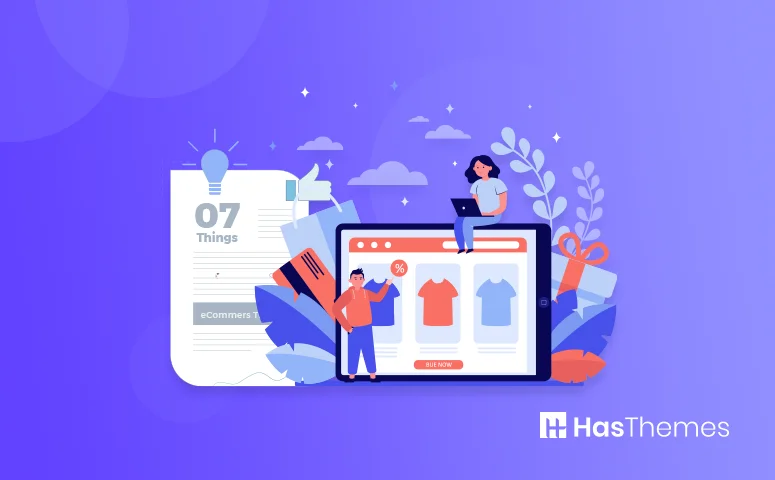
7 Things to Consider When Choosing an Ecommerce Theme

Ecommerce has been growing steadily in popularity over the last ten years. Digital revenues increased by almost 15% across the board last year and are expected to rise only in the future.
If you start a company and sell goods and/or services, an e-commerce platform is critical in order to capitalize on this exponential rise in online sales.
Although you could employ a web developer to get your business going, those costs will hinder your ability to grow quickly. Opting for a fully-developed eCommerce theme saves both time and money.
However, one problem is that you have a lot of choices available, so how do you know you are choosing the right one? This article highlights 7 things to consider when choosing an eCommerce theme to ensure you pick the best one for your brand.
Key Takeaways
- Understand the importance of mobile-friendly designs and responsive themes for attracting mobile users.
- Learn how to select a design that aligns with your brand and appeals to your target audience.
- Discover how pricing structures can affect your budget and which platforms offer cost-effective solutions.
- Identify the role of SEO-friendly themes in improving search engine visibility and organic traffic.
- Explore the significance of reliable customer support and how it impacts new eCommerce businesses.
- Learn why scalability is essential for accommodating future growth without unnecessary expenses.
7 Things to Consider When Choosing an eCommerce Theme
Selecting the right eCommerce theme is vital for your store’s success. Focus on features that match your goals and improve customer experience. Here we have enlisted 7 things to consider when you choose an eCommerce theme:
1. Mobile-friendliness
More than 77 % of Americans already own a smartphone. Mobile users make up a significant portion of organic eCommerce traffic. It’s important to appeal to your mobile audience when selecting an eCommerce theme for your app.
Once you go for the most attractive theme out there, make sure it’s built to be mobile responsive. Responsive design means that the web content is tailored to the screen size of the devices used to access it. Nevertheless, responsive design is just the beginning of a mobile theme.
Many theme providers offer other mobile-friendly functions to ensure that mobile users don’t miss out on sale promotions and newsletters. If you’re using WordPress, some themes require plugins to make your website mobile-friendly. When you’re looking for a theme, make mobile-friendliness the priority.
2. Design
It’s important that you like the theme you choose, but it’s more important than the theme suits your brand and appeals to your customers. You may see a theme with some flashy high-tech functions that you like, but it won’t work if you run a small, handmade gifts company.
You also want to ensure that your home page, category page, and product page have features that help showcase your products. View it at the full-screen size of your PC and then check it on smaller screen sizes. Simply resize your browser window to see how the theme adapts to different dimensions.
3. Pricing
Although this can sound like a common-sense idea, the fact is that different platforms may deliver various features at differing prices. Many sites offer one flat rate without paying extra transaction fees. Some platforms have a base rate, charged per transaction, and require subscriptions for more advanced features. This can easily add up if you don’t pay attention, which means that your total cost will be far higher.
4. Easy Navigation:
User-friendly design is necessary to give your website a great experience browning your products. By replacing a complex interface with simple user-friendly and streamlined elements, you can make your users’ journey smooth. Holding the number of UI elements to a minimum, such as font types, font sizes, icons, would also boost the overall user experience.
The design of world-class websites is intuitively understandable. If the interface is hard to navigate, your website visitors would be confused and leave. The easiest way to verify the interface’s usability is to ask your grandma to test it. Ask her to put a product in your cart. Is that easy for her? If not, there’s something that needs to be improved.
On top of that, icons, fonts, colors, and other UI elements should be consistent. When your users complete their tasks without interruption and contemplation, you scored a goal, and your website interface is decent.
Visitors will quickly locate the item they are searching for, review the product, and process the payment seamlessly. And if any of these three moves fail to please them, your reputation will be partly hurt. You can potentially prevent such issues if you prefer to use ready-made themes with a well-thought-out user interface.
5. SEO Friendliness
Search engine optimization is essentially a function of great content, but the content needs to be picked up by search-engine bots searching for information to address search queries. Topics that rely heavily on JavaScript and Flash technologies are hiding content from web crawlers. Make sure that the material on the sites that use them is identifiable.
Good SEO practices appreciate the importance of using links to related content, both internally and externally. On the eCommerce website, this means linking relevant content to one another, hyperlinking images to content, creating metadata for each image, and a meta description for each page. When you are using WooCommerce, the Yoast plugin is an incredibly useful tool and checklist.
6. Customer service
For new eCommerce entrepreneurs, technical support for your chosen platform is of great value to your company. Most websites only provide assistance during business hours in their time zone, Monday through Friday. Some sites provide support 24/7.
This is also necessary to consider the form of support provided. Some organizations can only provide help online or via a call. Certainly, the amount of assistance that you will be eligible to offer will be closely related to your service plan. Larger sites also provide FAQs and self-service help tutorials.
7. Scalability
Business owners certainly hope that their company will expand in the future, but you may not know to what degree. Nevertheless, it’s important to look for a platform that can scale with your company.
You don’t want to pay for apps and storage that you don’t need when you launch. You want to keep up with higher demands as your company starts. Use a theme that you can scale to the size of your company and that won’t charge you any excessive fees for doing so.
Elevate Your Marketing with Semrush
Maximize your digital impact with SEMrush—the ultimate tool for SEO, keyword mastery, and competitor intelligence
Recommended Themes for Your eCommerce Store
Now that you have a clear strategy to choose the right design template for your eCommerce brand, you’re good to go. Start searching the available choices thoroughly and pick the one that you see fit.
It’s a good idea to take a paper and draw up a plan. Which kind of features do you need? Put everything from SEO resources that you think will level up your Google site (or Bing, Yahoo, whatever) to marketing strategies that will maximize your audience. And cross out the choices that seem to be redundant. If you’re not sure about any features right now, you might not be going to use them in the near future.
To help you choose the right theme without having to go through exhaustive lists of themes on the Internet, here are two options that I would recommend you to choose and I believe that either of them will be good enough to accommodate your needs.
Flone – Minimal WooCommerce WordPress Theme
Flone – Minimal WooCommerce WordPress Theme is a super-smooth and innovative website template. The developer is providing top-notch demo websites as they are studying the demand and predicting the potential development in this industry. They have successfully applied all the highest quality features and user-friendly attributes to the Flone WordPress theme.
Feature-wise, Flone comes with 7 Header Styles, 25+ Sections, and 4+ Footer styles that add a new taste to your site every day. Flone is developed with Bootstrap 4, W3C validate code, and HTML 4. The best thing people can enjoy on your website with Flone is multi-currency, cross-browser compatibility, and responsive layout.
On top of that, the Flone theme has an excellent product showcase with selection sorting, product video, and product analysis. In addition, Discuss Comment, Product Share, and Smooth Scroll will further engage your clients on the web. Remember, the more your clients are engaged with your website, the more sales you will have.
In addition, this sleek, clean, and quick website has a very fast configuration and a smart-SEO-friendly coding pattern that will carry your website to the top ranking in a short time. Flone will be a great tool for you to create a profitable eCommerce company.
99fy
99fy is a responsive and fast-loading WooCommerce WordPress Theme. 99fy is a FREE theme, and it uses Elementor Page Builder to easily build pages and supports the popular WooCommerce Addon-WooLentor. WooLentor helps develop custom templates for shop and product pages.
All the common niches for the WooCommerce Stores are included in this theme such as Pets, Books, Cosmetics, Vehicles, Electronics, Clothing, Furniture, Fruits, Plants, Flowers, Handmade, Health & Beauty, Minimal Stores, Jewelry, Kitchen, Kids Shop, Matcha Shop, Perfume, Maternity, Plant & Nursery, Athletics, Shapewear, Tools & Equipment, Watch, etc. More niches are introduced on a regular basis.
You Might Also Like:
- 50+ Best Free WooCommerce Theme of 2024
- 20 Best Technology WordPress Themes 2024
- 10 Best Magento Themes 2024
ShopLentor- WooCommerce Builder for Elementor & Gutenberg
A versatile page builder to build modern and excellent online stores with more than 100k+ Active Installations.
Bonus: How to Detect an eCommerce Theme with a Single Click
Have you ever come across a Shopify shop that has the look and features you’re searching for? Now if only you could find out what kind of Shopify theme they’re using. Shopify has over 100 themes to choose from, and with so many themes, how are you going to tell? Fortunately, using this Shopify theme detector, you can find out what that is with a single click.
Frequently Asked Questions
Why is mobile-friendliness important when choosing an eCommerce theme?
Mobile users make up a significant portion of online shoppers. A mobile-friendly theme ensures your website looks and works well on all devices, which improves user experience and sales.
How does SEO affect the success of an eCommerce website?
SEO helps your website rank higher in search engine results, making it easier for potential customers to find your products. These themes with SEO-friendly code and structure are essential for better visibility.
What features should I prioritize for easy navigation in an eCommerce theme?
Look for simple menus, clear categories, consistent UI elements, and a user-friendly checkout process. These features make it easier for visitors to find and purchase products.
What does scalability mean in the context of eCommerce themes?
Scalability ensures your website can handle increased traffic and sales as your business grows. Choose a user-friendly WordPress theme for eCommerce that supports future expansion without needing costly upgrades.
Are free eCommerce themes reliable for starting an online store?
Free WordPress themes can be a good starting point, especially for new businesses. However, ensure the theme for WordPress is well-designed and responsive. It also offers essential features like SEO support and customization options.
Final Words
Starting a new business is always challenging. Moving from a traditional physical store to an online store can feel overwhelming. With so many theme options available, choosing a WordPress theme for eCommerce platform becomes a tough decision for many business owners.
Using the criteria in this guide as a checklist when looking for an eCommerce theme, you will be able to find a decent one in no time. Please feel free to leave comments below for further discussion.