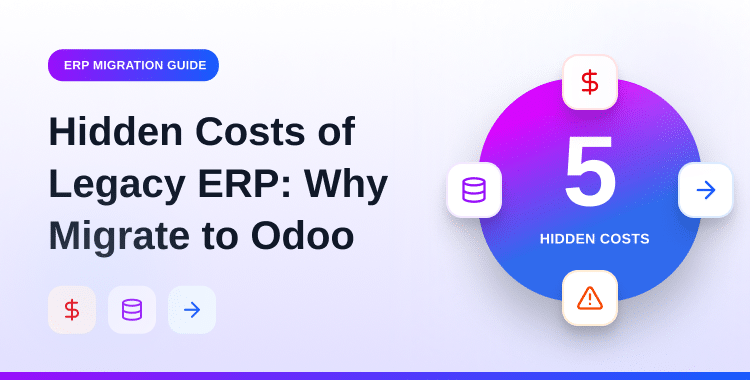
The 5 Hidden Costs of Legacy ERP Systems: Why Businesses Migrate to Odoo

Your legacy ERP system isn’t free, it’s just disguising its true cost in spreadsheets, maintenance invoices, and missed opportunities. Every month, hidden expenses chip away at your bottom line, consuming resources that could drive business growth. Companies often fail to recognize these invisible drains until they reach a critical threshold where the system becomes a liability rather than an asset.
The statistics are staggering. Your IT team likely spends 60-80% of their budget just keeping an aging system alive, while employees waste hours on manual workarounds that productivity tools should have eliminated decades ago.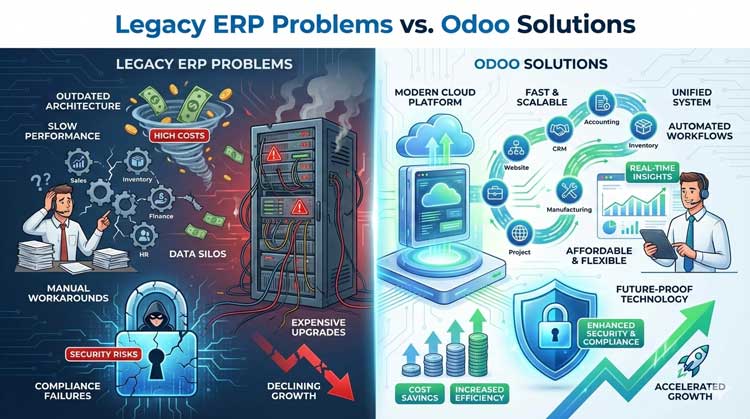
Security vulnerabilities silently accumulate, creating exposure to costly breaches and regulatory penalties that can devastate a mid-sized business. This comprehensive guide reveals the five hidden cost categories that legacy ERP systems impose on your business, quantifies their real financial impact, and explains why thousands of companies are migrating to Odoo, a modern ERP platform that reduces operational costs by 30-50% while unlocking genuine growth potential.
ShopLentor- WooCommerce Builder for Elementor & Gutenberg
A versatile page builder to build modern and excellent online stores with more than 100k+ Active Installations.
What are the Hidden Costs of Legacy ERP Systems?
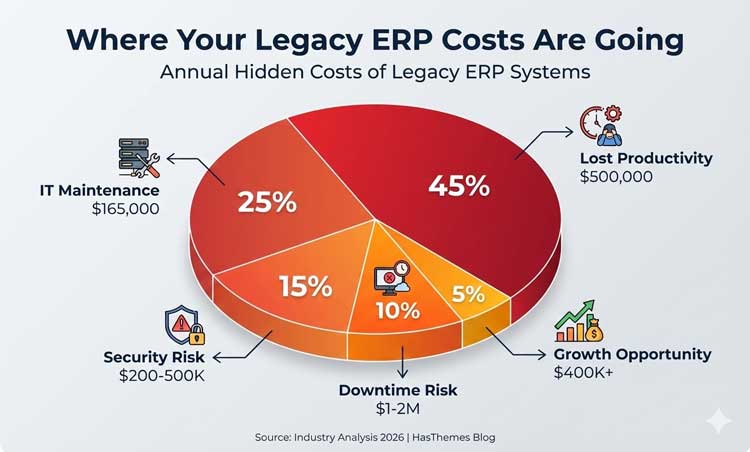
Legacy ERP systems—outdated platforms like SAP, Oracle, Infor, or custom-built solutions—carry massive financial burdens that accumulate silently over the years. These hidden costs rarely appear as discrete line items in your budget, making them nearly invisible until you perform a comprehensive analysis. Understanding these five cost categories is essential for any business evaluating whether to continue investing in legacy infrastructure.
Hidden Cost #1: Endless IT Maintenance and Support
Your IT department likely dedicates one to two full-time employees solely to maintaining your legacy ERP system, representing an annual personnel cost of $80,000-$150,000. Beyond salaries, you’re paying for specialized expertise that becomes increasingly expensive as fewer professionals understand outdated technology.
When your system needs patching, testing, or updates, these specialized staff must interrupt critical work to manage routine maintenance that modern systems handle automatically.
The infrastructure burden adds another layer of expense. On-premise legacy systems require expensive server hardware ($10,000-$50,000 annually), dedicated network infrastructure, climate-controlled data centers ($5,000-$20,000 yearly), backup systems, and round-the-clock energy consumption.
For a typical mid-market company, total annual IT maintenance costs average $165,000 or more, a figure that includes dedicated staff, infrastructure, external support contracts, and hardware upgrades.
A manufacturing firm we worked with previously spent over $200,000 annually maintaining legacy ERP infrastructure. After migrating to Odoo, their IT costs dropped to $40,000 per year, reducing IT overhead by 80% while improving system reliability and security standards.
Hidden Cost #2: Lost Productivity from Manual Workarounds
Your employees aren’t just frustrated with slow systems—they’re spending significant portions of their workday compensating for system limitations.
Legacy ERP interfaces operate at glacial speeds compared to modern platforms, with typical transactions requiring 5-10 second delays instead of 1-2 seconds.
Employees navigate outdated interfaces requiring multiple screens to complete tasks that should take single interactions, and they perform extensive manual data entry between disconnected systems.
Without real-time integration, information gets transferred manually between systems at every stage. Your sales team enters customer data into one system, accounting re-enters invoice data into the ERP, your warehouse manually updates inventory, and management consolidates reports from multiple sources.
Each manual entry increases error rates by 15-30%, creating rework cycles that compound productivity loss. When you calculate the true impact—100 employees spending 2 hours weekly on system workarounds—you reach 10,000 wasted hours annually, equivalent to five full-time employees working exclusively on system inefficiencies.
At a fully-loaded cost of $50 per hour, this productivity drain totals $500,000 annually for a company your size. Beyond the financial impact, outdated systems drive employee frustration, increasing turnover rates among tech-savvy staff and accelerating recruitment costs. Younger talent specifically resists working with obsolete technology, creating a talent retention crisis that compounds over time.
Hidden Cost #3: Cybersecurity Vulnerabilities and Compliance Exposure
Legacy ERP systems were designed for a pre-cloud, pre-mobile era when security threats looked entirely different. Your aging system lacks modern encryption standards, multi-factor authentication, real-time threat monitoring, and API-level security for integrations. These architectural limitations create a honeypot for sophisticated attackers who specifically target legacy systems because they know defenses are weak and exploitation is easier.
The financial exposure is sobering. Average enterprise data breaches cost $4.5 million according to IBM’s 2024 research, while mid-market companies face breach costs ranging from $1-3 million.
Beyond direct breach costs, regulatory penalties compound your exposure: GDPR violations can reach €20 million or 4% of global revenue, CCPA violations reach $7,500 per violation, and HIPAA violations in healthcare organizations can exceed $100,000 per incident.
Audit complexity alone requires specialized consultants costing $50,000-$500,000 annually to demonstrate compliance with modern standards.
Legacy systems account for over 70% of all enterprise security breaches, according to industry research. When vendors discontinue support for your system version, security patches stop arriving, zero-day vulnerabilities go unpatched, and your exposure multiplies exponentially.
The true cost of security vulnerability isn’t just a potential breach—it’s the ongoing compliance liability, audit expenses, and regulatory risk that accumulates every single month your legacy system remains in production.
Hidden Cost #4: System Failures and Expensive Downtime
Legacy systems experience three to five times more downtime than cloud-based modern platforms due to outdated hardware prone to failure, accumulated technical debt creating cascading system failures, rigid architecture without redundancy, and inadequate testing before updates.
When your system goes down, the impact is immediate and devastating. A mid-market company processing $100,000 per hour in transactions loses $1,667 per minute of downtime, not just in lost revenue processing but in internal productivity, SLA penalties owed to customers, and brand damage from service disruptions.
One retail company experienced a six-hour outage during Black Friday, losing $540,000 in direct sales, facing $150,000 in SLA penalties and customer refunds, paying $50,000 in emergency IT contractor costs, and suffering unmeasurable damage to customer relationships.
That single outage totaled $740,000 in documented costs. With legacy systems averaging 2-3 unplanned outages per year lasting 4-8 hours each, your annual downtime exposure reaches $1.3-2 million even when accounting for the reality that actual revenue loss is typically 20-30% of total exposure.
Modern cloud systems provide automatic failover, redundancy, and backup systems that virtually eliminate unplanned downtime. The financial comparison is stark: legacy systems create constant downtime risk while modern platforms transform this from an ongoing crisis to a managed, predictable operational expense.
Hidden Cost #5: Inability to Scale and Missed Growth Opportunities
Your legacy system reaches hard limits as your business grows. It experiences performance degradation under increased transaction volume, creates database bottlenecks that can’t be easily expanded, enforces user limit caps requiring expensive licenses for growth, and hits concurrent user limitations that prevent company expansion. These constraints aren’t minor inconveniences—they represent $2-5 million in unrealized opportunity over five years.
When you want to launch a new sales channel, cloud competitors move in 2-4 weeks while your team requires 3-6 months to adapt legacy systems, costing you $50,000-$500,000+ per month in missed revenue.
Market entry without system overhaul becomes impossible; international expansion requires custom development ($30,000-$100,000) and 6-12 month integration timelines.
Acquiring another company forces expensive data migration projects ($100,000-$500,000+) and 6-18 month integration windows where synergy value evaporates while systems integrate.
Consider a real scenario: Year one missed market opportunity costs $200,000, year two failed channel launch costs $400,000, year three lost competitive advantage costs $600,000, year four slower growth than market costs $1 million, and year five M&A opportunity lost due to system incompatibility costs $1.5 million.
Five-year cumulative opportunity cost reaches $3.7 million, far exceeding the cost of migrating to modern infrastructure. Your legacy system doesn’t just cost money; it costs you your growth trajectory.
Why Do Companies Keep Legacy ERP Systems Despite Rising Costs?
Sunk Cost Fallacy
Many companies believe they must extract remaining value from their initial investment, “throwing good money after bad” by continuing expensive maintenance. However, legacy maintenance costs typically exceed the original implementation cost within 3-5 years.
Continuing investment is economically irrational; modern ERP solutions over five years cost $500,000-$700,000 versus your $1.3 million legacy infrastructure investment, delivering $600,000-$800,000 in net savings.
Fear of Migration Risk
Companies worry that ERP migration will cause data loss, extensive downtime, and project failure. Modern implementations employ de-risked methodologies with phased approaches and parallel running periods, delivering 85%+ success rates.
Industry data shows phased implementations achieve 94% success rates, data migration accuracy reaches 99.9%+ with experienced partners, and companies using certified partners report 85% successful projects versus 50% for unsupported migrations.
“It Still Works?” Mentality
When orders are processed and reports are generated, systems feel functional despite running at a fraction of possible efficiency. Your company is experiencing the true costs outlined above $1.5-2.5 million annually in hidden expenses, while the system “works” poorly.
Modern platforms eliminate 80% of these costs while dramatically improving operational efficiency, visibility, and decision-making speed.
Implementation Timeline and Disruption Concerns
Modern ERP implementations using certified partners can be completed in 3-6 months using phased rollout approaches that maintain business continuity throughout the transition.
The fear of disruption, while understandable, doesn’t match reality, with professional implementation teams managing 90% of technical work while your IT team focuses on oversight. Your actual involvement burden remains minimal despite the comprehensive nature of migration.
Recommended Blogs for You:
👉 Subscription Analytics for WooCommerce: How to Boost Recurring Revenue (Real Examples)
👉 Odoo ERP Implementation Service Company in Bangladesh: Complete Guide to Choosing the Right Partner in 2026
👉 Project Management With Capacity Planning in Odoo ERP: Delivering On Time, On Budget, Every Time
👉 Odoo eCommerce ERP Integration: Automating Orders, Inventory, and Payments for Scalable
Why Businesses Are Migrating to Odoo
Odoo represents a fundamentally different approach to enterprise resource planning compared to rigid, expensive legacy systems. The open-source architecture provides unlimited customization flexibility without vendor lock-in and true data ownership.
Modular design lets you pay only for what you use, adding or removing modules as business needs evolve, unlike legacy licensing models charging for unused functionality.
Cost advantages are immediately apparent. Odoo pricing ranges from $24.90-$37.40 per user monthly (annual contracts) versus legacy ERP costs of $100-$500+ per user monthly. Implementation costs run $50,000-$150,000 versus $200,000-$1 million for enterprise systems.
The five-year total cost of ownership for Odoo ranges from $400,000 to $600,000, including modest licensing and support costs, while legacy systems cost $1.3 million+, yielding over $700,000 in comparative savings.
Performance improvements directly impact your bottom line. Companies implementing Odoo report 25% productivity increases within months, 60% operational cost reduction, 80% user satisfaction ratings, and real-time data visibility, replacing outdated batch reporting.
Manufacturing clients achieve 40% lead time reductions through improved planning visibility, while order processing speeds triple due to system responsiveness. Return on investment achieves 150% over three years on average, with break-even typically occurring within 6-18 months.
Modern security and compliance standards come built-in. Odoo provides enterprise-grade AES-256 encryption, automatic security updates with zero downtime, audit trails, and compliance automation for GDPR/HIPAA/SOC 2, role-based access control, and regular third-party security audits. You eliminate the compliance anxiety inherent to legacy systems while gaining professional security infrastructure.
Scalability evolves with your business. Add unlimited users without additional licensing, introduce new modules as needs change, support multi-company and multi-location operations seamlessly, integrate with 93% of third-party applications, and scale cloud infrastructure automatically as your business grows.
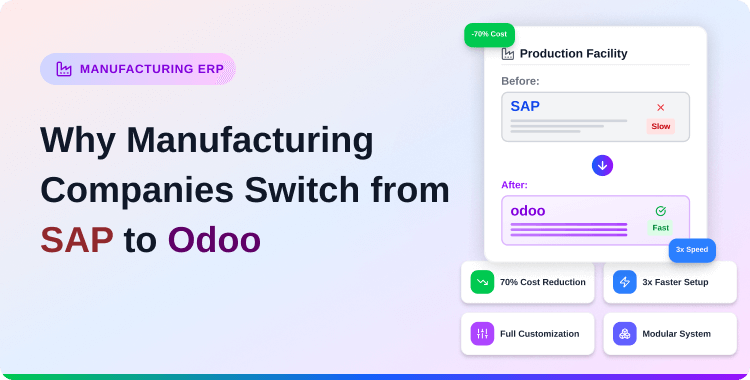
One manufacturing company migrated from SAP to Odoo, reducing IT maintenance costs 80% while improving inventory visibility to real-time, cutting lead times 40%, and tripling order processing speed—achieving full ROI within 11 months.
Making the Business Case for ERP Modernization
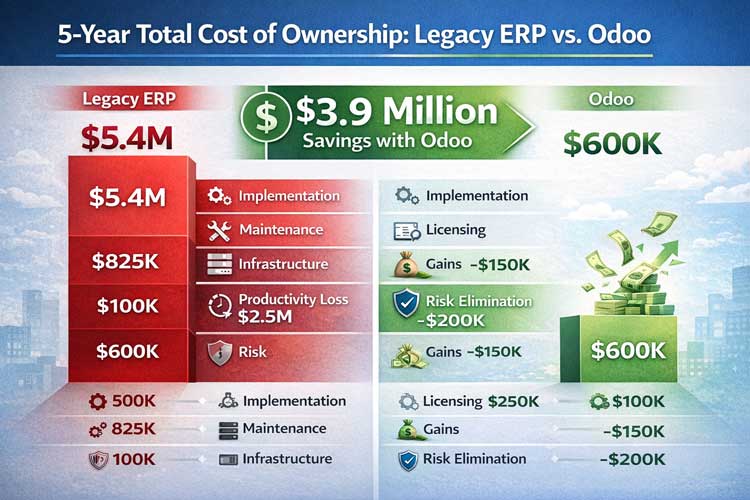
The financial comparison is compelling. For a typical mid-market company, legacy ERP systems cost $1.5-2.5 million annually in hidden expenses across IT maintenance ($165,000), lost productivity ($500,000), security/compliance risk ($500,000-$2 million exposed), downtime risk ($1-3 million exposed), and missed growth opportunities ($400,000+ annually). Over five years, this accumulates to $5.4 million in costs plus potential breach and downtime exposure reaching $5-15 million.
Odoo costs $40,000-$80,000 annually for licensing and support ($200,000-$400,000 over five years), includes $50,000-$150,000 implementation investment (one-time), eliminates infrastructure expenses through cloud hosting, and generates $150,000-$750,000 in annual cost savings through productivity improvements and operational efficiency.
Your net five-year benefit reaches negative $900,000, meaning Odoo costs $900,000 less than legacy systems while delivering far superior capabilities.
The strategic imperative is clear: every year you delay migration costs $1.5-2.5 million in ongoing hidden expenses while deepening competitive disadvantage, increasing breach risk exposure, and limiting growth trajectory. The question isn’t whether you can afford to migrate—it’s whether you can afford to wait.
HasTech IT Limited: Your Certified Odoo Implementation Partner
HasTech IT Limited is an official certified Odoo implementation partner based in Dhaka, Bangladesh, serving organizations across Asia-Pacific and beyond.
With over 10 years of expertise in enterprise software solutions and digital transformation, HasTech specializes in helping mid-market companies transition from legacy ERP systems to modern, scalable Odoo solutions.
Our deep understanding of both technical implementation and business process optimization ensures that every Odoo deployment drives measurable ROI and operational excellence.
As a certified Odoo partner, HasTech brings professional-grade expertise, industry best practices, and direct access to Odoo’s support network. This means your implementation benefits from proven methodologies, advanced technical capabilities, and continuous training on the latest Odoo versions. We’re not just implementing software, we’re transforming how your business operates.
Why Choose HasTech for Your Odoo Migration?
Certified Odoo Expertise and Proven Track Record
HasTech maintains active Odoo certifications across multiple modules, with our consultants regularly trained on the latest Odoo versions. We’ve successfully implemented Odoo for businesses across manufacturing, retail, distribution, professional services, and healthcare sectors. Our portfolio demonstrates consistent delivery of on-time, on-budget implementations with client satisfaction ratings exceeding 90%.
End-to-End Implementation Services
We manage every aspect of your Odoo migration, from initial requirements analysis through post-implementation optimization. Our services include comprehensive business process analysis to identify genuine requirements versus legacy workarounds, complete system configuration and customization to match your specific workflows, secure data migration from legacy systems with 99.9%+ accuracy validation, seamless integration with your existing tools and platforms, comprehensive user training ensuring rapid adoption, and ongoing support ensuring continuous system optimization.
Transparent Pricing and Partnership Approach:
We believe in transparent partnerships without surprise costs. Our fixed-price implementation packages clearly define scope, timeline, and deliverables. We offer flexible payment terms accommodating various business situations. We communicate honestly about complexity, timeline, and investment required, ensuring you make informed decisions. Most importantly, we view our relationship as a partnership focused on your long-term success, not a transaction-focused engagement.
Our Odoo Implementation Methodology
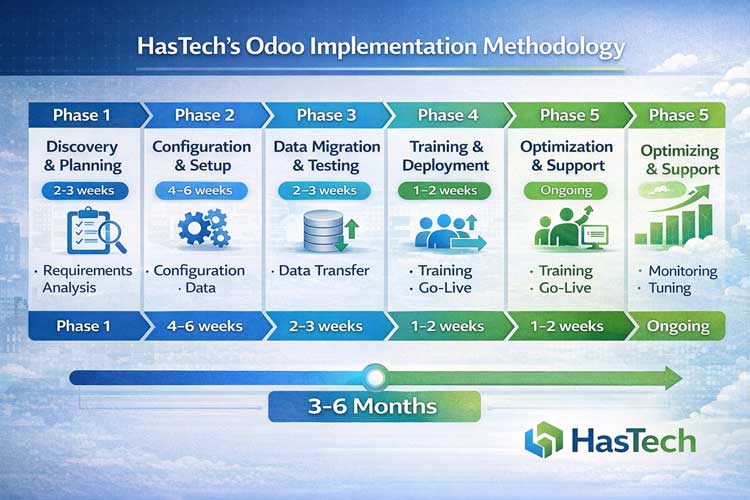
Phase 1: Discovery & Planning (2-3 weeks) – We begin by deeply understanding your business requirements, current system pain points, and strategic objectives. Our team conducts comprehensive business process analysis, identifies gaps between your current processes and Odoo’s capabilities, and develops a detailed project roadmap including timeline, resource requirements, and success metrics.
Phase 2: Configuration & Setup (4-6 weeks) – We configure Odoo to match your business processes, customize modules when genuine business requirements justify customization, prepare your data for migration by cleansing and mapping legacy data, and set up integrations with your existing systems and applications.
Phase 3: Data Migration & Testing (2-3 weeks) – Our team extracts and transforms legacy data into Odoo format, conducts thorough validation ensuring data accuracy and integrity, performs parallel system running to validate results against legacy system outputs, and completes comprehensive testing including security verification and compliance validation.
Phase 4: Training & Deployment (1-2 weeks) – We conduct department-specific training ensuring all users understand their roles in the new system, certify super-users who can support other users post-go-live, execute go-live with experienced supervision, and provide intensive support during the critical transition period.
Phase 5: Optimization & Support (Ongoing) – Post-go-live monitoring and performance tuning ensures system operates at peak efficiency, we gather user feedback and optimize workflows based on real-world usage, conduct quarterly business reviews to identify optimization opportunities, and provide escalation support for complex issues.
We’re Actively Seeking Odoo Migration Projects
HasTech is currently accepting Odoo implementation projects from organizations across these sectors:
- Manufacturing & Production: Companies needing production planning, shop floor control, material requirements planning, and supply chain optimization to improve efficiency and reduce lead times.
- Retail & Distribution: Retailers and wholesalers requiring inventory management, multi-location coordination, omnichannel capabilities, and warehouse automation to streamline operations.
- Professional Services: Service firms needing project management, resource allocation, time tracking, and profitability analysis to optimize team utilization and project delivery.
- Healthcare & Pharmaceuticals: Medical facilities and pharmaceutical companies requiring compliance-ready implementations addressing healthcare-specific regulations and workflows.
- Trading & Wholesale: Import/export and trading companies needing comprehensive supply chain visibility, regulatory compliance, and operational efficiency across global operations.
If your organization operates legacy ERP systems in any of these sectors, HasTech can help you understand your hidden costs and design a migration path that delivers measurable ROI.
Video Presentation: Odoo ERP vs Legacy Systems: The Hidden Cost of Falling Behind
Your Next Step: Free Odoo Readiness Assessment
If your company operates a legacy ERP system and experiences any of the hidden costs described in this guide, a free Odoo readiness assessment is your optimal first step. This assessment requires no obligation, no upfront cost, and no sales pressure—just honest analysis of your situation and recommendations for moving forward.
What’s included in your free assessment:
Your current system analysis documents specific pain points and limitations affecting your business. Quantified hidden cost calculation, estimating the specific annual expenses your legacy system imposes based on your company’s size and industry. Odoo suitability evaluation for your specific industry and business model.
Implementation timeline and investment estimate based on your system complexity and data volume. Projected ROI calculation showing break-even timeline and long-term savings potential. Customized recommendations for a phased migration approach, minimizing disruption while maximizing value capture.
The process is simple: Contact us to request an assessment, we schedule a brief consultation to understand your business, we analyze your current situation and create your customized assessment, and we present recommendations with no obligation to proceed.
Frequently Asked Questions
How long does an ERP migration typically take?
Most Odoo implementations complete within 3-6 months for mid-market companies, compared to 6-12 months for enterprise systems. Phased approaches allow departments to go live sequentially, maintaining business continuity throughout the transition period.
What are the biggest risks in ERP migration?
Data quality issues represent the primary challenge—ensuring legacy data transfers accurately without corrupting relationships or context. Inadequate change management, where employees resist new processes rather than embracing system improvements, presents the second major risk. Mitigating these requires thorough data cleansing before migration and comprehensive user training.
Can we migrate without completely disrupting business operations?
Yes, phased migrations and parallel running strategies maintain operational continuity. Departments can migrate sequentially rather than enterprise-wide simultaneously, allowing teams to stabilize on new systems before others transition. Many companies run legacy and modern systems in parallel during transition windows.
How much does Odoo implementation really cost?
Implementation typically runs $50,000-$150,000 depending on complexity, customizations, and data migration scope. Annual licensing ranges $40,000-$80,000 for mid-market companies, with cloud hosting included. Compare this to $200,000-$1 million implementation costs for enterprise systems plus $165,000+ annual maintenance.
What happens to our data in cloud systems?
Odoo provides encrypted data storage with enterprise-grade security, automatic backups with point-in-time recovery options, and compliance with GDPR, HIPAA, and SOC 2 standards. Your data belongs to you; Odoo hosts it securely but cannot access your business information. Cloud infrastructure provides disaster recovery capabilities superior to on-premise servers.
How does Odoo compare to maintaining our legacy system?
Keeping legacy systems costs $1.3 million over five years while Odoo costs $400,000-$600,000 for equivalent functionality—delivering $700,000+ in savings. Odoo provides real-time visibility replacing manual reporting delays, eliminates manual data entry between disconnected systems, and offers modern interfaces that improve user adoption.
Will our industry-specific requirements be met?
Odoo serves manufacturing, retail, distribution, healthcare, and professional services with industry-specific modules and configurations. If you require specialized functionality beyond standard capabilities, Odoo’s open-source architecture and partner ecosystem provide customization options. Certified implementation partners understand industry-specific requirements and configure systems accordingly.
Conclusion
The hidden costs of legacy ERP systems accumulate silently but devastate bottom-line profitability, operational efficiency, and growth trajectory. Most companies fail to recognize these costs until they reach crisis levels, system failures that interrupt operations, security breaches that expose data, or missed market opportunities that allow competitors to capture market share.
By quantifying your true expenses across IT maintenance, productivity loss, security exposure, downtime risk, and opportunity costs, you create the financial business case for modernization.
Odoo represents a transformation opportunity, delivering 30-50% operational cost reduction while unlocking capabilities legacy systems cannot provide. Implementation timelines of 3-6 months with professional partners ensure business continuity throughout migration. Break-even financial payback typically occurs within 6-18 months as cost savings accumulate and new capabilities drive revenue growth.
HasTech IT Limited is ready to help you transition from legacy ERP to modern Odoo solutions. As a certified Odoo implementation partner, we’ve successfully migrated dozens of companies across Asia-Pacific, achieving 90%+ customer satisfaction and average ROI of 150% over three years. We provide comprehensive services including requirements analysis, system configuration, data migration, user training, and ongoing support.
The time to act is now. Your hidden costs are accumulating daily, competitive advantages are eroding, and growth opportunities are passing by. Contact HasTech IT Limited today for your free Odoo readiness assessment—understand your specific hidden costs, receive customized implementation recommendations, and see exactly how much you could save by modernizing your ERP infrastructure.