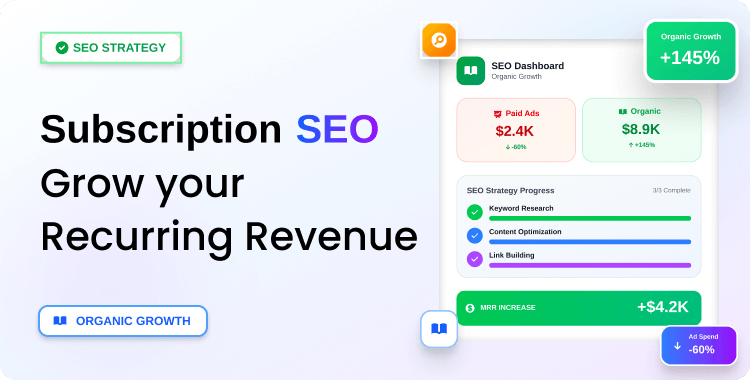
Subscription SEO: How to Grow Your Recurring Revenue With Less Paid Traffic

Every dollar you spend on paid ads disappears the moment you stop paying. But every dollar invested in SEO keeps generating returns for months, even years.
Organic traffic delivers an average ROI of 748%, compared to just 36% for paid channels. For subscription businesses focused on recurring revenue, this difference is transformational.
The subscription e-commerce market is projected to reach $9,051.84 billion by 2034, growing at 14.40% CAGR. Competition for paid keywords is intensifying, and customer acquisition costs keep rising.
The businesses that will thrive are those building sustainable organic traffic engines that deliver subscribers month after month, without the ad spend treadmill.
In this guide, you’ll learn how to leverage SEO specifically for subscription revenue growth, track organic performance with the right metrics, and use tools like Recurio to maximize the lifetime value of every organic subscriber.
Key Takeaways
- Organic traffic delivers 748% ROI compared to just 36% for paid ads—making SEO the most cost-effective channel for subscription businesses.
- SEO leads convert 8.5x better than outbound leads (14.6% vs 1.7%), meaning higher-quality subscribers who stick around longer.
- Compounding returns: Unlike paid ads that stop when you stop paying, SEO continues generating recurring revenue month after month.
- Lower CAC, higher LTV: Organic subscribers typically have lower acquisition costs and higher lifetime value than paid-acquired customers.
- The right tools matter: Recurio’s built-in analytics help you track MRR, churn, and LTV from organic traffic—so you can measure SEO’s true impact on recurring revenue.
Why SEO Is the Ultimate Recurring Revenue Channel
Subscription businesses have a unique advantage when it comes to SEO: the compounding effect of recurring revenue amplifies the value of every organic visitor.
The ROI Comparison: Paid vs. Organic
| Metric | Paid Ads | Organic SEO |
| Average ROI | 36% | 748% |
| Conversion Rate | 1.3% | 2.4% |
| Traffic Contribution | 21% | 62% |
| Lead Close Rate | 1.7% | 14.6% |
| Cost When You Stop | Traffic stops | Traffic continues |
Source: First Page Sage
Consider this scenario for a subscription business:
- Paid ad subscriber: Costs $50 to acquire, generates $30/month subscription = needs 2 months to break even on CAC
- Organic subscriber: Costs $8-15 to acquire (content investment), generates the same $30/month = profitable from month 1
Multiply that across hundreds or thousands of subscribers, and you see why SEO is the foundation of sustainable subscription growth.
How Compounding Works for Subscription SEO
A SaaS SEO case study showed one company grew monthly recurring revenue from $25,000 to $135,000—a 440% increase—purely through organic search. They achieved a 1,909% ROI on their SEO investment.
Content published in month one continues generating subscribers in month twelve. Unlike paid campaigns where returns are linear, SEO creates exponential value over time.
For more foundational strategies, check out this guide on eCommerce SEO best practices.
Understanding Customer Acquisition Cost for Subscriptions
Tracking Customer Acquisition Cost (CAC) properly is critical for subscription businesses. Most businesses only track paid CAC—missing the bigger picture.
The CAC Formula
The standard CAC formula is:
CAC = (Marketing Costs + Sales Costs) / Number of New Customers
For subscription businesses, track this separately for:
- Paid channels (Google Ads, Facebook, etc.)
- Organic channels (SEO, content marketing)
- Referral and word-of-mouth
CAC by Channel: A Realistic Breakdown
| Channel | Typical CAC | Time to Results | Duration of Results |
| Google Ads | $50-200 | Immediate | Stops when budget stops |
| Facebook Ads | $30-150 | Immediate | Stops when budget stops |
| SEO/Content | $15-50 | 3-6 months | Continues indefinitely |
| Email (existing list) | $5-15 | Immediate | Depends on list health |
While paid CAC appears similar to organic CAC in raw numbers, organic subscribers typically:
- Have a higher lifetime value (they found you through research, not impulse)
- Show lower churn rates (they’re more intentional about subscribing)
- Refer more customers (they trust your brand enough to recommend it)
A tool like Recurio gives you visibility into LTV, churn, and revenue by customer segment—so you can measure the true value of organic vs. paid subscribers.
Recommended Blogs for You:
👉 How to Optimize Your WooCommerce Product Pages for SEO and Conversions
👉 WooCommerce SEO: 6 Crucial Technical SEO Tips for eCommerce Stores
👉 Proven Link Building Strategies to Maximize Your SEO Potential
👉 Shopify Success Rate 2026: Why Most Stores Fail & How to Win
Building Your Subscription SEO Strategy
Here’s how to build an SEO strategy specifically designed to grow recurring revenue.
Step 1: Map Keywords to Subscription Intent
Not all keywords are equal for subscription businesses. Prioritize based on buyer intent:
High-Intent Subscription Keywords:
- “[product] subscription”.
- “monthly [product] delivery”.
- “subscribe and save [product]”.
- “[product] subscription box”.
Problem-Aware Keywords:
- “best way to get regular [product]”.
- “how to never run out of [product]”.
- “automatic [product] delivery”.
Comparison Keywords:
- “[competitor] vs [your brand] subscription”.
- “best [product] subscription services”.
- “[competitor] alternative subscription”.
Use these keywords in your product pages, category pages, and blog content to capture subscribers at every stage of the funnel.
Step 2: Optimize Subscription Product Pages
Your subscription product pages need to work harder than typical e-commerce pages. They must:
- Explain recurring value clearly (not just the product, but why subscribing is better).
- Address subscription-specific objections (cancellation policy, flexibility, billing transparency).
- Show the math (savings vs. one-time purchase).
- Build trust (reviews, testimonials, security badges).
For detailed product page strategies, see this guide on WooCommerce product presentation tips.
Step 3: Create Content That Attracts Subscribers
The best subscription businesses create content ecosystems that naturally guide readers toward subscribing.Content Type Purpose Example How-To Guides Build authority “How to Build a Coffee Routine” Comparison Posts Capture commercial intent “Best Coffee Subscriptions Compared” Problem-Solution Address pain points “Never Run Out of Coffee Again” Calculator Tools Show value “Subscription Savings Calculator” Lifestyle Content Build connection “Morning Routines of Successful People”
Each piece should include natural CTAs pointing to your subscription products.
Step 4: Build Strategic Internal Links
Internal linking is one of the most underutilized SEO tactics. Studies show that 82% of internal linking opportunities are missed by most websites.
Internal Linking Strategy for Subscriptions:
- Blog posts → Subscription category pages
- Category pages → Individual subscription products
- Product pages → Related subscription options
- FAQ pages → Subscription products as solutions
This creates a content flywheel where your educational content continuously feeds subscribers to your product pages.
How Recurio Powers SEO-Driven Subscription Growth
Your subscription plugin plays a crucial role in converting organic traffic into recurring revenue.
Recurio is built specifically to help WooCommerce stores maximize the value of every subscriber.
Track What Matters: Subscription Analytics
Recurio provides real-time analytics that help you understand how organic traffic converts to recurring revenue:
- Monthly Recurring Revenue (MRR): Track organic vs. paid MRR growth
- Annual Recurring Revenue (ARR): Project long-term revenue impact
- Customer Lifetime Value (LTV): Compare LTV by acquisition channel
- Churn Rate: Monitor if organic subscribers retain better
- Average Revenue Per User (ARPU): Measure subscriber value
With these metrics, you can prove SEO’s impact on recurring revenue—not just traffic.
Convert More Organic Visitors
Organic visitors often need more convincing than paid traffic—they’re researchers, not impulse buyers. Recurio helps you convert them with:
Subscribe & Save Options: Offer a one-time purchase alongside a subscription, allowing cautious visitors to try before committing.
Recurio’s Subscribe & Save feature shows visitors exactly how much they save by subscribing.
Flexible Billing Periods:
- Daily, weekly, monthly, quarterly, yearly
- Custom intervals (every 2 months, every 6 weeks, etc.)
- Trial periods to reduce commitment friction
Trial Periods: Organic visitors often want to “test” before subscribing. Recurio makes it easy to offer free or paid trials that convert researchers into loyal subscribers.
Reduce Churn and Recover Revenue
The real value of SEO isn’t just acquisition—it’s retention. Recurio helps you keep subscribers longer:
Customer Self-Service Portal:
Let subscribers manage their own subscriptions, pause, resume, update payment methods—without contacting support. This reduces friction and prevents cancellations from frustration.
Smart Dunning (Pro): Recover failed payments automatically with intelligent retry logic. Recurio Pro recovers 40-70% of failed payments that would otherwise be lost.
Churn Prediction (Pro): AI-powered analytics identify at-risk subscribers before they cancel, giving you a chance to intervene with retention offers.
Learn more about essential WooCommerce plugins that complement your subscription setup.
Measuring SEO’s Impact on Recurring Revenue
Here’s how to connect your SEO efforts to actual subscription revenue growth.
Set Up Proper Tracking
Google Analytics 4 Configuration:
- Create segments for organic traffic
- Track subscription product purchases as conversions
- Set up enhanced e-commerce for subscription products
- Create custom reports: Organic Traffic → Subscription Revenue
Recurio Dashboard Metrics:
- Monitor MRR growth trends
- Track new subscribers per month
- Compare churn rates over time
- Analyze LTV by cohort (signup month)
Key Metrics to Track Monthly
| Metric | What It Tells You | Target |
| Organic Traffic to Subscription Pages | SEO visibility | +10% MoM |
| Organic Conversion Rate | Content effectiveness | 2-4% |
| New Subscribers from Organic | Acquisition success | Track trend |
| Organic Subscriber LTV | Quality of traffic | Higher than paid |
| Churn Rate (Organic Cohort) | Retention quality | Lower than paid |
Calculate SEO ROI for Subscriptions
Use this formula:
SEO ROI = (Revenue from Organic Subscribers – SEO Investment) / SEO Investment × 100
For subscriptions, calculate “Revenue from Organic Subscribers” as:
- New organic subscribers × Average subscription price × Average subscription length
- PLUS renewal revenue from previously acquired organic subscribers
This captures the compounding value of SEO for recurring revenue businesses.
For deeper analytics capabilities, explore this comparison of subscription analytics tools for WooCommerce.
Recurio Free vs. Pro: Choosing the Right Plan
Depending on your subscription business stage, different Recurio features will matter most.
Recurio Free: Perfect for Starting Out
The free version includes everything you need to launch subscriptions and track basic metrics:Feature Benefit Monthly/Yearly Billing Cover core subscription models Analytics Dashboard Track MRR, ARR, LTV, churn Customer Portal Reduce support load, improve retention 8 Automated Emails Keep subscribers engaged REST API Connect to analytics tools
Best for: New subscription businesses testing organic acquisition
Recurio Pro: Scale Your Growth
When you’re ready to maximize organic subscriber value, Pro features unlock advanced capabilities:Feature Benefit All Billing Periods Daily, weekly, quarterly options Subscribe & Save Convert researchers with discount incentive Smart Dunning Recover 40-70% of failed payments Churn Prediction Retain at-risk subscribers Revenue Forecasting Project growth accurately Variable Subscriptions Multiple options on single page Webhooks Automate marketing workflows
Best for: Growing subscription businesses investing seriously in organic growth
Pricing That Makes Sense
Recurio Pro starts at $99/year for a single site—a fraction of what you’d spend on one month of paid ads. Consider:
- Smart dunning recovers $40-70 for every $100 in failed payments
- Churn reduction of just 10% on $50K MRR saves $60K ARR
- Advanced email campaigns can increase LTV by 30%
The ROI math is clear: Pro pays for itself many times over.
Advanced Strategies: SEO + Recurio Integration
Here’s how sophisticated subscription businesses combine SEO and Recurio for maximum growth.
Strategy 1: Content-Led Subscription Funnels
Setup:
- Create pillar content around your subscription niche (comprehensive guides)
- Build supporting content targeting specific questions
- Use Recurio’s Subscribe & Save on all product pages
- Track which content drives the highest-LTV subscribers
Example Funnel:
- Top of Funnel: “Complete Guide to Specialty Coffee” (informational queries)
- Middle of Funnel: “Best Coffee Subscriptions for Home Baristas” (comparison intent)
- Bottom of Funnel: Product page with Subscribe & Save enabled, trial offer
Strategy 2: Retention-Focused Content
Most subscription SEO focuses on acquisition. Smart businesses also create content for existing subscribers:
- “How to Get the Most from Your [Product] Subscription”
- “New Features in Your [Brand] Subscription”
- “Subscriber-Only Tips and Tricks”
This content:
- Ranks for branded queries (protecting your brand)
- Provides value that reduces churn
- Gets shared by happy subscribers (natural backlinks)
Use Recurio’s automated email campaigns to share this content with subscribers.
Strategy 3: Win-Back Content
Target people who’ve cancelled or are researching alternatives:
Keywords to target:
- “[your brand] cancel subscription”
- “[your brand] alternative”
- “why I cancelled [your brand]”
Create honest, helpful content addressing these queries. Include:
- Acknowledgment of common issues
- What you’ve improved
- A compelling win-back offer
Recurio Pro’s win-back email campaigns (offering 10%, 20%, or 30% discounts) complement this strategy.
For more marketing strategies, explore this guide on eCommerce marketing strategy.
Implementation Checklist
Use this checklist to start growing recurring revenue with less paid traffic:
Foundation Setup
- Install Recurio(Free or Pro)
- Configure subscription products
- Set up analytics dashboard tracking
- Enable customer self-service portal
- Configure automated emails
SEO Optimization
- Research subscription-focused keywords
- Optimize subscription product pages (titles, descriptions, schema)
- Create supporting blog content
- Build internal links to subscription pages
- Submit subscription pages to the sitemap
Conversion Optimization
- Enable Subscribe & Save options
- Set up trial periods
- Add clear cancellation/pause policies
- Display savings prominently
- A/B test subscription page elements
Retention & Revenue Recovery
- Configure smart dunning sequences (Pro)
- Set up renewal reminder emails
- Create subscriber-only content
- Monitor churn prediction alerts (Pro)
- Implement win-back campaigns
Tracking & Analysis
- Set up GA4 segments for organic traffic
- Track organic subscriber LTV in Recurio
- Monitor MRR growth from organic channels
- Calculate and report SEO ROI monthly
- Compare organic vs. paid subscriber metrics
Frequently Asked Questions
How long does it take for SEO to impact subscription revenue?
Expect 3-6 months before seeing meaningful organic subscription growth. SEO is a long-term investment, but unlike paid ads, the results compound over time. A case study showed 400% ROI in month one, growing to 2,600% ROI by month twelve. For subscription businesses, this compounding effect is even more powerful because organic subscribers continue generating recurring revenue.
Is organic traffic really better than paid-for subscriptions?
For long-term recurring revenue, yes. Organic leads convert at 14.6% compared to 1.7% for outbound/paid leads—8.5x better conversion. Organic subscribers also tend to have higher LTV and lower churn because they found you through research, not an impulse-driven ad click.
How does Recurio help with SEO?
Recurio supports SEO in several ways: clean URL structures for subscription products, variable product subscriptions on single pages (better for SEO than multiple thin pages), analytics to track organic subscriber value, and features like Subscribe & Save that help convert research-driven organic visitors. The self-service portal also improves user experience, which indirectly supports SEO performance.
What’s the most important metric for SEO + subscriptions?
Organic Subscriber Lifetime Value (LTV). This single metric captures both acquisition (did SEO bring subscribers?) and retention (do organic subscribers stick around?). Track this in Recurio’s analytics dashboard and compare it to paid subscriber LTV. If organic LTV is higher, your SEO investment is paying off.
Should I use Recurio Free or Pro?
Start with Free to test your subscription model and basic organic acquisition. Upgrade to Pro when you’re ready to maximize subscriber value through Subscribe & Save (higher conversions), smart dunning (revenue recovery), variable subscriptions (consolidate multiple pages into one), and churn prediction (retention optimization).
Conclusion
The path to sustainable subscription growth doesn’t run through ever-increasing ad budgets. It runs through organic search, a channel that compounds over time, delivers higher-quality subscribers, and continues working even when you’re not actively spending.
Here’s what the data tells us:
- Organic traffic delivers 748% ROI versus 36% for paid ads
- Organic leads convert at 14.6% compared to 1.7% for paid
- One SaaS company achieved 1,909% ROI and 440% MRR growth through SEO alone
For subscription businesses, these advantages multiply. Every organic subscriber you acquire today continues generating revenue next month, next quarter, next year. That’s the compounding power of SEO for recurring revenue.
Your next steps:
- Start tracking the right metrics: Use Recurio’s analytics to measure MRR, LTV, and churn by acquisition channel
- Map your keywords: Identify subscription-intent keywords in your niche
- Optimize your product pages: Make them comprehensive enough that visitors don’t need to search again
- Create supporting content: Build pillar content that drives organic traffic to your subscription products
- Maximize retention: Use smart dunning, self-service portals, and churn prediction to keep subscribers longer
The subscription businesses thriving today aren’t the ones with the biggest ad budgets. They’re the ones building organic traffic engines that deliver qualified subscribers month after month.