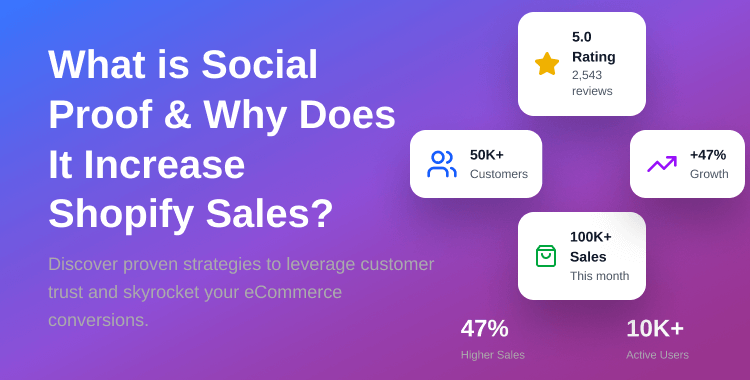
What is Social Proof & Why Does It Increase Shopify Sales?

You’re about to hit that “Buy Now” button on an e-commerce site when you pause. Your cursor hovers above the checkout button. Doubt creeps in. Is this product actually good? Will it work for me? Then you scroll down and see 500+ five-star reviews from real customers just like you. Suddenly, your hesitation disappears.
That moment when other people’s choices influence your decision is social proof in action.
Every day, Shopify store owners face the same challenge: converting visitors into customers. The barrier isn’t usually the product or the price. It’s purchase anxiety. Customers are unsure. They’re skeptical. They want proof that your product is worth their money and trust.
This is where social proof becomes your competitive advantage.
Research shows that real-time social proof notifications boost conversions by 98% compared to static pages. Adding just three customer testimonials to your product page can increase conversion rates by 34%. When customers see that others have made the purchase and loved it, their buying confidence soars.
In this guide, you’ll discover what social proof really is, why it’s so powerful, and exactly how to implement seven different types on your Shopify store. By the end, you’ll understand the psychology behind human decision-making and have a clear action plan to start building trust with your visitors today.
Key Takeaways
- Social proof increases conversions by up to 98%.
- Psychology explains why strangers’ opinions matter.
- Seven proven types to implement immediately.
- Real-time notifications drive urgency and sales.
- Customer reviews solve purchase hesitation forever.
- Shopify stores must strategically place social proof.
What is Social Proof? Understanding the Core Concept
At its core, social proof is the psychological phenomenon where people conform to the actions of others they perceive as similar to themselves or as industry experts. In simpler terms, we trust what other people have already tried and approved.
Think about it. You’re more likely to eat at a restaurant that’s packed with customers than an empty one. You’ll choose a hotel with 4.8 stars over one with 2.5 stars. You’ll buy the product that has thousands of positive reviews. These decisions aren’t entirely rational; they’re driven by the implicit belief that “if others liked it, I probably will too.”
This concept isn’t new. In 1895, French psychologist Gustave Le Bon introduced the idea of crowd psychology, explaining how individuals in groups tend to adopt the behaviors and opinions of the majority. Over a century later, his observations remain remarkably accurate.
In the context of eCommerce, social proof serves as a trust-building mechanism. It’s psychological comfort. When a customer sees that hundreds of others have purchased from you and left positive reviews, they feel safer making their own purchase. The risk feels lower. The confidence feels higher.
The core principle behind social proof is simple yet powerful: humans are inherently social creatures who seek validation through the actions and opinions of others. This isn’t a weakness; it’s how our brains evolved to work. In a complex world with endless choices, we use shortcuts to make decisions faster. Social proof is one of the most effective shortcuts your brain can use.
Why does social proof work in e-commerce specifically? Because online shopping removes the traditional trust signals that in-store shopping provides. You can’t touch the product. You can’t talk to the sales associate. You can’t see your friend using it right now. Social proof bridges that gap by providing the reassurance that comes from other real people’s experiences.
The Complete Guide to Social Proof Types & Implementation
Not all social proof is created equal. Different types work better in different contexts, for different products, and at different stages of the customer journey. Understanding these seven types and how to use them strategically is the difference between a Shopify store that converts well and one that leaves money on the table.
Customer Reviews & Testimonials: The Most Powerful Form of Social Proof
Customer reviews and testimonials are the gold standard of social proof.
When someone considers buying from your store, they’re essentially asking: “Has anyone else bought this and been happy?” A genuine five-star review from a verified customer answers that question directly and persuasively.
The numbers back this up. Products with positive ratings are 68% more likely to be chosen by consumers compared to those without ratings. Even more compelling: 92% of consumers trust recommendations from peers more than any other form of marketing.
What makes reviews so powerful? Authenticity. Unlike ads you run or marketing copy you write, reviews come from real people with nothing to gain by lying. When a customer reads that another customer loved your product, they’re getting the unfiltered truth.
Types of review social proof:
- Written reviews with star ratings
- Photo/video reviews (exponentially more powerful)
- Detailed customer stories and use-case testimonials
- Q&A sections where customers answer questions
- Video testimonials from real users
For Shopify stores, implementing customer reviews is straightforward. Apps integrate directly into your product pages, pulling reviews from verified purchases. The key is making reviews prominent, not hidden at the bottom of the page. Display them near the product description and especially near the “Add to Cart” button.
Research shows that adding just three customer testimonials increases conversion rates by 34%. Three! You don’t need hundreds of reviews to see a dramatic impact. Quality and strategic placement matter more than quantity.
Real-Time Purchase Notifications & Sales Popups: Creating Urgency
This is where things get interesting. While static testimonials build trust over time, real-time purchase notifications create immediate urgency and social proof simultaneously.
Imagine a pop-up appearing in the corner of your store: “Sarah from New York just purchased the blue jacket!” or “Michael just bought 3 units of your bestselling supplement!” These aren’t made up. They’re happening in real-time. And they’re incredibly powerful.
Why? Because they trigger two psychological principles at once:
1. Social proof – Other people are buying right now, so it must be good.
2. FOMO (Fear of Missing Out) – There’s a sense of immediacy and scarcity. The action is happening now.
Research shows that real-time sales notifications boost conversions by 98%. That’s not a marginal improvement, that’s nearly doubling your conversion rate.
The mechanism is simple: when a customer sees a real-time notification that someone just purchased, it activates their competitive instinct. It makes the product feel more desirable. It removes the hesitation that comes from uncertainty.
Real-time notifications work especially well for:
- High-traffic stores where many purchases happen simultaneously (the notifications feel authentic)
- Impulse products where seeing others buy triggers buying motivation
- Limited stock items (combine with the real purchase data for maximum impact)
- New product launches where you need to build momentum
User-Generated Content & Community Proof: Building Authentic Trust
User-generated content (UGC) is any content created by your customers: photos, videos, reviews, social media posts, or stories. When customers showcase your product on their Instagram, TikTok, or in review photos, that’s incredibly valuable social proof.
Why? Because customers trust other customers far more than they trust brands. When someone sees a photo of a real person using your product in their real life, not in a professional photoshoot, it feels authentic. It feels trustworthy.
The impact is measurable. UGC increases engagement rates by up to 4-5 times compared to branded content. Conversion rates improve because customers see themselves in the user-generated content—they see someone like them enjoying the product.
Smart Shopify stores actively encourage UGC by:
- Creating branded hashtags and asking customers to tag the store
- Running UGC contests or giveaways
- Displaying customer photos on product pages with permission
- Resharing customer content on social media and in email campaigns
- Creating dedicated UGC galleries on the website
The beauty of UGC is that it’s free, abundant, and authentic. Your customers are your best marketers if you give them the platform to share.
Expert Endorsements & Authority Signals: Leveraging Industry Credibility
Not all products appeal to a broad audience. Some require specialized knowledge. This is where expert endorsements become crucial.
Imagine you sell fitness equipment. A recommendation from a certified personal trainer carries more weight than a review from a random customer. A beauty brand endorsed by professional makeup artists resonates more strongly. Tech products recommended by industry journalists feel more credible.
Expert social proof works because we trust authority. We assume that experts have vetted the product and determined it’s worth recommending. This is especially powerful in B2B e-commerce, where purchasing decisions involve higher stakes.
Ways to implement expert endorsement:
- Get quotes from industry experts for your website
- Display certifications or awards your product has won
- Feature expert reviews or media mentions
- Create case studies showing how professionals use your product
- Partner with influencers in your niche (even micro-influencers)
For Shopify stores, this might mean reaching out to five micro-influencers in your niche and offering free products in exchange for honest reviews. It might mean displaying a badge that says “Trusted by 500+ Fitness Professionals.” Small investments in expert credibility yield outsized conversion improvements.
Popularity Metrics & Customer Count: The “Wisdom of Crowds” Effect
Humans are pattern-matching creatures. We look for signals that tell us whether something is popular, successful, and worth our attention. Displaying popularity metrics taps into this instinct.
“Over 50,000 customers served,” “Best seller in this category,” or “500+ units sold this month” tells the customer: “Everyone else thinks this is good, so it probably is.”
This works because of a principle called the “wisdom of crowds.” When many people independently choose something, their collective choice contains valuable information. You don’t need each person’s individual reasoning; the crowd’s behavior is itself proof.
On Shopify, displaying popularity is simple:
- Add “bestseller” badges to your top products.
- Display total units sold in a time period.
- Show “Items left in stock” to create mild scarcity.
- Display the total customer count or review count.
- Use “trending” labels for fast-growing products.
The paradox of choice tells us that when customers face too many options, they often don’t buy anything. Popularity metrics solve this by highlighting which options others have chosen. It narrows the field for the customer and makes their decision easier.
Celebrity & Influencer Endorsements: Borrowed Authority
When a celebrity uses your product, it becomes cool. That’s the simple mechanism behind celebrity endorsements. You’re borrowing the celebrity’s credibility and status.
The challenge? Celebrity endorsements are expensive and often go to large brands only. But micro-influencer endorsements are different. Micro-influencers (typically 10K-100K followers) often have more engaged audiences and more affordable rates.
For Shopify stores, celebrity endorsements might be out of reach, but working with relevant micro-influencers is absolutely achievable. A fitness product might partner with a personal trainer with 30K Instagram followers. A skincare brand might work with a dermatologist with 50K TikTok followers.
The key is relevance. An endorsement from someone your target customer respects is far more valuable than an endorsement from someone famous but unrelated to your niche.
Trust Seals & Security Badges: Reducing Perceived Risk
Here’s a psychological fact: people are more willing to enter their payment information when they see security assurances.
Trust seals like “SSL Certified,” “Norton Secured,” “PayPal Verified,” and “Money-Back Guarantee” badges reduce the perceived risk of purchasing. They tell customers, “It’s safe to enter your credit card here.”
Research shows that displaying trust badges near checkout fields increases conversions by 5-15%, depending on the badge’s credibility. The most effective badges are those that customers already recognize and trust.
On Shopify, these are often built in or easily added through apps. Displaying your SSL certificate, PayPal acceptance, money-back guarantees, and other security credentials, especially near checkout, is essential social proof.
Wisdom of Friends & Referral Proof: The Strongest Influence
Here’s what might surprise you: the strongest form of social proof isn’t reviews or celebrity endorsements, it’s a recommendation from a friend.
This is called the “wisdom of friends” or trusted-circle effect. When someone you know personally recommends something, it carries more weight than any other form of social proof. Why? Because they have no incentive to recommend something that won’t work for you. Their reputation with you is on the line.
This is why referral programs are so effective. When you incentivize customers to refer their friends, you’re leveraging the most powerful form of social proof. A customer who buys because a friend recommended it is more likely to buy, more likely to be satisfied, and more likely to refer others.
Shopify stores can implement this through:
- Referral programs with cash incentives or discounts
- “Share with a friend” buttons on product pages
- Email forwarding options that let customers recommend to friends
- Word-of-mouth marketing incentives
How SalesPulse Helps You Implement Real-Time Social Proof on Shopify
Now that you understand the power of social proof and the seven proven types, you might be wondering: “How do I actually implement this on my Shopify store without hiring a developer or spending thousands on custom solutions?”
This is where real-time purchase notifications become your game-changer. And SalesPulse makes it effortless.
What SalesPulse Does
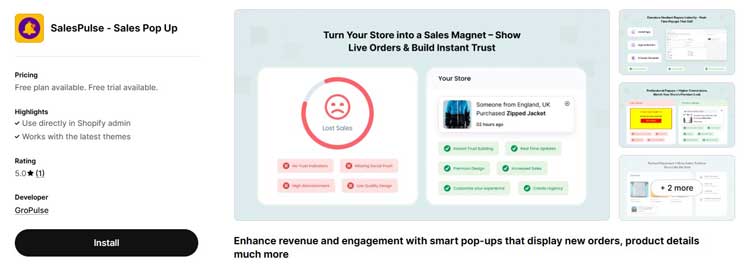
SalesPulse is a Shopify app that automatically displays real-time purchase notifications and recent customer activity on your store. Every time someone buys from your store, SalesPulse instantly shows a beautiful popup notification displaying:
- Product purchased (with product image)
- Customer location (City, State/Country)
- Time of purchase (e.g., “purchased 2 minutes ago”)
- Quantity purchased (when relevant)
These notifications appear automatically on your store pages, creating a continuous stream of social proof that tells every visitor: “Real people are buying from this store right now.”
Why Real-Time Notifications Are the Fastest Way to Boost Conversions
Remember earlier when we mentioned that real-time social proof notifications boost conversions by 98%? That’s not theoretical—that’s what happens when you display live purchase activity.
Here’s why real-time notifications work better than static testimonials alone:
1. Immediate credibility. When a visitor sees “Sarah from New York just purchased the bestselling jacket,” they’re seeing proof happening in real-time. It’s harder to question the authenticity of something happening right now.
2. FOMO activation. Real-time notifications trigger urgency. If others are buying now, there might be limited stock, or the product might be out of style soon. This psychological trigger drives faster purchase decisions.
3. Reduced purchase anxiety. A visitor hesitating between your store and a competitor will feel more confident buying from you when they see multiple recent purchases. “If 10 people bought in the last hour, it must be good.”
4. Continuous social proof. Unlike a testimonial that stays static, real-time notifications are constantly updating, creating a sense of activity and momentum around your store.
SalesPulse Features That Make Implementation Easy
You don’t need technical expertise to implement social proof with SalesPulse. The app handles everything:
Customization to match your brand:
- Choose your notification style (modern popup, slide-in, banner)
- Customize colors to match your store theme
- Adjust transparency and positioning
- Set notification duration (how long popups stay visible)
Control over what displays:
- Choose which pages show notifications (homepage, product pages, entire store)
- Decide how many recent orders to display
- Filter by product category if desired
- Show or hide customer locations
- Adjust notification frequency
Flexible options:
- Free plan available (perfect for getting started)
- Paid plans for advanced features
- Multi-language support (15+ languages)
- Mobile-optimized notifications
- Works with all Shopify themes
Zero technical setup required:
- Install from the Shopify App Store
- Configure in a few clicks
- Start displaying notifications immediately
- No coding, no theme modifications, no developer needed
Real-World Example: How SalesPulse Drives Results
Imagine you run a Shopify store selling sustainable fashion. Without social proof, a first-time visitor might think: “Is this company legit? Does anyone actually buy here?”
With SalesPulse enabled, that same visitor sees:
“Emma from Los Angeles purchased the organic cotton tee 3 minutes ago”
“Marcus from Chicago purchased 2 items from the sustainability bundle 8 minutes ago”
“Jennifer from Austin purchased the recycled jacket 12 minutes ago”
Suddenly, your store doesn’t feel empty or unknown. It feels active. It feels trusted. It feels like a place where real people are making real purchases.
Studies show this type of real-time social proof can increase conversions by 98%, which is nearly doubling your sales from the same traffic.
How to Get Started with SalesPulse
- Go to the Shopify App Store and search for “SalesPulse Sales Pop-up
- Click “Add app” (it’s free to start)
- Grant permission for the app to display notifications
- Configure your settings (choose notification style, colors, pages, frequency)
- Start selling – real-time notifications begin displaying immediately
The free plan includes:
- Unlimited sales notifications
- Full customization
- 1 announcement bar (if you want to test other content)
- Basic support
Paid plans unlock additional features if you want advanced customization or higher volume displays.
Combining SalesPulse with Other Social Proof Types
Remember our discussion about combining multiple types of social proof for compound results? SalesPulse is the perfect centerpiece of a complete social proof strategy:
Real-time notifications (SalesPulse) + Customer reviews + Trust badges = Maximum conversions
Here’s how to layer them:
- Product pages: Display SalesPulse notifications + customer reviews + trust badges
- Homepage: Show SalesPulse notifications to create initial momentum
- Checkout page: Display trust badges + SalesPulse to reinforce confidence during the most critical moment
This multi-layered approach addresses different psychological needs at different stages of the customer journey.
Why Choose SalesPulse Over Alternatives?
There are other social proof apps available, but SalesPulse stands out because:
- Free plan with real features (not just a trial)
- No credit card required to start
- Automatic setup (notifications start displaying immediately)
- Mobile-optimized (notifications look great on all devices)
- Flexible customization (adapt to your brand)
- Multi-language support (reach global customers)
- Works with all themes (no compatibility issues)
- Proven results (used by thousands of Shopify stores)
Common Mistakes & Advanced Implementation Strategies
Social proof is powerful, but it’s easy to get wrong. Here are the most common mistakes Shopify store owners make and how to avoid them.
Mistakes to avoid:
- Relying on just one type of social proof. Using only reviews? You’re leaving conversions on the table. Combining 2-3 types of social proof creates compound results.
- Placing social proof in invisible locations. Testimonials hidden at the bottom of the page don’t help. Place social proof near decision points—next to the “Add to Cart” button, in product descriptions, during checkout.
- Using low-quality or unverified testimonials. Fake reviews erode trust. Authentic, verified reviews work infinitely better.
- Never updating testimonials. Old testimonials from 2021 feel stale. Refresh them regularly.
- Ignoring mobile presentation. 60%+ of e-commerce traffic comes from mobile. Social proof must be readable and compelling on mobile devices.
- Forgetting about timing. Display social proof at the moment of decision, not after the customer has already committed.
Advanced strategies that actually work:
1. Multi-format social proof combinations. Pair real-time purchase notifications with customer reviews. Combine user-generated content with expert endorsements. The combination is more powerful than the sum of its parts.
2. Strategic placement near decision points. A/B test social proof placement. Place reviews right next to the product description. Place purchase notifications visible while customers are browsing. Place trust badges in checkout. Placement matters as much as the proof itself.
3. Personalization based on customer segment. Show different social proof to first-time visitors vs. repeat customers. Display location-based reviews (“Other customers in New York loved this”).
4. Video testimonials. Video testimonials convert 80% better than written reviews. Yes, they’re harder to produce, but the ROI is massive.
5. Combining scarcity + social proof. “Only 2 units left + 50 people bought this month” is more powerful than either alone. The combination triggers both urgency and social proof.
6. A/B testing different proof types. What works for a fashion brand might not work for a software tool. Test different types and measure conversion lift for each.
7. Real-time integration across all touchpoints. Use real-time notifications on your homepage, product pages, and checkout. Make the social proof visible everywhere the customer journey extends.
The most successful Shopify stores don’t just add one social proof element and call it a day. They strategically layer multiple types, optimize placement, and continuously test to find what resonates with their specific audience.
Video Presentation of SalesPulse Apps
Frequently Asked Questions
Q: Does social proof actually increase Shopify sales?
A: Absolutely. Research shows that real-time social proof notifications boost conversions by 98%, while customer reviews increase purchase likelihood by 68%. Shopify stores implementing multiple social proof strategies see average conversion rate improvements of 20-50%, depending on implementation quality. The effect compounds when you combine multiple types strategically.
Q: What type of social proof works best for e-commerce?
A: Customer reviews with photos or videos are most effective for e-commerce, showing 20-50% conversion lift. Real-time purchase notifications rank second, boosting conversions by 98%. The most successful Shopify stores combine 2-3 types of social proof strategically placed near decision points where customers are actively evaluating products.
Q: How do I add social proof to my Shopify store?
A: You can implement social proof through Shopify apps that display customer reviews, real-time notifications, testimonials, or trust badges. Review apps pull and display customer feedback automatically. Sales pop-up apps like SalesPulse show real-time purchases and recent customer activity in beautiful, customizable pop-ups that match your branding. These install directly from the Shopify App Store and require no coding. You get a free plan to start, then upgrade as you scale.
Q: What percentage of customers actually read reviews before buying?
A: 71% of consumers check online reviews before making a purchase decision. Additionally, 92% of consumers trust recommendations from peers more than advertising. When reviews are visible, customers are 18.67% more likely to complete a purchase. The presence of reviews alone, even without reading them, creates psychological comfort.
Q: Can fake testimonials harm my Shopify store?
A: Yes, significantly. Fake testimonials erode trust, damage brand credibility, and violate FTC guidelines. Customers have become sophisticated at spotting fake reviews. Authentic social proof, real customer reviews, genuine testimonials, and verified purchases outperform inauthentic proof by a massive margin and build long-term customer loyalty. The short-term gain from fake reviews isn’t worth the long-term damage to your brand.
Grow Your eCommerce Business with Valuable Resources, Tools, and Lead Magnets
- Bring your ideas to life for $1/month
- One platform that lets you sell wherever your customers are—online
- Create a beautiful eCommerce website
- Start for free, then enjoy $1/month for 3 months
- Build your own website in a few steps
- Create a website in minutes easily, secure method
- Turn what you love into what you sell
- Discover the Shopify Point of Sale
- AI Based Business Name Generator
Conclusion
Social proof is no longer optional for e-commerce stores—it’s essential. When a customer lands on your product page, uncertain about whether to buy, social proof answers their unspoken questions: “Has anyone else bought this? Did they like it? Can I trust this store?”
The psychology is simple but powerful. Humans are social creatures who look to others’ behavior for guidance. When that guidance is visible and authentic, it dramatically increases purchase confidence and conversions.
You now understand the seven proven types of social proof:
- Customer reviews and testimonials
- Real-time purchase notifications
- User-generated content
- Expert endorsements
- Popularity metrics
- Celebrity and influencer endorsements
- Trust seals and security badges
The key insight? Don’t just pick one. Layer multiple types strategically, optimize placement, and commit to authentic proof. The stores seeing the biggest conversion gains combine 2-3 types of social proof and place them strategically throughout the customer journey.
Ready to implement social proof on your Shopify store? Start with the easiest wins:
Week 1: Enable customer reviews on all product pages (use a Shopify review app).
Week 2: Add real-time purchase notifications to create immediate urgency and social proof. SalesPulse makes this effortless—install it from the Shopify App Store, configure in minutes, and start displaying real-time notifications immediately. The free plan includes unlimited notifications and full customization, with no credit card required.
Week 3: Add trust badges near checkout and create a referral program.
Week 4: A/B test placement and measure conversion improvements.
The stores that act fastest will see results first. Your competitors are likely not fully leveraging social proof yet. That’s your opportunity.
Start building trust with your visitors today. Ready to implement real-time social proof? Install SalesPulse from the Shopify App Store now and watch your store’s conversion potential multiply. Join thousands of Shopify store owners already using real-time purchase notifications to boost sales.
Subscribe to our blog for more Shopify conversion optimization strategies delivered straight to your inbox.