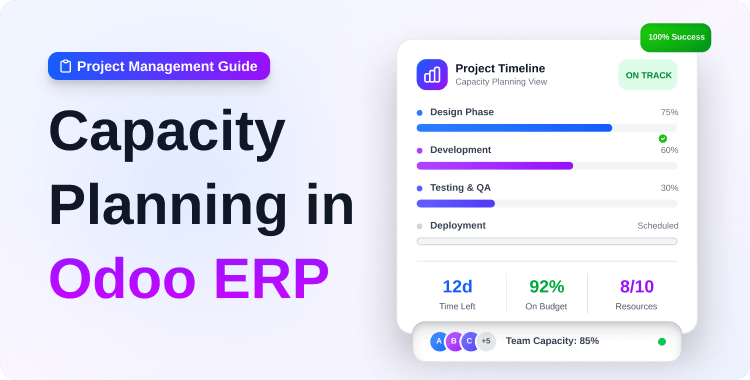
Project Management With Capacity Planning in Odoo ERP: Delivering On Time, On Budget, Every Time

Projects fail for many reasons, but one of the most preventable is poor capacity planning. When teams overcommit, resources are bottlenecked, and deadlines slip, causing costs to balloon. Yet in today’s hyperconnected business environment, organizations have no excuse for flying blind on resource capacity.
According to the latest market research, the global project management software market reached $8.1 billion in 2026 and is projected to grow at 7.1% annually through 2033, driven by increasing demand for cloud-based collaboration and real-time resource visibility.
Meanwhile, 75% of project failures can be traced back to inadequate resource planning and poor team capacity visibility, a gap that modern ERP solutions like Odoo are designed to close.
Capacity planning in Odoo ERP transforms resource management from a reactive, spreadsheet-driven nightmare into a data-driven, intelligent process.
By combining real-time workload tracking, skill-based allocation, predictive forecasting, and integrated project management, Odoo enables organizations to deliver projects on time, on budget, and with happier teams.
This comprehensive guide walks you through what capacity planning is, why it matters, how Odoo implements it, and the practical strategies to make it work in your organization.
Key Takeaways
- Capacity planning in Odoo ERP eliminates resource guesswork, providing real-time visibility into team workloads and preventing overallocation that derails timelines
- Strategic resource allocation reduces project delays by 25-40%, ensuring skills match assignments and critical tasks never lack resources
- Odoo’s integrated approach unifies project tracking, timesheets, and resource management in a single platform, eliminating costly tool fragmentation and improving collaboration across teams
- Three-tier capacity planning (strategic, tactical, operational) enables organizations to forecast long-term needs while managing daily workload balance, supporting growth from startups to enterprises
- Preventing resource overallocation saves 15-30% in operational costs while dramatically improving team morale and project delivery predictability
What Is Capacity Planning in Odoo ERP?
Capacity planning in Odoo ERP is the systematic process of aligning organizational resources with project demands by analyzing current workforce capabilities, forecasting future requirements, and strategically distributing tasks to optimize utilization without causing burnout.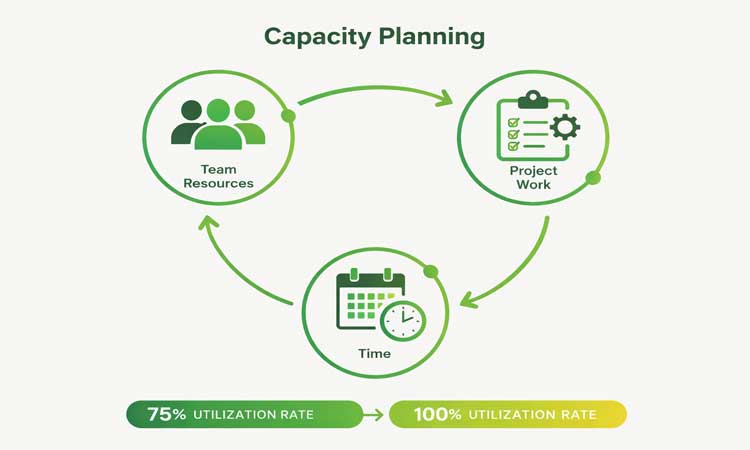
In simpler terms, it’s about knowing who you have, what they can do, when they’re available, and how to match them to work in a way that maximizes productivity while maintaining quality and team morale.
Core Components of Odoo’s Capacity Planning Approach
Odoo’s capacity planning framework addresses three critical dimensions:
Real-time resource tracking monitors every team member’s workload, availability, and current assignments across all active projects. This eliminates the common problem of invisible overallocation, where a manager assigns work to someone already stretched thin because they lack visibility into the full picture.
Skill-based task allocation doesn’t just match hours available; it matches competencies to assignments. An employee with free time may not be the right fit for a technical task. The system tracks skills, certifications, and role qualifications, enabling precise matching that reduces rework and speeds delivery.
Predictive workload forecasting uses historical project data, team capacity trends, and upcoming demand signals to forecast future resource needs, whether for the next sprint, quarter, or year. This enables proactive hiring, training, or contractor engagement rather than reactive scrambling.
The integration of these three elements creates a unified resource management ecosystem that spans from tactical daily assignment decisions to strategic multi-year workforce planning.
The Three Types of Capacity Planning in Odoo ERP
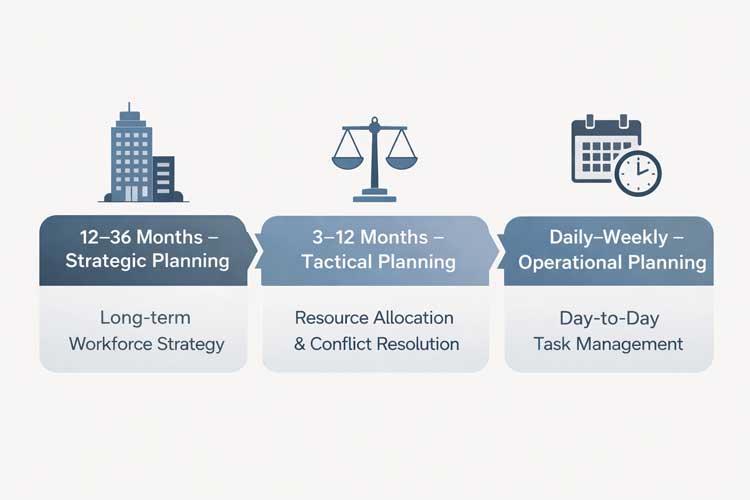
Effective capacity planning operates on three distinct time horizons, each addressing different organizational needs.
1. Strategic Capacity Planning (12–36 Months)
Purpose: Align long-term workforce capabilities with business growth and market positioning.
Key Activities: Forecasting future skill requirements based on product roadmaps and market expansion plans, planning high-level staffing levels, identifying skill gaps, budgeting for resources, and supporting decisions around organizational restructuring.
Example: A mid-sized software company planning to enter the Asian market in 18 months uses strategic capacity planning in Odoo to identify the need for 25 additional developers with cloud architecture expertise and 8 sales professionals fluent in Mandarin. The system forecasts current utilization trends and projects future demand, enabling HR to begin targeted recruitment and training programs 12 months in advance.
2. Tactical Capacity Planning (3–12 Months)
Purpose: Balance departmental resource needs across multiple concurrent projects while optimizing team composition.
Key Activities: Allocating resources across competing projects and departments, managing rotating assignments, handling seasonal demand fluctuations, resolving resource conflicts, and planning for team member leaves and skill rotation.
Example: A consulting firm manages four simultaneous client engagements in Q3. Tactical capacity planning identifies that the Data Analytics team is overallocated (120% utilization) while the Change Management team has 30% available capacity.
The system recommends rebalancing by shifting one project’s analytics work to a cross-trained associate and deploying change management resources to data preparation tasks, bringing both teams to healthy 80% utilization.
3. Operational Capacity Planning (Daily to Weekly)
Purpose: Manage immediate workload distribution, prevent daily bottlenecks, and ensure smooth task execution.
Key Activities: Assigning daily and weekly tasks based on real-time availability, responding to urgent work or priority changes, monitoring workload balance, identifying and resolving same-week resource conflicts, and adjusting schedules based on completion rates.
How Odoo ERP Integrates Project Management and Capacity Planning
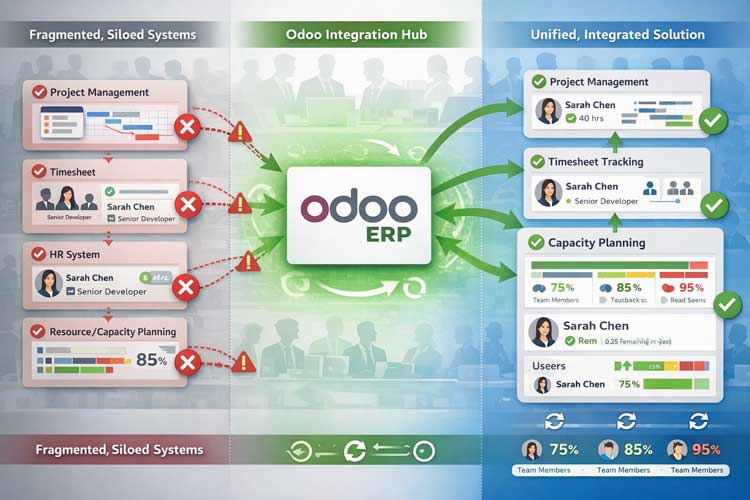
The fundamental insight: Project management and resource planning are inseparable. You cannot execute a realistic project plan without understanding team capacity, and you cannot manage capacity effectively without visibility into project demands.
Odoo bridges this gap through a unified, modular architecture that connects project, HR, timesheet, and planning modules into a seamless workflow.
Real-Time Resource Visibility Across Projects
Odoo’s project module integrates directly with employee profiles in the HR module. Every team member has a complete profile, including role, skill set, current workload across all projects, and availability windows. When a project manager creates a new task or assigns a resource, they immediately see:
- The resource’s current allocation percentage.
- Whether adding this task would exceed healthy utilization limits.
- Alternative team members with similar skills and a lower workload.
- Availability calendars showing free capacity windows.
This eliminates the common scenario where a project manager unknowingly assigns a 20-hour task to someone already committed to 30 hours of work in that week.
Skill-Based Task Matching
Rather than defaulting to availability, Odoo recommends assignments based on skill alignment. When a project manager tags a task with required skills (e.g., “Python development,” “AWS architecture”), the system:
- Filters available team members by skill match
- Ranks matches by experience level and past performance
- Flags skill gaps where internal capacity doesn’t exist
- Suggests external contractors to fill gaps
This skill-first approach dramatically reduces rework, speeds delivery, and increases assignment satisfaction.
Integrated Gantt Charts for Visual Planning
Odoo’s native Gantt view displays the entire project timeline alongside resource allocation. Project managers can:
- Drag tasks to adjust timing based on resource availability
- Visualize task dependencies and critical path
- Identify resource bottlenecks where multiple critical tasks require the same person
- Adjust scheduling to smooth resource utilization
Timesheet Integration for Accurate Tracking
Odoo’s timesheet module captures actual work hours against each project task. These timesheets flow directly into capacity planning analytics, enabling:
- Comparison of estimated vs. actual effort
- Identification of scope creep
- Real-time assessment of whether the team is staying within planned utilization
- Visibility into “hidden” work that consumes capacity
Capacity Planning Features in Odoo ERP: A Detailed Breakdown
# 1: Centralized Resource Tracking
Odoo maintains a single source of truth for resource information. All resource data lives in one integrated system:
- Employee profiles with skills, roles, certifications, and availability.
- Resource calendars showing vacation, training, and working hours.
- Project assignments linked to specific tasks and timelines.
- Utilization dashboards showing current allocation percentage.
- Capacity reports aggregated by skill, role, department, or customer.
# 2: Skill-Based Resource Matching
Odoo enables tagging of both team members and tasks with detailed skill taxonomies. This enables matching on concrete competencies rather than title alone, enabling instant identification of qualified resources, cross-training opportunities, and external resources for skill gaps.
# 3: Real-Time Capacity Visualization
Odoo’s dashboards provide at-a-glance views of team capacity:
- Utilization heatmaps color-coded by allocation percentage (green 60-80%, yellow 80-95%, red >95%).
- Capacity histograms displaying resource workload over time with visual identification of overallocation periods.
- Resource availability calendars showing free vs. committed time blocks.
# 4: Automated Workload Balancing
Rather than requiring manual reassignment, Odoo can recommend or automate workload balancing through:
- Automated alerts when utilization thresholds are exceeded.
- Suggested alternatives with similar skills and a lower workload.
- Opportunities to resequence tasks to reduce bottlenecks.
- Optional automated rebalancing across team members.
# 5: Cross-Departmental Project Coordination
Odoo enables:
- Visibility across departments into who’s available and for what work.
- Cross-functional resource pooling, where team members contribute part-time to projects outside their primary department.
- Shared resource calendars prevent double-booking.
- Conflict resolution workflows when departments compete for resources.
# 6: Performance Metrics and Forecasting
Odoo tracks capacity planning performance and drives continuous improvement through:
- Comparison of actual vs. planned utilization.
- Schedule variance analysis (are projects completing on time?).
- Resource utilization by role.
- Forecast accuracy metrics (how well do demand predictions match reality?).
- Turnover and skill gap tracking.
Recommended Blogs for You:
👉 Top 10 Software Development Companies in Bangladesh 2026: Complete Guide
👉 The 5 Hidden Costs of Legacy ERP Systems: Why Businesses Migrate to Odoo
👉 Odoo ERP Implementation Service Company in Bangladesh: Complete Guide in 2026
👉 Manufacturing Excellence: How Odoo MRP Transforms Production Planning and Reduces Costs
👉 Odoo eCommerce ERP Integration: Automating Orders, Inventory, and Payments for Scalable
Preventing Resource Overallocation: Practical Strategies
Overallocation is the silent project killer. Team members are stretched too thin, deliver poor quality, miss deadlines, burn out, and churn. Yet it’s preventable with proper visibility and discipline.
The 80/20 Rule for Utilization
Best practice suggests targeting 70–80% utilization, not 100%. The remaining 20–30% capacity serves critical functions:
- Handling urgent requests without abandoning planned work
- Ad-hoc collaboration and mentoring
- Professional development and skill building
- Unexpected blockers and rework
- Team meetings and administrative work
When utilization creeps above 85%, team members begin cutting corners on quality and experiencing stress-related performance drops.
Weekly Capacity Planning Ceremonies
Best-in-class organizations hold 30-minute weekly resource planning meetings where:
- Project managers review the next 2–6 weeks by project, role, and person
- Capacity hotspots and conflicts are identified
- Rebalancing decisions are made (task resequencing, contractor engagement)
- Staffing changes are documented and redeployed
Skill-Matching Over Hour-Matching
Never assign based on hours available alone. A marketing manager with 20 open hours next week is not the right fit for Java backend development.
Odoo’s skill-based matching prevents this by showing:
- Team members with the right skills AND available capacity
- Candidates for cross-training
- External resources for one-off skill gaps
Communication and Transparency
Resource overallocation thrives in silence. Encourage team members to speak up when workload exceeds capacity. Odoo supports this by:
- Showing team members their own utilization dashboard
- Automating workload alerts so managers don’t rely on team members to complain
- Creating transparent assignment workflows
Building Flex Capacity
Smart organizations maintain a bench of lower-priority work (internal tools, documentation, process improvements) that absorbs available capacity:
- Junior developers maintain internal code libraries
- Project managers update delivery playbooks
- Support engineers create knowledge base articles during slow periods
When capacity opens up, this flex work is ready to absorb it, maintaining utilization without burnout.
Common Pitfalls in Capacity Planning and How to Avoid Them
Pitfall 1: Siloed Data and Disconnected Tools
The problem: Organizations use separate tools for project management, HR, timesheets, and resource planning. Data doesn’t sync, creating multiple versions of truth.
The Odoo solution: A unified platform where project tasks, resource assignments, timesheets, and HR data all flow seamlessly. When a task is completed, it updates project progress AND available capacity in real-time.
Pitfall 2: Ignoring Skills and Forcing Generic Matching
The problem: “We need a developer with 20 hours free this week?” ignores whether that developer has the right skills.
The Odoo solution: Skill-based task tagging and resource matching. The system recommends qualified candidates first, then identifies upskilling opportunities.
Pitfall 3: Static Capacity Planning Without Real-Time Adjustments
The problem: “We planned capacity for Q3 in June. Now it’s August, and everything’s changed, but we’re still following the old plan.”
The Odoo solution: Real-time capacity dashboards that update as projects progress. Forecasts automatically adjust as historical performance data accumulates.
Pitfall 4: Overestimating Capacity Due to Wishful Thinking
The problem: Capacity decisions based on optimism rather than data.
The Odoo solution: Historical data and forecasting tools replace guesswork. Odoo analyzes past project velocities, actual effort vs. estimates, and team composition to predict realistic capacity.
Pitfall 5: Neglecting Hidden Work and Administrative Overhead
The problem: Capacity planning counts billable project work (80 hours/week) but ignores meetings, admin, support, and learning (actual capacity is 60 hours/week).
The Odoo solution: Comprehensive timesheet tracking that captures ALL work, billable projects, meetings, training, support, and admin. This reveals the actual capacity available for new projects.
Odoo Capacity Planning Best Practices for On-Time, On-Budget Delivery
# 1: Implement Clear Utilization Targets by Role
Different roles have different healthy utilization levels:
- Client-facing roles (Consultants, Customer Success): 60–75% billable, 25–40% admin/unbillable
- Technical roles (Developers, Architects): 70–80% project work, 20–30% code review/mentoring/learning
- Leadership roles (Directors, Managers): 50–60% direct management, 40–50% individual contribution
- Support roles (Finance, HR, Admin): 70–85% allocated work, 15–30% flex for peak periods
Odoo enables setting target utilization by role and tracking actual vs. target. This replaces the myth that everyone should be “100% utilized”.
# 2: Establish Weekly Resource Planning Cadence
Structure:
- 30-minute meeting (same day/time each week)
- Attendees: Project managers, resource manager, department leads
- Agenda: Review heatmaps for next 6 weeks, resolve resource conflicts, plan for leaves, adjust forecasts
Outcomes:
- Resource conflicts are resolved proactively
- Bottlenecks are identified 2–6 weeks in advance
- Reallocation decisions are made with full visibility
- Teams stay aligned on priorities
# 3: Use Skill Tags Extensively
Rather than generic resource titles (“Developer,” “Analyst”), use granular skill tags:
- Languages: Python, JavaScript, Go, Java, SQL
- Frameworks: React, Django, FastAPI, Spring Boot
- Domains: Healthcare, Fintech, E-commerce, SaaS
- Infrastructure: AWS, GCP, Kubernetes, Terraform
- Soft skills: Technical writing, training delivery, incident command
Tag both team members and tasks. This enables Odoo to recommend precise matches and identify skill gaps.
# 4: Automate Alerts and Escalations
Rather than relying on managers to manually monitor capacity, configure Odoo to automatically alert when:
- A resource is allocated above 85% in any week.
- A skill gap exists (no one on the team has required skills).
- A single resource is a bottleneck (3+ critical tasks depend on them).
- Forecast demand exceeds available supply.
# 5: Invest in Forecasting Accuracy
Capacity planning is only as good as demand forecasts. Invest in:
- Detailed project estimation: Break projects into tasks, estimate each, and sum to project total.
- Historical velocity analysis: Track how long similar projects actually took.
- Pipeline tracking: Connect sales pipeline to resource demand.
- Seasonal adjustments: Factor in holidays, vacation patterns, and cyclical demand.
- Buffer planning: Add 10–20% buffer for unexpected work and learning.
# 6: Continuously Monitor and Adjust
Capacity plans are living documents. Establish a rhythm:
- Daily: Team leads review next week’s assignments.
- Weekly: Resource planning meeting reviews 6-week forecast.
- Monthly: Department heads review capacity trends.
- Quarterly: Review forecast accuracy; adjust models.
- Annually: Strategic capacity planning.
Odoo’s Competitive Advantages for Project and Capacity Management
Odoo vs. Microsoft Dynamics 365
| Dimension | Odoo | Microsoft Dynamics 365 |
| Integration | Fully integrated project, HR, timesheet, and planning modules | Strong but requires Power Platform customization |
| Cost | $24.90–$46.80/user/month | $165–$250+/month per user |
| Customization | Highly modular; 30,000+ apps in marketplace | Less flexible; Power Platform required |
| Implementation | 2–4 weeks basic; 2–6 months full | 3–6 months minimum |
| Best for | SMEs and mid-market; service companies | Large enterprises; Microsoft ecosystem integration |
Verdict: Odoo wins for organizations prioritizing cost-effectiveness, speed of deployment, and integrated resource planning.
Odoo vs. SAP
| Dimension | Odoo | SAP |
| Cost | $24.90–$46.80/user/month + implementation | $100,000–$500,000+ per year |
| Time to Value | 2–4 weeks basic; 2–6 months full | 6–12+ months minimum |
| Customization | Open source; unlimited customization | Highly complex; requires SAP experts |
| SME Suitability | Excellent; scales as company grows | Overkill for <1000 employees |
| Best for | Startups to mid-market | Large multinational enterprises |
Verdict: Odoo is the clear winner for organizations under 500 employees.
Implementation Costs and Timeline for Odoo Capacity Planning
Licensing Costs (2026 Pricing)
| Edition | Cost | Target Use Case |
| Community (Free) | $0 | Unlimited users; requires self-support |
| Standard | $31.10/user/month (annual) | SMEs; all core modules included |
| Custom | $46.80–$61.10/user/month | Enterprises; unlimited customization |
Note: Odoo announced a 30% price increase effective January 2026.
Implementation Costs by Business Size
| Business Size | User Count | Implementation Cost | Timeline | Total Year 1 |
| Small | 1–10 | $5,000–$20,000 | 1–2 months | $16,600–$35,000 |
| Medium | 11–50 | $20,000–$50,000 | 2–6 months | $70,000–$150,000 |
| Large | 50–100+ | $50,000–$150,000+ | 6–12+ months | $150,000–$400,000+ |
Example: Mid-sized Company (30 Users, 5 Modules)Cost Component Annual Notes Software licensing $11,160 30 users × $31.10/month Implementation $35,000 Configuration, customization, data migration Hosting (Odoo.sh) $3,000 30-user cloud setup Training $5,000 2-day onsite + online modules Year 1 Total $54,160 ~ $1,800 per user invested Ongoing Annual $19,160 Licensing + support
ROI Timeline: Organizations typically recoup implementation costs within 12–18 months through:
- 20–30% reduction in project delays
- 15–25% improvement in resource utilization
- 10–15% reduction in staff turnover
- Elimination of tool fragmentation and duplicate data entry
Implementing Capacity Planning in Odoo: Step-by-Step
Phase 1: Foundation (Weeks 1–2)
- Audit current state and document existing practices
- Define capacity targets by role
- Set up employee profiles in Odoo HR
- Configure project structure
- Import historical data
Phase 2: Configuration (Weeks 3–6)
- Enable planning module and link to Projects.
- Configure capacity rules and utilization thresholds.
- Create comprehensive skill taxonomy.
- Set up dashboards for managers.
- Define workflows for request flow.
- Train core team.
Phase 3: Pilot (Weeks 7–10)
- Select 2–3 representative projects for testing
- Run weekly planning meetings using Odoo data
- Capture timesheets through Odoo
- Monitor estimated vs. actual effort
- Gather feedback from teams
- Iterate on configurations
Phase 4: Full Rollout (Weeks 11–24)
- Expand to all projects
- Scale training to all PMs and team leads
- Establish weekly planning meetings and monthly reviews
- Continuously improve demand and utilization forecasts
- Build role-specific dashboards
- Document best practices playbooks
Partner Spotlight: HasTech IT – Certified Odoo Implementation Partner
Successfully implementing capacity planning in Odoo requires more than software; it requires experienced partners who understand both the technology and your business context. HasTech IT is a certified Odoo implementation partner specializing in end-to-end ERP deployment, customization, and optimization for mid-sized enterprises and service organizations globally.
With a proven track record across diverse industries, software development firms, consulting companies, manufacturing enterprises, and service delivery organizations, HasTech brings deep expertise in translating complex resource management challenges into practical, revenue-generating Odoo solutions.
Why Choose HasTech IT as Your Odoo Implementation Partner?
Certified Expertise: HasTech IT is officially recognized by Odoo as a trusted implementation partner, ensuring you work with consultants trained on the latest Odoo modules, best practices, and industry-specific solutions. Their team combines technical depth with real-world operational experience gained from hundreds of successful ERP implementations across Asia, Europe, and North America.
Tailored Capacity Planning Implementation: HasTech’s implementation approach begins with a comprehensive audit of your current resource management processes, identifying inefficiencies, bottlenecks, and automation opportunities specific to your organization.
Their consultants design a capacity planning system aligned with your organizational structure, industry workflows, and growth objectives. During configuration, they establish skill taxonomies relevant to your business, build forecasting models from your historical project data, and create role-specific dashboards for project managers, resource managers, and C-level executives.
Throughout the pilot and rollout phases, HasTech ensures your team has the knowledge and discipline to sustain capacity planning practices independently long-term.
Proven Results for Odoo Customers: Organizations partnering with HasTech for Odoo capacity planning implementation achieve measurable results within 3–6 months: improved on-time project delivery (25–40% reduction in delays), optimized resource utilization (15–30% improvement), reduced team turnover through better workload balance, and elimination of tool fragmentation and data silos.
Beyond implementation, HasTech provides ongoing optimization support, helping organizations refine forecasting accuracy, scale across new business units, and adapt capacity planning strategies as business needs evolve.
Looking for Your Next Odoo Implementation Partner?

HasTech IT is actively seeking organizations ready to transform their project and resource management through Odoo ERP.
Whether you’re planning your first ERP implementation, upgrading from legacy systems, or expanding your current Odoo setup, HasTech’s certified consultants work collaboratively with your team to ensure rapid deployment, minimal operational disruption, and maximum return on investment.
Their customer-first approach means you’re not just getting software, you’re gaining a strategic partner invested in your long-term success and growth.
Ready to deliver projects on time, on budget, and with optimized resources? HasTech IT is here to partner with you on your Odoo journey:
Connect with HasTech IT Today:
- Explore Services: Visit https://hastechit.com/ to learn about our end-to-end Odoo implementation services
- View Certified Partner Profile: Check out our official Odoo Partner Profile on Odoo’s partner registry
- Schedule a Free Consultation: Contact HasTech IT to discuss your specific capacity planning and ERP requirements, receive customized implementation timelines and cost estimates, and explore how working with a certified Odoo partner accelerates your time to value
Don’t let resource overallocation, project delays, and operational inefficiency continue impacting your bottom line. HasTech IT specializes in turning Odoo’s powerful capacity planning and resource management capabilities into a sustainable competitive advantage for your organization.
Reach out today to discuss implementation options tailored to your industry, company size, and maturity level, your path to on-time, on-budget project delivery starts here.
Frequently Asked Questions
Q: Will Odoo’s capacity planning eliminate the need for experienced resource managers?
A: No. Odoo provides visibility and data; judgment still requires humans. Resource managers become more strategic—they spend less time chasing status updates and more time resolving conflicts, planning careers, and aligning capacity with strategy.
Q: How long does it take for capacity planning to show ROI?
A: Organizations typically see measurable benefits within 3–6 months: fewer overallocated team members, fewer project delays due to resource bottlenecks, and higher on-time delivery rates. Significant financial ROI (15–30% improvements in project margins) often takes 12–18 months.
Q: Can we use Odoo’s capacity planning across multiple offices or geographies?
A: Yes. Odoo supports global multi-company, multi-location deployments. Capacity can be planned across geographies, time zones, and business units.
Q: What if our team’s skill set is unique to our company? How do we set up skill matching?
A: You define your own skill taxonomy. Start broad (programming languages, industries, certifications), then add company-specific skills.
Q: How does Odoo handle contractors and freelancers in capacity planning?
A: Odoo treats contractors like employees in the capacity planning system. Create contractor profiles with skills, availability windows, and utilization targets.
Q: Can we use Odoo capacity planning for non-project work (support, operations)?
A: Yes. Any repetitive, demand-driven work can be capacity-planned. Define ticket categories, estimate effort, and allocate capacity to support teams.
Conclusion
Capacity planning in Odoo ERP is not a luxury—it’s a necessity for organizations serious about delivering projects on time, on budget, and with happy teams.
The cost of poor capacity planning is staggering: missed deadlines, budget overruns, rework, team burnout, and turnover. Yet it’s entirely preventable with the right visibility and discipline.
Odoo provides that visibility through integrated project management, real-time resource tracking, skill-based matching, and predictive forecasting. Organizations that implement capacity planning discipline see:
- 25–40% reduction in project delays
- 15–30% improvement in team utilization
- 20–25% reduction in staff turnover (through better workload balance)
- 10–20% improvement in project margins (fewer overruns and rework)
The implementation path is straightforward: start small with core projects, build forecasting accuracy, expand to your full portfolio, and establish weekly planning rhythms. Within 3–6 months, you’ll have visibility that most organizations lack.
The organizations that win in today’s competitive environment are not those with the biggest budgets—they’re those that optimize the resources they have. Odoo’s capacity planning makes that optimization concrete, data-driven, and repeatable.
If your organization is struggling with resource overallocation, project delays, or team burnout, capacity planning in Odoo ERP is a proven path to better outcomes. Start with a conversation with an Odoo implementation partner to understand the opportunity in your context.