WooCommerce Subscription SEO: 7 Proven Ways to Grow Recurring Revenue Without Paid Ads

Every dollar you spend on paid ads disappears the moment you stop paying. But every dollar invested in SEO keeps compounding, month after month, subscriber after subscriber.
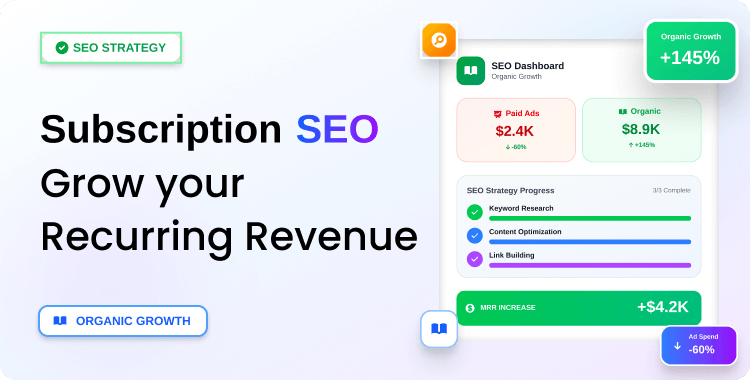
For WooCommerce store owners running subscription products, this difference is not just theoretical. Organic traffic delivers an average ROI of 748%, compared to just 36% for paid channels. The subscription e-commerce market is projected to reach $9,051.84 billion by 2034, growing at 14.40% CAGR — and competition for paid keywords is intensifying as that market grows.
The WooCommerce stores that will win this decade are not the ones with the biggest ad budgets. They are the ones building sustainable organic traffic engines that deliver qualified subscribers month after month — without the paid ads treadmill.
In this guide, you will learn a complete WooCommerce subscription SEO strategy: how to map keywords to subscription intent, optimize your product pages for organic conversions, build content funnels that attract buyers, and measure SEO’s real impact on your Monthly Recurring Revenue (MRR) using tools like Recurio.
TL/DR:
The fastest way to grow WooCommerce subscription revenue without paid ads is to
(1) target subscription-intent keywords on product pages,
(2) build supporting content that captures problem-aware searches,
(3) use internal links to route organic traffic toward subscription products, and
(4) measure organic subscriber LTV separately from paid.
Together, these four steps create a compounding SEO flywheel that grows MRR month over month.
Table of Contents
Key Takeaways
- Organic traffic delivers 748% ROI compared to just 36% for paid ads — making SEO the most cost-effective channel for WooCommerce subscription businesses.
- SEO leads convert 8.5x better than outbound leads (14.6% vs 1.7%), meaning higher-quality subscribers who stick around longer.
- Compounding returns: Unlike paid ads that stop when you stop paying, WooCommerce subscription SEO continues generating recurring revenue month after month.
- Lower CAC, higher LTV: Organic subscribers typically cost less to acquire and churn less — because they found you through research, not an impulse ad.
- The right plugin matters: Recurio’s built-in analytics let you track MRR, churn, and LTV from organic traffic — so you can measure SEO’s true impact on recurring revenue, not just clicks.
Why WooCommerce Subscription SEO Is Different From Regular SEO
WooCommerce subscription SEO is the practice of optimizing subscription product pages, supporting blog content, and internal site architecture to attract organic subscribers — reducing reliance on paid acquisition while growing Monthly Recurring Revenue (MRR) compoundingly over time.
Subscription businesses have a structural SEO advantage that one-time-purchase stores do not: the compounding effect of recurring revenue amplifies the value of every organic visitor.
When a one-time store acquires an organic visitor who converts, they get one sale. When a WooCommerce subscription store does the same, they get a subscriber who may pay for 12, 24, or 36 months. That single organic conversion is worth dramatically more, which means every improvement in organic rankings creates an outsized revenue impact.
The ROI Comparison: Paid vs. Organic
| Metric | Paid Ads | Organic SEO |
| Average ROI | 36% | 748% |
| Conversion Rate | 1.3% | 2.4% |
| Traffic Contribution | 21% | 62% |
| Lead Close Rate | 1.7% | 14.6% |
| Cost When You Stop | Traffic stops | Traffic continues |
Consider this scenario for a subscription business:
- Paid subscriber: Costs $50–200 to acquire via Google Ads, generates $30/month → needs 2–7 months to break even on CAC.
- Organic subscriber: Costs $8–15 to acquire (content investment), generates the same $30/month → profitable from month 1.
Multiply that across hundreds of subscribers, and the case for WooCommerce subscription SEO becomes undeniable.
How Compounding Works for Subscription SEO
One SaaS company grew monthly recurring revenue from $25,000 to $135,000, a 440% increase – purely through organic search, achieving a 1,909% ROI on their SEO investment. Content published in month one continues generating subscribers in month twelve.
For WooCommerce subscription stores specifically, this compounding effect works on two levels:
- Traffic compounds: Well-optimized content accumulates backlinks and improves in rankings over time, driving more visitors without additional spend.
- Revenue compounds: Each organic subscriber acquired today continues paying next month, next quarter, and next year, meaning the LTV of a single organic conversion keeps growing.
Unlike paid campaigns, where returns are linear (spend more, get more), WooCommerce subscription SEO creates exponential value over time.
For foundational eCommerce SEO principles that apply to all WooCommerce stores, see this guide on eCommerce SEO best practices.
Understanding Customer Acquisition Cost for WooCommerce Subscription Businesses
Most WooCommerce store owners only track paid Customer Acquisition Cost, missing the bigger picture. To properly measure the impact of subscription SEO, you need to track CAC separately by channel.
The CAC Formula
The standard CAC formula is:
CAC = (Marketing Costs + Sales Costs) / Number of New Customers
For subscription businesses, track this separately for:
- Paid channels (Google Ads, Facebook, etc.)
- Organic channels (SEO, content marketing)
- Referral and word-of-mouth
CAC by Channel: A Realistic Breakdown
| Channel | Typical CAC | Time to Results | Duration of Results |
| Google Ads | $50-200 | Immediate | Stops when budget stops |
| Facebook Ads | $30-150 | Immediate | Stops when budget stops |
| SEO/Content | $15-50 | 3-6 months | Continues indefinitely |
| Email (existing list) | $5-15 | Immediate | Depends on list health |
While paid CAC appears similar to organic CAC in raw numbers, organic subscribers typically:
- Have a higher lifetime value (they found you through research, not impulse)
- Show lower churn rates (they’re more intentional about subscribing)
- Refer more customers (they trust your brand enough to recommend it)
A tool like Recurio gives you visibility into LTV, churn, and revenue by customer segment—so you can measure the true value of organic vs. paid subscribers.
Strategy 1: Map Keywords to Subscription Intent
Not all keywords are equal for WooCommerce subscription businesses. The keywords that drive subscriber growth fall into three distinct intent categories — and you need content targeting all three.
High-Intent Subscription Keywords (target on product and category pages):
[product] subscriptionmonthly [product] deliverysubscribe and save [product][product] subscription boxwoocommerce subscription product
Problem-Aware Keywords (target with blog content):
best way to get regular [product]how to never run out of [product]automatic [product] deliverywoocommerce subscription not renewing(also see our WooCommerce subscription troubleshooting guide)
Comparison and Evaluation Keywords (target with comparison posts):
best [product] subscription services[competitor] vs [your brand] subscriptionrecurio vs woocommerce subscriptions(see our full comparison)
Use these keywords in your WooCommerce product pages, category pages, and blog content to capture subscribers at every stage of the funnel.
Strategy 2: Optimize Your WooCommerce Subscription Product Pages
Your subscription product pages need to work harder than typical eCommerce pages. A visitor arriving from organic search is a researcher — they are evaluating whether to commit to recurring payments. Your page must convert them.
Every WooCommerce subscription product page should:
- Explain recurring value clearly — not just the product, but why subscribing beats buying once.
- Address subscription-specific objections — cancellation policy, pause options, billing transparency.
- Show the savings math — display the per-unit cost savings vs. one-time purchase prominently.
- Build trust — reviews, subscriber count, security badges, and a clear refund policy.
- Use schema markup — Product schema with
subscriptionPricesignals help Google understand subscription pricing.
For WooCommerce-specific page optimization tactics, see the guide on WooCommerce product page SEO and conversions.
Strategy 3: Create Content That Attracts Subscription-Ready Buyers
The best WooCommerce subscription businesses build content ecosystems that naturally guide readers toward subscribing. Each piece of content targets a different stage of the subscriber journey.Content Type Purpose Subscription SEO Example How-To Guides Build authority at top of funnel “How to Set Up a WooCommerce Subscription Product” Comparison Posts Capture commercial intent “Best WooCommerce Subscription Plugins Compared” Problem-Solution Address pain points “Why WooCommerce Subscription Payments Fail” Calculator Tools Show subscription value “Subscription Savings Calculator” Analytics Guides Educate on tracking “How to Track Subscription MRR in WooCommerce”
Each piece should include natural CTAs pointing toward your subscription products or Recurio. For inspiration on content structures that work, see subscription analytics for WooCommerce.
Strategy 4: Build Strategic Internal Links
Internal linking is one of the most underutilized WooCommerce SEO tactics. Studies show that 82% of internal linking opportunities are missed by most websites — and for subscription businesses, this directly costs recurring revenue.
Internal Linking Architecture for WooCommerce Subscriptions:
textBlog Posts (Informational)
    ↓
Subscription Category Pages (Commercial)
    ↓
Individual Subscription Product Pages (Transactional)
    ↓
Recurio Plugin / Sign-Up CTA
Strategy 5: Target Long-Tail Subscription SEO Keywords
Broad terms like “subscription SEO” are dominated by massive domains. Long-tail keywords with WooCommerce-specific intent are where HasThemes can win organic traffic quickly.
High-opportunity long-tail targets to add to your WooCommerce subscription content:
Instead of competing on broad terms like ‘subscription SEO,’ target WooCommerce-specific long-tail queries where you can realistically rank. Terms like ‘woocommerce subscription product page optimization,’ ‘how to track subscription MRR from organic traffic,’ and ‘reduce subscription CAC with SEO’ have clear intent, lower competition, and are exactly what your target audience searches for.
Strategy 6: Use Recurio to Power SEO-Driven Subscription Growth
Your WooCommerce subscription plugin directly impacts SEO performance — not just conversion. Recurio is built specifically to help WooCommerce stores maximize organic subscriber value.
How Recurio Supports WooCommerce Subscription SEO:
Subscription Analytics (Free + Pro): Recurio provides real-time analytics that connect organic traffic to recurring revenue:
- Monthly Recurring Revenue (MRR): Track organic vs. paid MRR growth side-by-side.
- Annual Recurring Revenue (ARR): Project long-term SEO revenue impact.
- Customer Lifetime Value (LTV): Compare LTV by acquisition channel — organic vs. paid.
- Churn Rate: Monitor whether organic subscribers retain better (they usually do).
- Average Revenue Per User (ARPU): Measure organic subscriber quality.
For a deeper look at subscription metrics, see subscription analytics for WooCommerce.
Convert More Organic Visitors:
Organic visitors are researchers — they need more convincing than paid traffic. Recurio helps convert them with:
- Subscribe & Save: Show visitors exactly how much they save by subscribing vs. buying once. Reduces friction for organic visitors who are comparison-shopping.
- Flexible Billing Periods: Daily, weekly, monthly, quarterly, yearly — and custom intervals. Matching billing frequency to subscriber preference improves conversion.
- Trial Periods: Organic visitors often want to test before committing. Recurio makes it easy to offer free or paid trials that convert researchers into long-term subscribers.
Retain Organic Subscribers Longer:
The real value of WooCommerce subscription SEO is not just acquisition — it is retention. Recurio keeps organic subscribers active:
- Customer Self-Service Portal: Let subscribers pause, resume, and update payment methods without contacting support. Reduces friction and prevents cancellations from frustration.
- Smart Dunning (Pro): Recover failed payments automatically with intelligent retry logic. Recurio Pro recovers 40–70% of failed payments — directly protecting your organic subscriber MRR. See the complete WooCommerce subscription dunning guide.
- Churn Prediction (Pro): AI-powered analytics identify at-risk subscribers before they cancel, giving you a retention window.
For a full plugin comparison, see Recurio vs WooCommerce Subscriptions.
Strategy 7: Measure SEO’s Real Impact on Recurring Revenue
Most WooCommerce store owners measure SEO performance by traffic and rankings. Subscription businesses need to go deeper — and measure organic SEO impact on MRR, LTV, and churn.
Google Analytics 4 Configuration:
- Create segments for organic traffic (Source/Medium = google/organic).
- Track subscription product purchases as conversion events.
- Set up enhanced eCommerce for subscription products.
- Create custom reports: Organic Traffic → Subscription Revenue.
For GA4 setup on WooCommerce, see the guide on Google Analytics eCommerce tracking.
Recurio Dashboard Metrics to Track Monthly:Metric What It Tells You Target Organic Traffic to Subscription Pages SEO visibility for subscription queries +10% MoM Organic Conversion Rate Content effectiveness 2–4% New Subscribers from Organic Acquisition success Track trend Organic Subscriber LTV Quality of organic traffic Higher than paid LTV Churn Rate (Organic Cohort) Retention quality Lower than paid churn
Calculate WooCommerce Subscription SEO ROI:
textSEO ROI = (Revenue from Organic Subscribers – SEO Investment) / SEO Investment × 100For subscriptions, calculate “Revenue from Organic Subscribers” as:
- New organic subscribers × Average subscription price × Average subscription length
- PLUS renewal revenue from previously acquired organic subscribers
This formula captures the compounding value of SEO for recurring revenue.
Recurio Free vs. Pro: Choosing the Right Plan
| Feature | Free | Pro |
|---|---|---|
| Monthly / Yearly Billing | ✅ | ✅ |
| Analytics Dashboard (MRR, ARR, LTV, Churn) | ✅ | ✅ |
| Customer Self-Service Portal | ✅ | ✅ |
| 8 Automated Emails | ✅ | ✅ |
| REST API | ✅ | ✅ |
| All Billing Periods (daily, quarterly, etc.) | ❌ | ✅ |
| Subscribe & Save | ❌ | ✅ |
| Smart Dunning (recover 40–70% failed payments) | ❌ | ✅ |
| Churn Prediction | ❌ | ✅ |
| Revenue Forecasting | ❌ | ✅ |
| Variable Subscriptions | ❌ | ✅ |
| Webhooks | ❌ | ✅ |
Best for Free:
New WooCommerce subscription stores testing organic acquisition.
Best for Pro: Growing stores investing seriously in WooCommerce subscription SEO and organic retention.
Recurio Pro starts at $99/year — a fraction of one month of paid ads. Smart dunning alone recovers $40–70 for every $100 in failed payments, making Pro self-funding within weeks.
For a detailed comparison of subscription plugins, see the best subscription plugins for WooCommerce.
Advanced WooCommerce Subscription SEO Strategies
Content-Led Subscription Funnels
Build a three-layer content funnel that captures organic visitors at every stage and routes them toward subscribing:
- Top of Funnel (Informational): “Complete Guide to WooCommerce Subscription Products” — targets researchers.
- Middle of Funnel (Comparison): “Best WooCommerce Subscription Plugins” — targets buyers evaluating options.
- Bottom of Funnel (Transactional): Subscription product page with Subscribe & Save + trial offer — converts.
Each layer links to the next with clear, intent-matched anchor text.
Retention-Focused Content
Most WooCommerce subscription SEO focuses entirely on acquisition. Smart stores also create content for existing subscribers — which ranks for branded queries, reduces churn, and generates natural backlinks:
- “How to Pause Your [Brand] WooCommerce Subscription” — see how to pause WooCommerce subscriptions
- “How to Update Your Payment Method in [Brand]”
- “Subscriber-Only Tips for Getting the Most from [Product]”
Use Recurio‘s automated email campaigns to distribute this content to your existing subscriber base.
Win-Back SEO Content
Target people who have cancelled or are researching alternatives with honest, helpful content:
[your brand] cancel subscription— acknowledge issues, show improvements, offer a win-back discount.[your brand] alternative— Compare fairly, highlight what makes your subscription better.
Recurio Pro’s win-back email campaigns (10%, 20%, 30% discount sequences) complement this content strategy perfectly.
WooCommerce Subscription SEO Implementation Checklist
Foundation
- Install Recurio (Free or Pro)
- Configure subscription products with a clear recurring value proposition
- Set up the Recurio analytics dashboard (MRR, ARR, LTV, churn tracking)
- Enable customer self-service portal
- Configure 8 automated email sequences
WooCommerce Subscription SEO Optimization
- Research subscription-intent keywords for your niche
- Add primary keyword to product page H1, meta title, and meta description
- Optimize subscription product page copy (value prop, objections, savings math)
- Add Product schema markup with subscription pricing
- Create supporting blog content targeting problem-aware keywords
- Build internal links from blog posts to subscription product pages
- Submit subscription pages to the XML sitemap
Conversion Optimization
- Enable Subscribe & Save with a visible savings percentage
- Set up trial periods to reduce commitment friction
- Add cancellation and pause policy — visible before checkout
- Display subscriber count or social proof
- A/B test subscription page CTA and pricing display
Retention and Revenue Recovery
- Configure smart dunning sequences (Pro) — 3–5 retry attempts over 7–14 days
- Set up renewal reminder emails (3 days and 1 day before renewal)
- Create subscriber-only content for retention
- Monitor churn prediction alerts (Pro) and intervene proactively
- Implement win-back campaign sequences for cancelled subscribers
Tracking and Measurement
- Set up GA4 organic traffic segments
- Track organic subscriber LTV in Recurio separately from paid
- Monitor MRR growth from organic channels monthly
- Calculate and report WooCommerce subscription SEO ROI monthly
- Compare organic vs. paid subscriber churn rates quarterly
Recommended Blogs for You
- 👉 How to set up WooCommerce subscriptions (setup intent audience)
- 👉 Reduce subscription churn with WooCommerce (retention angle)
- 👉 Free trials vs paid subscriptions (conversion decision)
- 👉 Best subscription plugins (tool selection)
- 👉 Subscription analytics for WooCommerce (measuring results)
- 👉 WooCommerce subscription renewal failed fix (problem-solution)
- 👉 WooCommerce technical SEO tips (technical foundation)
Frequently Asked Questions
How long does WooCommerce subscription SEO take to show results?
Expect 3–6 months before seeing meaningful organic subscription growth. WooCommerce subscription SEO is a long-term investment — but unlike paid ads, the results compound. One case study showed 400% ROI in month one, growing to 2,600% ROI by month twelve. For subscription businesses, compounding is even more powerful because every organic subscriber acquired today keeps paying for months or years.
Is organic traffic really better than paid ads for WooCommerce subscriptions?
For long-term recurring revenue, yes, significantly. Organic leads convert at 14.6% compared to 1.7% for paid outbound leads, 8.5x better. Organic WooCommerce subscribers also tend to have higher LTV and lower churn because they found you through research, not an impulse ad click. This makes SEO the highest-ROI channel for subscription businesses focused on MRR growth.
What keywords should I target for WooCommerce subscription SEO?
Focus on three keyword tiers:
(1) high-intent terms like [product] subscription and subscribe and save [product] on product pages,
(2) problem-aware terms like woocommerce subscription not renewing and how to recover failed subscription payments in blog content, and
(3) comparison terms like recurio vs woocommerce subscriptions in comparison posts.
Prioritize long-tail, WooCommerce-specific terms where you can compete against specialized content rather than giant SEO domains.
How does Recurio help with WooCommerce subscription SEO?
Recurio supports WooCommerce subscription SEO in several ways: clean URL structures for subscription products, variable product subscriptions on single pages (better for SEO than multiple thin pages), analytics to track organic subscriber LTV, and Subscribe & Save features that increase organic visitor conversion rates. The self-service portal also reduces bounce from frustrated subscribers, improving user experience signals that indirectly support rankings.
What is the most important metric for measuring WooCommerce subscription SEO?
Organic Subscriber Lifetime Value (LTV). This single metric captures both acquisition (did SEO bring subscribers?) and retention (do organic subscribers stick around?). Track this in Recurio’s analytics dashboard and compare it to paid subscriber LTV. If organic LTV is higher than paid, which it typically is, your SEO investment is compounding your recurring revenue in the most efficient way possible.
Should I use Recurio Free or Pro for subscription SEO?
Start with Free to validate your subscription model and organic acquisition strategy. Upgrade to Pro when you are ready to maximize organic subscriber value with Subscribe & Save (improves organic conversion), smart dunning (recovers failed payment revenue), variable subscriptions (consolidates thin pages for SEO), and churn prediction (protects organic subscriber retention).
Conclusion
The path to sustainable WooCommerce subscription growth does not run through ever-increasing ad budgets. It runs through organic search, a channel that compounds over time, delivers higher-quality subscribers, and keeps working even when you are not actively spending.
The data is clear:
- Organic traffic delivers 748% ROI versus 36% for paid ads.
- Organic leads convert at 14.6% compared to 1.7% for paid.
- WooCommerce stores using SEO for subscription growth report compounding returns that paid channels can never replicate.
For WooCommerce subscription businesses, these advantages multiply with every billing cycle. Every organic subscriber you acquire today keeps generating recurring revenue next month, next quarter, and next year.
Your next steps:
- Track the right metrics: Use Recurio’s analytics to measure MRR, LTV, and churn by acquisition channel, organic vs. paid.
- Map subscription-intent keywords: Identify the specific WooCommerce subscription keywords your audience uses, at every funnel stage.
- Optimize your product pages: Make subscription product pages comprehensive enough that organic visitors do not need to search again.
- Build supporting content: Create a pillar content system that drives organic traffic to subscription products across all intent stages.
- Maximize retention: Use smart dunning, self-service portals, and churn prediction to keep organic subscribers longer and protect your MRR.
The subscription businesses thriving today are not the ones with the biggest ad budgets. They are the ones with the best WooCommerce subscription SEO engines delivering qualified, long-term subscribers month after month.
Continue Learning
- How to Set Up WooCommerce Subscriptions
- Reduce Subscription Churn With WooCommerce
- Free Trials vs Paid Subscriptions: What Converts Better
- Best WooCommerce Subscription Plugins
- Subscription Analytics for WooCommerce
- WooCommerce Subscription Renewal Failed Fix
- WooCommerce SEO: Technical Tips for eCommerce Stores