Why Your Website Traffic Is Dropping in 2026 (AI & Zero-Click Search Impact)

Website traffic is declining because Google has fundamentally shifted from a search engine to an answer engine. More than 60% of all searches now end without a single click, driven by AI Overviews (SGE) and AI Mode, which resolve user queries directly on the Search Engine Results Page (SERP).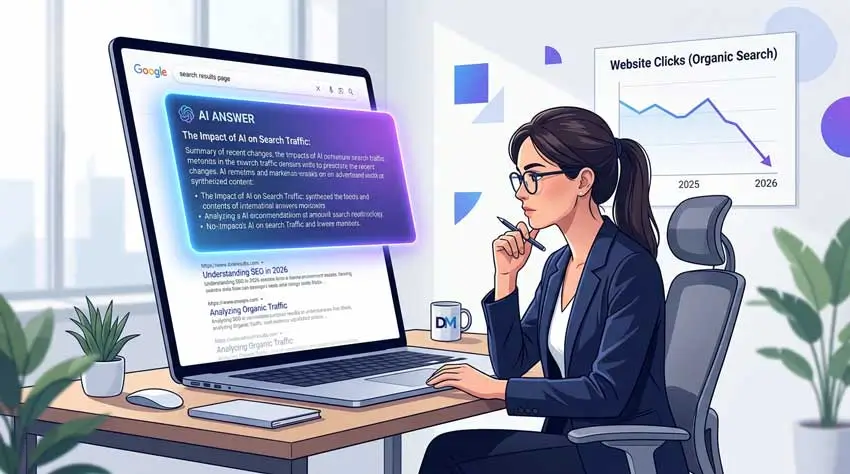
To stay visible, marketers must stop focusing only on “ranking for clicks” and start optimizing for citations in AI answers, using tools like Semrush One to track brand visibility across both traditional SERPs and AI-generated results.
The Great Traffic Erosion: A Structural Shift
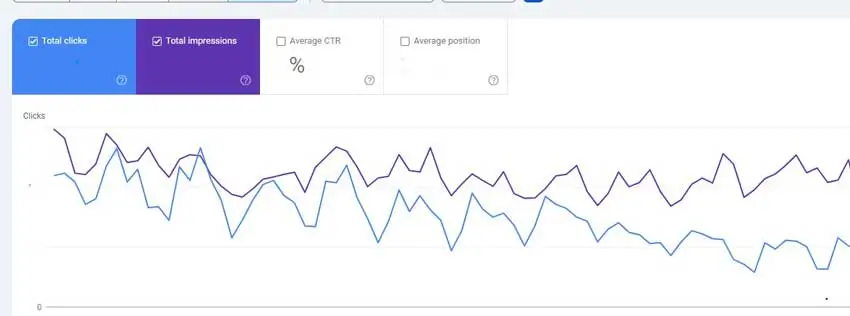
Over the past two years, digital marketers have started noticing a clear shift in traffic patterns. It often starts as a quiet pattern in Google Search Console: impressions hold steady, rankings look fine, but clicks keep sliding down month after month.
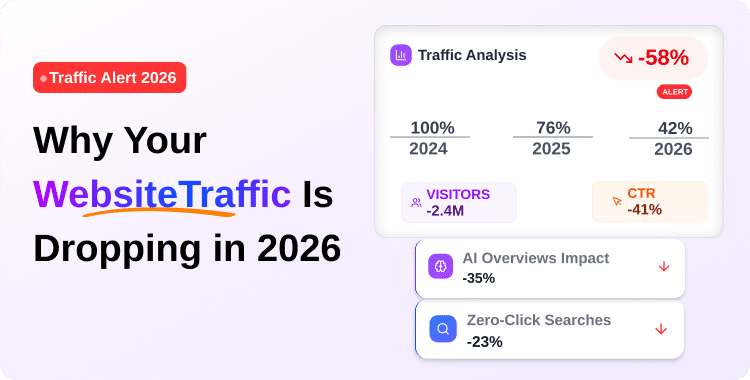
A study tracking 64 publisher websites, collectively receiving over 1.7 billion organic clicks per quarter, found a staggering 42% decline in organic search traffic between Q1 2023 and Q4 2025 (Define Media Group, 2026). This is not about one update, a technical bug, or “bad content.” It is the result of Google redesigning search to keep users inside its own ecosystem.
It feels like we’re moving into what many call a ‘closed-loop ecosystem. Understanding this shift and adapting to it is now one of the most important jobs for any website owner.
The Rise of the Zero-Click Reality
For most of Google’s history, the deal was simple: you publish content, Google indexes it, and in exchange, it sends traffic to your website. That basic model is clearly changing now. Today, Google uses your content to answer the query directly on the SERP, and often never sends the visitor to your site at all.
The Numbers Tell the Story
SparkToro’s research shows that more than 60% of Google searches in the US now end without the user clicking on any external website. On mobile, where AI Overviews can take up the entire initial screen, several studies suggest that zero‑click behavior is even more common.
Click‑through rate data paints the same picture. A September 2025 study by Seer Interactive found that when an AI Overview appears for a query, the average CTR for the top organic result drops from 1.62% to just 0.61%, a fall of more than 60%. In other words, “Position 1” still exists, but much of its traffic advantage has been hollowed out by AI.
The “Ask Maps” and AI Mode Trap
The zero‑click problem does not stop at standard web results. Google’s Ask Maps feature now gives conversational recommendations for local businesses, like where to eat or which plumber to call without users ever opening a business’s website.
At the same time, AI Mode retention elements such as the “Ask about this” overlay are designed to keep users inside the AI interface just as they are about to click out to an external page. This is clearly designed to keep users inside Google instead of visiting your site.
The Citation Economy: Who Is Google Actually Citing?
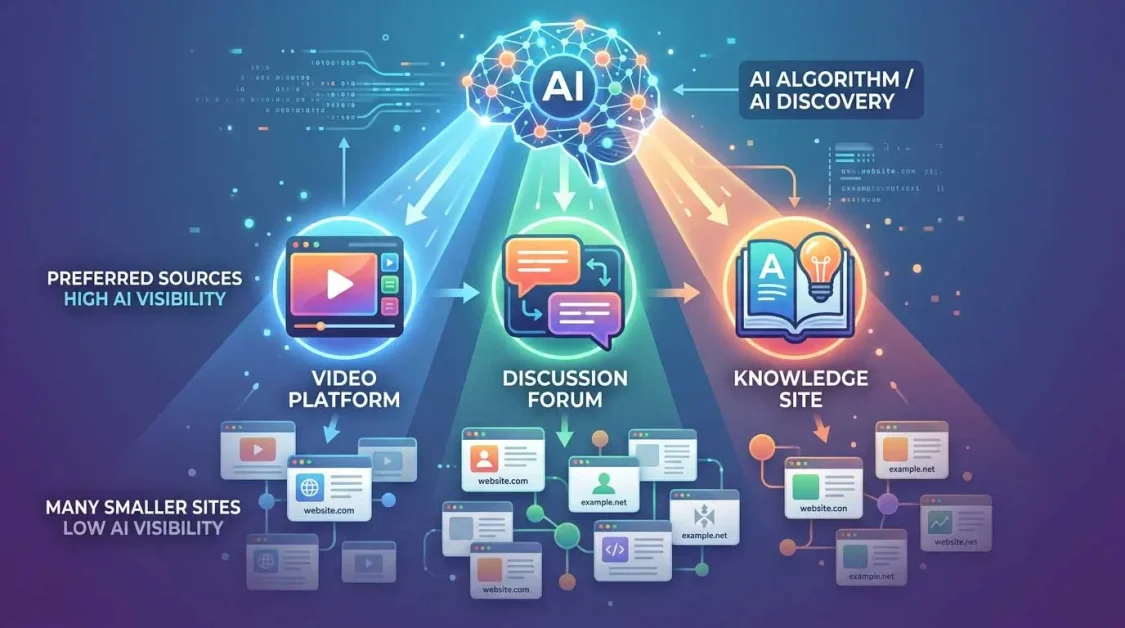
In this new landscape, trying to “win” by only aiming for Position 1 is no longer enough. When Google itself is answering the question, your real goal is to be the source that the AI cites when it constructs those answers.
An analysis of 1.3 million AI Mode citations, referenced in Semrush One’s AI Overview & Zero‑Click briefing, revealed a clear hierarchy of trust. The most frequently cited sources are:
- Google’s own verticals (Flights, Hotels, Shopping, etc.)
- YouTube (also owned by Google)
- The “trust giants”: Reddit, Wikipedia, Amazon, and a handful of large publishers
If your brand is missing from the pool of sites that AI systems pull from, you effectively disappear from the user’s decision‑making journey, even if you technically still rank in the traditional 10 blue links.
This is where Semrush One’s AI Overview Tracking becomes essential: it lets you see whether your brand is being cited, mentioned, or ignored inside AI answers across Google AI Overviews, ChatGPT, Perplexity, and Gemini, instead of relying only on click‑based metrics.
The Attribution Crisis: When Metrics Stop Making Sense
Many marketers are seeing a confusing pattern in their dashboards. I noticed this exact pattern in my own GSC dashboard:
- Rankings look stable
- Brand searches may be up
- Direct traffic is flat or slightly improving
- But organic clicks from Google are clearly down
What is happening? In many cases, AI is recommending your brand inside an AI Overview, so users are still seeing and considering you. But because they get enough information without clicking, that visibility never shows up as a session in Google Analytics.
Early reports from agencies like Rise at Seven suggest that when brands do appear inside AI answers, conversions can actually improve, even as overall click volume drops. The visitors who still click have already been “pre‑sold” by the AI answer.
The real problem, then, is not just disappearing traffic. It is that traditional analytics tools were not built to measure off‑site AI visibility. That gap is the attribution crisis: your KPIs are stuck measuring a version of the web that no longer reflects how people discover and evaluate brands.
The Silver Lining: Google Discover Is Booming
The news is not all bad. While classic web search is sending fewer clicks, Google Discover—the personalized content feed in the Google app and Chrome—is growing rapidly. For some major publishers, Discover has already overtaken traditional web search as the top traffic source.
Why is Discover growing while organic clicks from search shrink?
- It rewards E‑E‑A‑T (Experience, Expertise, Authoritativeness, Trustworthiness)
- It favors fresh, timely, and visually rich content.
- It leans into real human perspective and storytelling.
These are things a static AI answer struggles to replace. An AI snippet can summarize facts, but it cannot match a first‑person case study, a deep opinion piece, or a timely analysis of breaking news in your niche.
The takeaway: you should not abandon SEO, but you should expand your surface area. Create content that both:
- Feeds Discover with original, human‑authored stories, and
- Is structured in a way AI systems can easily quote and attribute.
How to Fight Back: A 3‑Step Strategy for 2026
You cannot win a 2026 visibility war with a 2020 SEO playbook. Here is a practical framework to start adapting.
Step 1: Audit Where AI Is Cannibalizing Your Clicks
Start in Semrush One’s Position Tracking:
- Sort your keywords by impressions and CTR.
- Look for queries where you rank well but have near‑zero CTR.
- Cross‑check those keywords to see if an AI Overview appears on the SERP.
Those keywords are likely being cannibalized by AI. For them, further optimizing for a higher blue‑link position brings diminishing returns. Instead, consider:
- Re‑targeting them as longer, more conversational queries.
- Targeting adjacent questions that AI struggles to fully answer.
- Using them as prompts for FAQs, videos, or richer assets that can win Discover and citation visibility.
Step 2: Structure Content for AI Retrieval and Citation
AI systems don’t “read” your article the way humans do. They look for clean, self‑contained passages they can extract.
To make your content AI‑friendly:
- Turn key answers into short, clear paragraphs that fully address a question in 2–4 sentences.
- Use descriptive subheadings that map closely to the questions your audience asks.
- Implement and validate schema markup (FAQ, HowTo, Article, Product) so entities, authors, and context are clearly defined.
- Avoid burying important information in long, meandering paragraphs.
Semrush One’s Site Audit can flag issues with schema, internal linking, and crawlability that directly affect how well AI systems can understand and reuse your content.
Step 3: Diversify Your Presence Beyond Traditional SERPs
If AI is citing YouTube, Reddit, and large community platforms, showing up in search now means showing up across the wider web, not just on your own site.
Actions to consider:
- Turn high‑performing posts into YouTube explainers, shorts, or webinars.
- Participate in relevant Reddit threads or expert communities where your brand can add genuine value, not just promotion.
- Publish original research, opinion pieces, or case studies that other sites naturally reference.
Use Organic Research and Keyword Gap in Semrush One to see:
- Which domains and platforms currently dominate citations around your target topics?
- Where competitors are earning mentions and AI visibility that you are not.
- Which keywords and surfaces are still delivering meaningful clicks, and which have become primarily awareness channels?
If you want to see exactly where AI is stealing your clicks, start a 7‑day free trial of Semrush One and run an AI Overview and Position Tracking audit on your top keywords.
Why Semrush One Fits This New Reality
Search is now fragmented across:
- Traditional Google results
- AI Overviews and Gemini
- ChatGPT, Perplexity, and other LLMs
- Google Discover
- Maps and local packs
No single classic metric can capture all of that. Semrush One is designed to be the visibility and measurement layer for this new environment.
Key tools to highlight:
- Position Tracking: Monitors your classic keyword rankings and shows where AI Overviews are pushing down your results. AI Overview Tracking” Reveals whether your brand is cited, mentioned, or missing from AI‑generated answers across major AI surfaces.
- Keyword Gap: Finds keywords where competitors are getting AI citations or rankings, and you are not, so you can prioritize the right topics.
- Site Audit: Checks your technical and structural readiness for AI retrieval, including schema, internal links, and content structure.
- Organic Research: Benchmarks your organic and AI‑adjacent visibility against competitors, so you can see where the traffic is shifting.
👉 Ready to map your true AI visibility? Start your Semrush One 7‑day free trial and see where your brand actually appears across SERPs, AI Overviews, and Discover.
Old SEO vs. 2026 AI‑Driven SEO
| Dimension | Old SEO (Pre‑2024) | AI‑Driven SEO (2026) |
| Primary goal | Get clicks to your website | Earn AI citations and brand mentions |
| Key metric | Keyword ranking position | “Share of Model” / AI visibility |
| Content focus | Long “ultimate guides” for every term | Clear, structured answer passages plus deep pieces |
| Discovery | Classic Google SERP (10 blue links) | AI Overviews, Discover, Maps, Gemini, social, LLMs |
| Measurement | Rank tracker + Google Analytics | Semrush One unified platform + outcome‑based KPIs |
| Success signal | Organic traffic volume | Citation frequency and downstream conversions |
Frequently Asked Questions
Is SEO dead in 2026?
No. What is disappearing is the idea that SEO success equals “more organic clicks, full stop.” SEO is evolving into Answer Engine Optimization (AEO), where the goal is to become the trusted source AI pulls from, not just to appear as one blue link among many.
How can I see if AI is citing my website?
Use AI Overview Tracking inside Semrush One. It shows you, at the keyword level, whether your brand appears inside Google AI Overviews and other AI surfaces, and how often you are being cited compared to competitors.
My rankings are good, but my traffic is falling. Why?
That is classic zero‑click behavior. When an AI Overview appears above your result, many users get their answer without scrolling or clicking through. Studies show this can cut top‑result CTR by more than 60% on affected queries. The solution is to aim for in‑box citations and to shift some of your focus to Discover, brand, and multi‑surface presence.
Is Google Discover worth investing in?
Yes, especially if you publish original, human‑authored content. Discover has become a major traffic source for many sites and rewards the very things AI struggles to fake: strong E‑E‑A‑T, timely insights, and engaging visuals.
Conclusion: The Traffic Has Not Disappeared, It Has Changed Shape
The 42% drop in organic traffic many publishers saw between 2023 and 2025 is not a temporary glitch. It is the signature of a permanent structural change in how search works. In many cases, Google is no longer a gateway to the open web—it is the destination where the entire interaction happens.
But the audience has not vanished. People are still searching, learning, and deciding what to buy. Much of that now happens inside AI experiences and feeds instead of on your page.
Your job in 2026 is to:
- Make your brand the source AI trusts and cites,
- Track visibility where it actually happens (not just where it used to),
- And measure success in terms of outcomes and brand influence, not only raw click counts.
👉 Try Semrush One Free and audit your AI visibility today.
Affiliate Disclosure: This post contains affiliate links to Semrush One. If you purchase through my link, I may earn a commission at no additional cost to you. I was also incentivized to create this content as part of the Semrush Affiliate Flash Promo Bonus program. All opinions are my own.