The ROI of Odoo for Retail: Real Numbers on How Omnichannel Integration Drives Sales and Loyalty

The retail landscape has fundamentally transformed. Today’s consumer expects seamless shopping across channels, browsing online while checking store inventory in real time, purchasing in-store while expecting home delivery, or ordering online and picking up the same day. This omnichannel complexity demands more than fragmented systems; it requires a unified, data-driven approach to operations.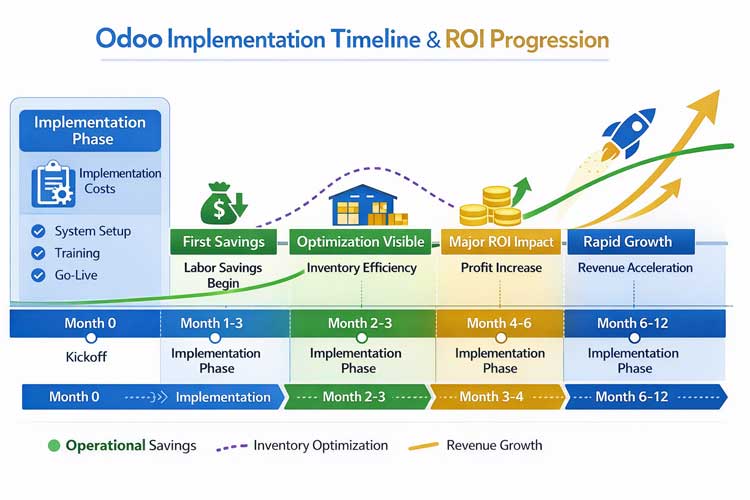
Enter Odoo for retail. As an integrated ERP solution, Odoo has become a game-changer for retailers seeking to optimize operations while maximizing profitability. The evidence is compelling: retailers leveraging Odoo’s omnichannel capabilities report dramatic improvements in inventory management, customer retention, and ultimately, bottom-line ROI.
In this guide, we’ll explore real-world metrics and actionable insights into how the ROI of Odoo for retail translates into tangible business growth, operational excellence, and sustainable competitive advantage.
Key Takeaways
- 30% operating cost reduction within six months through inventory automation and labor optimization
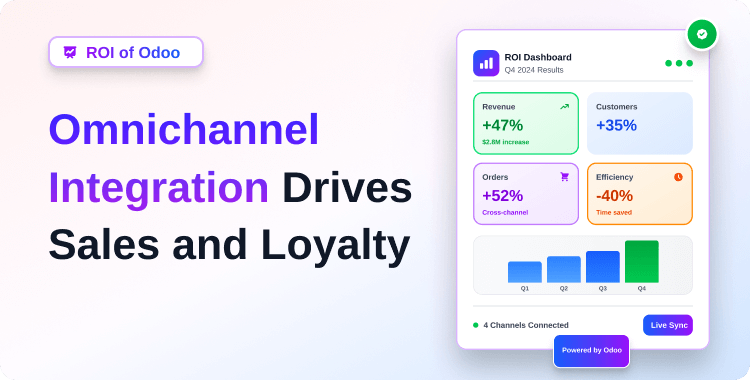
- 45% online sales growth and 18% in-store sales increase with omnichannel integration
- Omnichannel customers spend 2.5x more than single-channel shoppers, driving lifetime value
- 98% inventory accuracy with real-time synchronization across all retail locations
- 40% faster order fulfillment and 20% reduction in logistics costs with intelligent order routing
- 89% customer retention rate for retailers implementing strong omnichannel engagement strategies
Understanding the ROI of Odoo for Retail: Core Concepts
When retail business owners evaluate the ROI of Odoo, they’re assessing much more than software licensing costs. True ROI encompasses the financial and operational improvements generated by streamlined processes, reduced errors, improved inventory turns, faster sales cycles, and enhanced customer retention.
What comprises ROI in retail?
- Cost Savings: Reduced labor costs, lower holding costs, fewer markdowns, and consolidated IT spending
- Revenue Growth: Increased sales through better inventory availability, omnichannel integration, and targeted customer engagement
- Operational Efficiency: Faster order processing, reduced manual errors, optimized warehouse operations, and improved cash flow
- Customer Lifetime Value: Enhanced retention, increased repeat purchases, and loyalty-driven revenue
For retail, the ROI of Odoo hinges on its core strength: unified data across inventory, sales, customer relationships, and accounting. When these systems operate in silos—as they do in many traditional retail operations—retailers lose visibility, make poor stocking decisions, miss cross-sell opportunities, and experience customer dissatisfaction.
Odoo breaks down these silos, enabling real-time decision-making and operational synchronization that directly translates to profitability.
How Odoo Drives ROI for Retail: In-Depth Analysis
1. Inventory Management & Cost Reduction
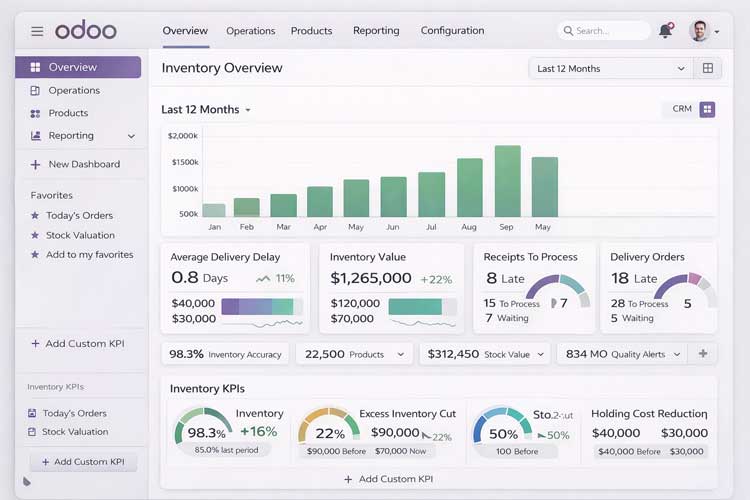
One of the most immediate and measurable ROI drivers in retail is inventory optimization. A mid-sized omnichannel retailer implementing Odoo achieved a 30% operating cost reduction ($200,000 annually) within six months—largely through inventory automation.
How does this happen?
Odoo’s real-time inventory tracking connects point-of-sale systems, e-commerce platforms, and warehouse management into a single source of truth. When a customer purchases online or in-store, inventory updates instantly across all locations. This eliminates the twin problems of overstocking (excess capital tied up) and stockouts (lost sales).
The impact is quantifiable:
- Inventory holding costs fell 25% through better demand forecasting and replenishment automation
- Inventory accuracy improved to 98% (up from 82%), reducing write-offs and markdowns
- Stockout incidents dropped by 50%, directly protecting revenue
- Excess inventory was cut by 22%, freeing up warehouse space and reducing carrying costs
In practical terms, a retailer managing nine stores saw synchronized inventory updates at the point of sale within seconds. When a customer checked product availability via an in-store kiosk or online, the system reflected true stock levels—no surprises at checkout, no disappointed customers.
2. Operational Efficiency & Labor Optimization
The ROI of Odoo for retail extends to labor productivity. The platform automates repetitive, error-prone tasks that consume disproportionate time without adding customer value.
Before Odoo: Manual spreadsheet-based inventory reconciliation took 16+ hours each week. Month-end financial close required 8 days of manual journal entries and bank reconciliation.
After Odoo: Week-end POS settlement automatically reconciles cash drawers and payment methods in 2–3 hours. Month-end close completes in 2–3 days. The time saved? Redirected to customer service and strategic initiatives.
Retailers report labor cost reductions of 15% without cutting staff—employees work smarter, not harder. Additional benefits include:
- Automated invoice generation and payment reminders reduce accounts payable delays
- Barcode scanning and wave picking accelerate warehouse operations and reduce picking errors
- Centralized employee scheduling improves shift optimization and reduces overtime
3. Omnichannel Sales Growth
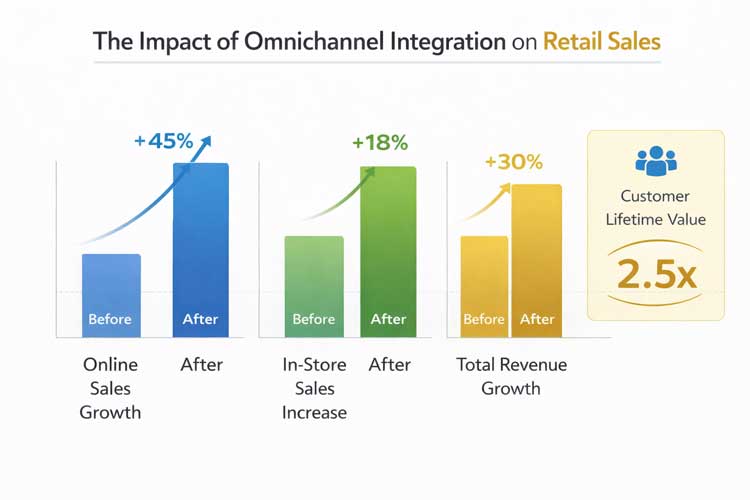
The ROI of Odoo for retail becomes transformational when omnichannel integration is properly executed. Real-world case studies demonstrate the magnitude:
Enterprise Retailer Case Study:
- Total revenue increased by 30% post-implementation
- Online sales grew by 45% (not cannibalizing in-store sales)
- In-store purchases increased by 18%, driven by improved stock visibility
- Omnichannel customers had a 2.5x higher lifetime value than single-channel shoppers
How does this happen? Odoo’s integration enables:
Buy Online, Pick Up In-Store (BOPIS): Customers purchase online, inventory is automatically reserved, and fulfillment is routed to the nearest store. This drives foot traffic—80% of online shoppers used BOPIS, capturing high-margin in-store impulse purchases.
Unified Customer Profiles: A customer’s purchase history, preferences, and loyalty points are visible across every channel. A sales associate in-store can see that a customer bought similar products online and recommend complementary items.
Intelligent Order Routing: Odoo analyzes inventory levels, fulfillment costs, and delivery times to route each order to the most efficient source—a local store for same-day pickup, a regional warehouse for next-day delivery, or a supplier for dropshipping. Result: Order fulfillment time dropped by 40%, and logistics costs fell by 20%.
4. Customer Loyalty & Retention
In retail, customer retention is exponentially more valuable than acquisition. Retained customers spend more, cost less to serve, and drive positive word-of-mouth. Odoo’s CRM and loyalty modules directly address this ROI driver.
Real Metrics:
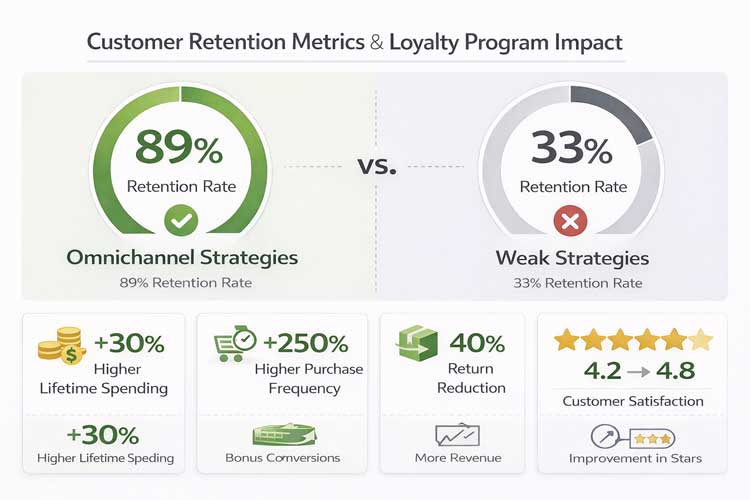
- Companies with omnichannel engagement strategies retain 89% of customers, compared to 33% for weak strategies
- Omnichannel customers spend 30% more over their lifetime than single-channel shoppers
- Purchase frequency is 250% higher with omnichannel engagement versus single-channel
Odoo enables this through:
Personalized Marketing Automation: The system tracks purchase history, browsing behavior, and customer segments. Retailers automatically send targeted campaigns—birthday discounts, loyalty rewards, or product recommendations based on past purchases. One retailer saw repeat customer rate improve by 12–15% within six months.
Loyalty Program Management: Odoo’s loyalty module lets customers earn points on every purchase and redeem them for discounts or exclusive offers. The system tracks redemption rules, point expiration, and tiered benefits (basic, premium, VIP). When customers feel valued through rewards, they return—and buy more.
Proactive Customer Service: CRM integration centralizes all customer interactions—emails, calls, service requests. When issues arise, the system alerts staff to resolve them before they escalate. Lower churn, higher satisfaction.
Real-World Impact: A retailer implementing Odoo-powered loyalty programs saw returns decrease by 40% (due to better product information and inventory transparency) and customer satisfaction scores rise from 4.2 to 4.8 points (out of 5).
5. Data-Driven Decision Making & Strategic Agility
Retail is inherently dynamic—fashion trends shift, competitors launch promotions, inventory imbalances emerge. The ROI of Odoo for retail includes the ability to respond quickly to these changes with confidence.
Real-Time Analytics Dashboards:
- Sales performance by region, product category, and channel
- Inventory turnover rates at the SKU level
- Customer lifetime value and retention metrics
- Forecast accuracy and demand planning insights
A clothing retailer using Odoo-powered analytics discovered that seasonal products had poor turnover in underperforming stores. By analyzing per-location data, the company rebalanced inventory, increasing sales growth by 15% year-over-year without excess markdowns.
Demand Forecasting with Historical Data:
Odoo’s forecasting tools analyze 18+ months of historical sales, seasonal patterns, and market trends. This reduces stockouts and overstocking—and it directly improves inventory turnover, a key profitability metric. The fashion industry case study mentioned earlier showed a 40% improvement in inventory turnover—well above the industry average of 15%.
Feature Comparison: Odoo vs. Traditional Retail Systems
| Capability | Odoo for Retail | Traditional ERPs (SAP, Oracle) | Standalone POS Systems |
| Initial Cost | $24.90/user/month (Online) + implementation | $100K–$500K+ annual licensing | $20–50/user/month |
| Implementation Timeline | 2–4 months typical | 6–12 months or more | 2–6 weeks |
| Omnichannel Integration | Native, real-time synchronization | Requires custom integrations | Limited to in-store |
| Inventory Visibility | Multi-location, real-time, 98%+ accuracy | Real-time (if properly configured) | Per-location only |
| CRM & Loyalty | Integrated natively | Often requires separate modules | Not available |
| Scalability | Modular—start small, expand as needed | Requires significant upfront investment | Limited growth path |
| Cloud vs. On-Premise | Flexible (Cloud or self-hosted) | Primarily on-premise | Cloud-based |
| Time to ROI | 4–6 months typical | 12–18 months typical | 2–3 months (limited scope) |
Why the difference? Odoo’s modular architecture and open-source foundation mean retailers pay only for what they use and can scale affordably. Implementation partners can configure standard features quickly rather than building custom integrations. For mid-market retailers, the cost-to-value ratio is unmatched.
Recommended Blogs for You:
👉 Top 10 Software Development Companies in Bangladesh 2026: Complete Guide
👉 10 Best Social Media Website Templates 2026
👉 Odoo eCommerce ERP Integration: Automating Orders, Inventory, and Payments for Scalable
👉 Why You Haven’t Found The Right WordPress CRM Yet: 7 Honest Reasons
👉 The 5 Hidden Costs of Legacy ERP Systems: Why Businesses Migrate to Odoo
Real-World ROI Metrics: Case Study Summary
Mid-Sized Omnichannel Retailer (9 stores + eCommerce)
Investment: ~$50,000 (software, implementation, training)
Results (6 months):
- Operating cost reduction: $200,000 annually (30%)
- Inventory holding costs: Reduced 25%
- Labor costs: Reduced 15% (~$30,000 annually)
- Order accuracy: Improved 20%
- Payback period: <4 months
- Year-over-year revenue impact: +8–12% (through better availability and loyalty)
Ongoing Annual Costs: ~$30,000 (licensing + support)
3-Year ROI: Cumulative savings of $480,000–$600,000 against $140,000 in total costs = 240–300% ROI.
Omnichannel Integration: The Game-Changer for Retail ROI
Omnichannel isn’t just a buzzword—it’s the primary driver of retail ROI in 2025. Here’s why:
Statistically speaking:
- 89% customer retention for companies with strong omnichannel strategies vs. 33% for weak ones
- 494% higher order rate for campaigns using 3+ channels vs. single-channel
- 9.5% annual revenue growth for effective omnichannel strategies vs. 3.4% for poor ones
- 80% increase in store foot traffic driven by omnichannel strategies
Odoo’s omnichannel capabilities—real-time inventory sync, unified customer profiles, intelligent order routing, and integrated POS—directly enable these outcomes.
A practical example:
A customer browses your website on Friday evening, checking stock availability across stores. Saturday morning, she visits a store, and the associate can see her browsing history and offer personalized recommendations. She makes a purchase in-store, earning loyalty points. Monday, she receives a personalized email suggesting complementary products based on her purchase. She buys online and selects BOPIS for pickup at her nearest location.
This seamless journey across channels is only possible with unified systems like Odoo. Each touchpoint reinforces the brand, and the customer’s lifetime value multiplies.
Advanced Strategies for Maximizing Odoo ROI in Retail
1. Demand Forecasting & Predictive Analytics
Beyond basic inventory tracking, Odoo’s advanced analytics can predict demand patterns, identify seasonal trends, and flag anomalies. Retailers using these tools achieve:
- Reduced stockouts by 50% or more
- Markdown reduction of 15–20% by selling through inventory before obsolescence
- Inventory turnover improvement of 20–40% depending on starting point
2. Supplier Collaboration & Vendor-Managed Inventory (VMI)
Odoo integrates with suppliers for better visibility into lead times, order status, and delivery schedules. Advanced implementations include:
- Automated purchase orders based on stock thresholds
- Supplier performance dashboards tracking on-time delivery and quality
- Collaborative demand planning where suppliers can see demand forecasts and adjust supply proactively
3. Warehouse Automation & Logistics Optimization
Odoo’s warehouse management module, combined with barcode scanning and RFID, enables:
- Wave picking groups orders by destination, reducing picking time by 30%+
- Automated replenishment based on bin locations and demand
- Route optimization reducing last-mile delivery costs by 15–25%
4. Customer Data Platform & AI-Driven Personalization
Odoo’s CRM centralizes customer data—purchases, returns, support tickets, and marketing engagement. When combined with AI:
- Churn prediction flags at-risk customers for proactive retention campaigns
- Product recommendations increase average order value by 10–15%
- Segmented marketing improves email ROI from $36 to $40+ per dollar spent
Odoo Pricing Structure & ROI Impact
Understanding Odoo’s cost model is essential for calculating true ROI.
Odoo Online (Cloud SaaS)
- Pricing: $24.90–$99/user/month depending on modules
- Typical setup: $30,000–$80,000 for implementation
- Advantages: Automatic updates, no infrastructure costs, predictable budgets
- Best for: Retailers wanting cloud flexibility and managed support
Odoo Enterprise (Self-Hosted or Cloud)
- Pricing: Custom enterprise licensing + hosting
- Typical setup: $50,000–$150,000+ for implementation
- Advantages: Full customization, integration flexibility, higher control
- Best for: Large chains requiring advanced customization and integration
ROI Timeline
| Milestone | Timeline | Metric |
| Implementation complete | Months 1–3 | Full system go-live |
| First operational savings | Month 2–3 | Reduced manual processes (labor) |
| Inventory optimization visible | Month 3–4 | Holding costs down, turnover up |
| Revenue impact | Month 4–6 | Omnichannel sales growth, loyalty effect |
| Payback period | Month 4–6 | Investment recovered from savings + growth |
| Full ROI acceleration | Year 1–2 | Continuous process improvements |
For a typical $50,000 investment, retailers see a 4–6 month payback and 100%+ ROI in the first year.
Common Pitfalls & How to Avoid Them
1. Insufficient Data Hygiene Before Implementation
- Problem: Dirty customer or product data transferred into Odoo perpetuates errors.
- Solution: Audit and cleanse data before migration. Invest in data governance protocols post-launch.
2. Underestimating Change Management
- Problem: Employees resisting system changes can undermine ROI.
- Solution: Invest heavily in training (at least 16–20 hours per user). Identify power users as champions. Celebrate early wins.
3. Over-Customization
Problem: Customizing Odoo extensively slows implementation and inflates costs.
Solution: Adopt standard Odoo workflows first, then customize sparingly. Use apps from the Odoo Marketplace for common needs.
4. Failing to Integrate Third-Party Systems
Problem: Odoo works best when fully integrated (e-commerce, shipping, payment processors).
Solution: Plan integrations upfront. Use Odoo’s native integrations where possible. Budget for custom API development if needed.
5. Not Monitoring KPIs Post-Launch
Problem: ROI is invisible if you don’t measure it.
Solution: Set baseline metrics before implementation (inventory turnover, labor hours, customer retention). Review KPI dashboards monthly. Adjust processes based on data.
Security, Scalability & Long-Term ROI
Security & Compliance
Retail handles sensitive customer data (payment information, loyalty program data). Odoo provides:
- Encrypted data storage (SSL/TLS)
- Role-based access control (granular permissions)
- PCI DSS compliance (for payment processing)
- Audit trails (tracking all system changes for compliance)
For retailers operating in regulated markets, Odoo’s security framework reduces compliance costs and mitigates data breach risk.
Scalability
Odoo’s modular architecture means ROI improves as you grow:
- Opening a new store? Add inventory locations and POS terminals; no system overhaul
- Launching a new sales channel (marketplace)? Integrate via APIs; existing workflows scale
- Expanding to new geographies? Multi-currency, multi-language support built in
This scalability ensures that Odoo ROI doesn’t peak—it compounds over time as operations expand.
Frequently Asked Questions
Q: What is the typical ROI of Odoo for a retail business?
A: Most retailers see 100–300% ROI in the first year through cost savings and revenue growth. A $50,000 investment typically generates $50,000–$100,000 in annual benefits. Payback occurs in 4–6 months.
Q: How does Odoo’s omnichannel integration improve sales and loyalty?
A: Omnichannel integration enables seamless shopping across channels (in-store, online, mobile) with unified inventory and customer data. This drives higher conversion rates, increases average order value, and improves customer lifetime value by 30%–250%.
Q: Is Odoo a good investment for retail businesses?
A: Yes, especially for mid-market retailers ($5M–$50M+ revenue) seeking to streamline operations and compete with larger players. The modular pricing, fast implementation, and measurable ROI make it one of the most cost-effective ERP solutions for retail.
Q: How long does it take to see ROI from Odoo?
A: Initial benefits (labor savings, faster order processing) appear in months 2–3. Significant ROI (from inventory optimization and revenue growth) is visible by months 4–6. Full compound ROI accelerates in years 2–3 as processes mature.
Q: What specific metrics should retailers track to measure Odoo ROI?
A: Key metrics include inventory turnover, holding costs, labor hours, order fulfillment time, customer retention rate, average order value, and revenue per employee. Dashboard monitoring of these KPIs should occur monthly.
Q: How does Odoo compare to competitors like SAP or Shopify Plus?
A: Odoo is significantly more affordable than SAP or Oracle (50–70% cost savings) while offering comparable functionality for mid-market retailers. vs. Shopify Plus: Odoo provides deeper backend integration (accounting, HR, manufacturing), whereas Shopify excels in the eCommerce front-end. Many retailers use both in tandem.
Q: Can Odoo integrate with existing systems (POS, e-commerce, shipping)?
A: Yes. Odoo has native integrations with major platforms (Shopify, WooCommerce, PayPal) and APIs for custom integrations. Implementation partners can typically connect existing systems in 2–6 weeks.
Partner with HasTech IT LTD: Your Trusted Odoo Implementation Expert
Choosing the right Odoo implementation partner is critical to realizing the ROI potential outlined in this guide. HasTech IT LTD, an official Odoo Partner headquartered in Dhaka, Bangladesh, specializes in delivering enterprise-grade Odoo solutions tailored to retail and eCommerce businesses.
Why HasTech IT LTD?
With 10+ years of product development experience and a dedicated team of certified Odoo consultants, HasTech brings proven expertise to complex retail implementations. The company has successfully deployed Odoo across diverse sectors—manufacturing, retail, eCommerce, and service industries—with a deep understanding of Bangladesh-specific business requirements (NBR compliance, VAT automation, local payment gateways).
Top Services Provided by HasTech IT LTD
1. Odoo ERP Implementation & Configuration
- Complete Odoo system setup from discovery to go-live
- Module configuration tailored to retail operations (POS, inventory, sales, accounting)
- Multi-store and omnichannel-ready architecture
2. eCommerce Development & Integration
- Shopify, WooCommerce, and custom eCommerce platform development
- Seamless Odoo-to-eCommerce integration for unified inventory management
- Shopping cart optimization and conversion rate improvement
3. Odoo Customization & Development
- Advanced module customization for unique retail workflows
- Custom feature development (loyalty programs, advanced reporting, AI-driven personalization)
- Integration with third-party systems (payment gateways, shipping providers, CRM platforms)
4. Web & Mobile App Development
- Custom retail management mobile applications
- Responsive website development for omnichannel retail
- Inventory tracking and order management apps
- Customer-facing loyalty and engagement apps
5. System Integration & API Development
- Seamless integration with local and international payment gateways (bKash, Nagad, Stripe)
- Third-party logistics provider integration for automated fulfillment
- Bank API integration for automatic reconciliation
- IoT and hardware integration for advanced inventory tracking
6. Data Migration & Legacy System Transition
- Safe migration from existing Tally, SAP, or spreadsheet-based systems
- Data cleansing and validation to ensure 98%+ accuracy
- Minimal downtime during transition with parallel running strategies
- Complete backup and rollback procedures
7. User Training & Change Management
- Comprehensive multi-level training (end-users, power users, administrators)
- Documentation in English and Bengali for accessibility
- Train-the-trainer programs to build internal expertise
- 30-60 day hypercare period with dedicated support team
8. Post-Implementation Support & Maintenance
- 24/7 technical support during critical deployment phases
- Annual Maintenance Contracts (AMC) with guaranteed response times
- System performance monitoring and optimization
- Regular health checks and proactive issue identification
9. Odoo AI Automation & Advanced Analytics
- AI-powered demand forecasting for inventory optimization
- Intelligent order routing and fulfillment optimization
- Automated customer segmentation for targeted marketing
- Advanced business intelligence dashboards
10. Industry-Specific Solutions
- Retail-specific Odoo configurations optimized for FMCG, fashion, electronics, and specialty retail
- Manufacturing-to-retail supply chain integration
- Multi-location inventory management across store networks
- Warehouse automation and logistics optimization
HasTech’s Proven Track Record
- Certified Odoo Partner with official partnership status
- 1,700+ completed projects across web, mobile, and eCommerce sectors
- 45+ full-time certified consultants with deep Odoo expertise
- Global presence serving businesses across 150+ countries
- Bangladesh expertise understanding local compliance, payment systems, and business workflows
- Proven ROI delivery: Clients report 30%+ cost reductions and 4-6 month payback periods
How HasTech Ensures Implementation Success
- Detailed Business Analysis: Workshops and process mapping to understand your current operations and pain points
- Fit-Gap Analysis: Identifying customization needs and leveraging Odoo’s out-of-the-box capabilities first
- Phased Implementation: Iterative approach with conference room pilots to gather feedback and refine solutions
- Comprehensive Testing: 100+ test scenarios covering functionality, integration, and performance
- Knowledge Transfer: Complete documentation, video tutorials, and hands-on training ensuring team self-sufficiency
- Risk Mitigation: Proven methodologies reducing implementation risk by 90%+
- Ongoing Optimization: Quarterly health checks, proactive optimization recommendations, and strategic reviews
Ready to Realize the ROI of Odoo for Your Retail Business?
Partner with HasTech IT LTD to transform your retail operations with a proven, certified Odoo implementation. From initial consultation to post-implementation optimization, HasTech provides end-to-end support ensuring you achieve the 30%+ cost reductions, 45% revenue growth, and 4–6 month ROI payback demonstrated in real-world case studies.
Contact HasTech IT LTD Today:
- Website: HasTech IT LTD
- Email: Available on Contact
- Location: Dhaka, Bangladesh
- Services Overview: Services
Conclusion: The Strategic Value of Odoo for Retail
The ROI of Odoo for retail extends far beyond software licensing. It’s a strategic investment in operational excellence, customer experience, and sustainable profitability. Retailers implementing Odoo report:
- 30% cost reductions through inventory and labor optimization.
- 30%+ revenue growth from omnichannel integration and improved availability.
- 89% customer retention through loyalty programs and personalized engagement.
- 4–6 month payback periods with compound returns in subsequent years.
In a market where thin margins, complex omnichannel expectations, and rising competition define success, Odoo provides the unified data infrastructure and operational efficiency required to thrive. Whether you operate a single boutique or a multi-state chain, Odoo scales affordably and delivers measurable, defensible ROI.
The question is no longer “Can we afford Odoo?” but rather “Can we afford not to implement Odoo?” For retail leaders serious about digital transformation and sustainable growth, the answer is clear.
Ready to unlock the ROI potential of Odoo for your retail business? Connect with an Odoo-certified implementation partner to assess your specific needs, build a business case, and begin your transformation journey today