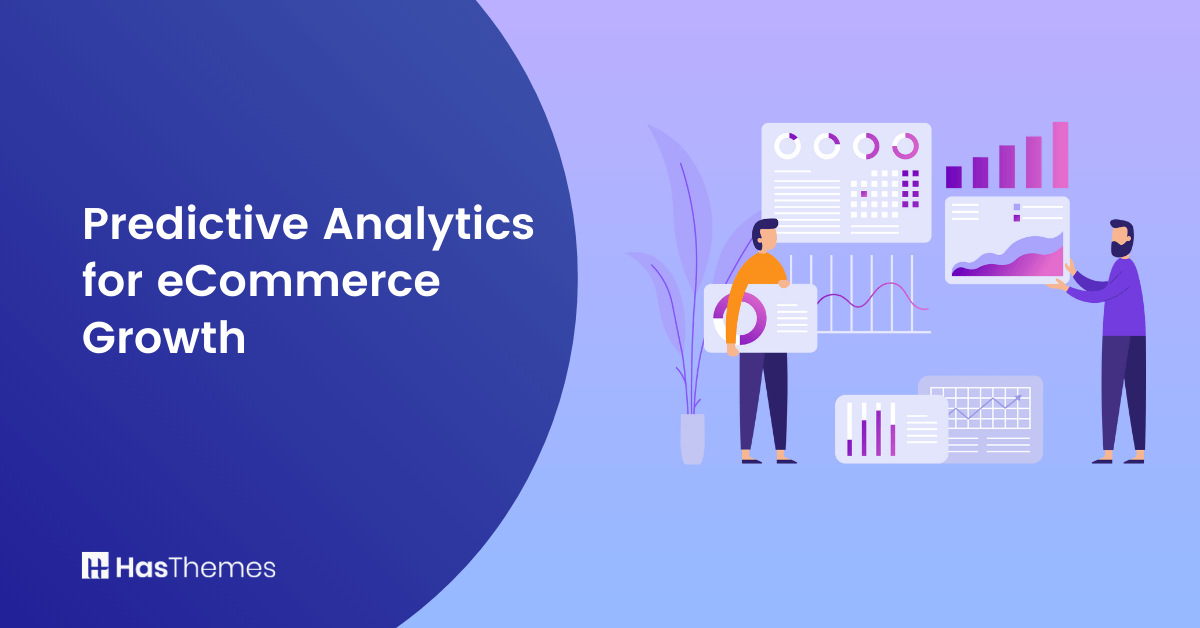
Predictive Analytics for eCommerce Growth

Have you ever wondered what goes on in the minds of your customers while they’re shopping?
What are they on the hunt for while surfing websites, or what are their interests?
For example, are they fitness freaks, foodies, bookworms, or tech geeks?
Or have you thought about how you can send a recommendation for products they have been searching for?
Or better yet, predicted when a customer might leave your store and took action to keep them?
Or dynamically adjusted your prices in real-time to maximize profit while remaining competitive?
Well, these seemingly uncanny abilities are possible through predictive analytics.
So, what is predictive analytics?
It can be simply described as the crystal ball of e-commerce. It allows business owners to use historical and current data to identify trends and predict customer behavior, thereby making informed decisions.
It also helps people like you, online retailers looking to build a new website or a new website theme. It guides you to get better insight into what will make customers respond to your call to action or buy your products.
Predictive analytics in eCommerce uses artificial intelligence (AI) and machine learning algorithms to forecast future outcomes based on historical data, enabling businesses to make data-driven decisions that directly impact revenue growth, customer retention, and operational efficiency.
A super important tool, right?
In fact, the global predictive analytics market is projected to grow exponentially, and businesses adopting these technologies are seeing remarkable results: a 30% boost in customer retention, 25% higher profit margins, and up to 22% increase in profitability through dynamic pricing optimization.
Now, let’s delve into the benefits of predictive analytics in e-commerce.
- What is Predictive Analytics in eCommerce?
- Benefits of Predictive Analytics in eCommerce
- Identifying Trends
- Personalized Experiences
- Optimizing Business Strategies
- Forecasting Demands
- Minimizing Risks
- Retaining Repeat Customers
- Running Targeted Campaigns
- Real-Time Inventory Management
- Predictive Analytics Applications in eCommerce
- Customer Lifetime Value (CLV) Prediction
- Churn Prediction and Customer Retention
- Dynamic Pricing and Price Optimization
- Getting Started with Predictive Analytics
- Data Collection and Storage
- Choosing the Right Tools
- Building Predictive Models
- Implementation and Monitoring
- Tips for Implementing Predictive Analytics
- The Future of Predictive Analytics in eCommerce
- Frequently Asked Questions
- Conclusion
HT Easy GA4
#1 📈 Google Analytics Plugin for WordPress
🚀 Supercharge your WordPress website with analytical insights. (Including WooCommerce Report)
What is Predictive Analytics in eCommerce?
Predictive analytics in eCommerce is the practice of using artificial intelligence (AI), machine learning algorithms, and statistical modeling to analyze historical and current data in order to forecast future customer behavior, market trends, and business outcomes.
Businesses can forecast future customer behavior and make smarter decisions by analyzing patterns and trends.
For example, it lets you know what products will likely sell out so you can stock up in advance. It also helps you forecast customer behavior, allowing you to personalize offers and marketing strategies to boost sales and loyalty.
More importantly, predictive analytics enables:
- Anticipating when customers are likely to make purchases
- Identifying which customers are at risk of leaving (churn prediction)
- Optimizing product prices in real-time based on demand and competition
- Personalizing each customer’s shopping experience to maximize engagement
- Preventing fraud before it occurs
A report by MarketsandMarkets highlights that the predictive analytics market is expected to grow from $10.5 billion in 2021 to $28.1 billion by 2026, showcasing its rising importance in trend forecasting.
However, recent 2024-2025 data shows the market is growing even faster, with AI-powered analytics platforms experiencing unprecedented adoption in the eCommerce sector.
Companies leveraging predictive analytics report improvements of 10-15% in revenue and 5-10% reductions in costs through optimized inventory management alone.
Benefits of Predictive Analytics in eCommerce

The benefits of predictive analytics in e-commerce cannot be overlooked. Predictive analytics helps retailers improve operations, customize customer experiences, and grow their business. It can help business owners make more informed decisions about product assortment, pricing, promotions, etc. Here are the comprehensive benefits:
Identifying Trends
Predictive analytics helps analyze data to spot patterns, giving tips on what is in demand and enabling you to predict what customers will buy next. This automatically gives you a head start against competitors.
Businesses using predictive analytics for eCommerce are 2.9x more likely to gain insights that directly improve decision-making.
Advanced trend identification now includes:
- Seasonal pattern recognition combining historical data with weather, local events, and economic indicators
- Emerging product category identification weeks before market saturation
Personalized Experiences
With this tool, you are able to know your customers’ personal style, preferences, and shopping history. This helps you understand them better and offer recommended products tailored to them.
According to Salesforce, 66% of consumers expect companies to understand their unique needs. This has evolved to 70% of consumers now expecting hyper-personalization, with 60% more likely to engage with brands offering personalized recommendations.
With machine learning models such as classification and neural networks, retailers can provide personalized product and service recommendations.
2024-2025 personalization innovations include:
- Conversational shopping assistants powered by NLP (Natural Language Processing) – like Zalando’s AI Shopping Assistant.
- Real-time product recommendations based on browsing behavior, not just purchase history.
- Personalized email content, product bundles, and offers tailored to individual preferences.
- Dynamic landing pages that adapt to each visitor’s profile and intent.
Optimizing Business Strategies
It analyzes data to uncover otherwise hidden insights to guide you toward the most influential business strategies. This helps business owners make smarter decisions, ultimately leading to success.
For instance, advanced data analytics uncovers patterns that guide decisions on pricing, product placement, and promotions.
Forecasting Demands
eCommerce predictive analytics is critical for accurate demand forecasting. It takes note of trends and predicts what products will be in high demand. As a business owner, you can then use that information to stock up on those products and recommend them to meet your customer’s needs.
According to Statista, inventory mismanagement costs businesses over $1.1 trillion annually, emphasizing the need for efficient predictive models.
Predictive risk management includes:
- Fraud detection using anomaly detection algorithms that identify suspicious transaction patterns
- Supply chain disruption early warnings based on external data monitoring
- Customer churn risk identification to enable proactive retention campaigns
- Demand volatility prediction to prevent stockouts and overstocking
Minimizing Risks
With predictive analytics, you can spot potential threats, such as cyberattacks or issues in demand, inventory, supply chain, etc., from a mile away.
When risks are identified early enough, you are able to take proactive measures to protect your business. Predictive insight enables businesses to anticipate challenges and implement strategies to mitigate risks.
Retaining Repeat Customers
In e-commerce, brand loyalty is essential. Studies show that a mere 5% increase in customer retention can boost profits by 25% to 95%. Predictive analytics can enable retailers to offer the right product to the right customer in the right way and at the right time.
Adobe research found that returning customers spend 3x more per visit than first-time shoppers, making retention a critical driver of profitability.
This approach allows businesses to optimize their communication strategies to confirm purchasing trends. This, in turn, converts new customers to loyal customers.
Running Targeted Campaigns
Due to its ability to identify specific customer segments, preferences, and behaviors, businesses can run targeted campaigns. This will allow for crafting personalized sales messages that resonate with their target audience.
Targeted campaigns have higher chances of getting engagement and an increase in conversion.
Real-Time Inventory Management
Predictive analytics offers a smart inventory management service that uses advanced analytics tools to monitor demand trends. It predicts demand so businesses can stock up on the right products.
For example, data scientists use predictive models to ensure businesses stock the right products in quantities. It also prevents stockout as long as the products are in demand. This service will help businesses reduce costs and increase customer satisfaction.
Recommended Blog for You:
👉 How to Install Google Analytics on WordPress
👉 Facebook Pixel vs Google Analytics
👉 5 Best WooCommerce Google Analytics Plugins
👉 The Best Google Analytics Plugins for WordPress
Predictive Analytics Applications in eCommerce
Customer Lifetime Value (CLV) Prediction
Customer Lifetime Value (CLV) is one of the most critical metrics for eCommerce success, yet many businesses ignore it while pouring resources into customer acquisition. Predictive CLV modeling helps you:
Calculate CLV Formula: CLV = (Average Order Value × Purchase Frequency) × Average Customer Lifespan
Example Calculation: – Average Order Value: $80 – Purchase Frequency: 4 times per year – Average Customer Lifespan: 3 years – CLV = $80 × 4 × 3 = $960 per customer
Why CLV Prediction Matters:
- 5% increase in retention = 25-95% increase in profits (according to Adobe)
- Returning customers spend 3x more per visit than first-time shoppers
- High CLV customers typically have 90% lower churn rates
CLV-Based Customer Segmentation:
- High-Value Tier: CLV $500-$2,000 – Target for upsells and loyalty programs
- Standard Tier: CLV $100-$500 – Focus on repeat purchase incentives
- At-Risk Tier: CLV declining – Implement win-back campaigns
How to Improve CLV Through Predictive Analytics:
- Identify high-CLV customer characteristics and look-alike audiences
- Predict which customers are likely to become high-value repeat buyers
- Tailor retention strategies based on predicted CLV trajectory
- Optimize marketing spend toward high-CLV segments
- Forecast revenue based on CLV growth strategies
Real-World Impact: Companies that prioritize CLV prediction see 20-30% improvement in customer retention and 15-25% higher profit margins compared to acquisition-focused competitors.
Churn Prediction and Customer Retention
Churn prediction is a game-changer for eCommerce businesses. Rather than reacting to lost customers, predictive models identify at-risk customers before they leave, enabling proactive retention.
Churn Prediction ML Algorithms:
1. Logistic Regression
- Determines probability of customer churn based on historical behavior
- Simple, interpretable, good for baseline predictions
2. Random Forests
- Identifies multiple decision trees to predict churn likelihood
- Handles complex relationships in customer data
- Top-performing for retail applications
3. Neural Networks
- Detects complex patterns in customer behavior
- Handles large datasets and non-linear relationships
- Higher accuracy but requires more data and computational power
4. Gradient Boosting Machines (GBM)
- Ensemble method combining multiple weak learners
- Excellent at capturing nuanced churn patterns
- Industry standard for enterprise implementations
5. Time-Series Models (LSTM, RNN)
- Captures temporal trends in customer engagement
- Useful for subscription and recurring purchase models
- Predicts churn windows with high precision
Early Warning Signs of Churn (What to Monitor):
- Declining purchase frequency over past 3-6 months
- Reduced order values or basket size
- Decreased website engagement (clicks, time on site)
- Negative customer support interactions or complaints
- Inactive email engagement (unopened emails, no clicks)
- Long time since last purchase relative to historical patterns
Retention Strategies Based on Churn Predictions:
- Personalized Incentives: Offer targeted discounts or exclusive products to at-risk customers
- Proactive Outreach: Send personalized re-engagement emails before they churn
- VIP Support: Assign dedicated customer service for high-value at-risk customers
- Win-Back Campaigns: Use AI to craft compelling comeback offers
- Product Recommendations: Suggest complementary products they might enjoy
- Loyalty Program Boosts: Offer bonus points or exclusive member benefits
Measurable Results: Businesses implementing churn prediction see 20-30% improvement in retention rates, directly translating to 5-15% increase in revenue. One major retailer reported reducing churn by 23% through ML-driven retention campaigns.
Dynamic Pricing and Price Optimization
Dynamic pricing powered by AI is revolutionizing eCommerce profitability. Instead of static prices, businesses now adjust prices in real-time based on demand, competition, inventory, and customer segments.
Why Dynamic Pricing Matters:
- AI-powered dynamic pricing can increase profitability by up to 22%
- Can lower excess inventory by 30%
- AI considers up to 60+ variables vs. traditional rule-based systems using only 3
- Real-time market responsiveness enables competitive advantage
Variables AI Pricing Algorithms Analyze:
- Sales and transaction data (historical prices, velocity, trends)
- Product master data (category, attributes, demand elasticity)
- Cost data (COGS, margins, fulfillment costs)
- Competitor data (competitor prices, promotional activity)
- Market data (seasonality, economic indicators, weather)
- Customer data (segment, purchase history, price sensitivity)
- Time-oriented data (day of week, time of day, holidays)
- Inventory levels (excess stock, slow movers, fast movers)
AI Pricing Algorithm Types:
1. Regression Models
- Forecast optimal prices using historical data
- Simple to implement, easy to understand
- Good for baseline pricing strategies
2. Classification Models
- Segment customers by price sensitivity
- Create personalized pricing strategies
- Enable dynamic bundling and offers
3. Reinforcement Learning Models
- Learn optimal pricing through trial and error
- Continuously adapt based on outcomes
- Maximize revenue through iterative optimization
Dynamic Pricing Strategies:
Time-Based Pricing:
- Seasonal pricing adjustments based on historical demand
- Day-of-week optimization (higher prices on high-traffic days)
- Hour-of-day optimization for specific time windows
- Product expiration or freshness-based pricing
Demand-Based Pricing:
- Increase prices when demand is high and inventory is low
- Lower prices when demand is low or competition increases
- Real-time demand forecasting triggers pricing adjustments
- Margin protection through algorithmic pricing floors
Competitor Pricing Module:
- Monitor competitor prices in real-time
- Analyze competitor promotional cycles
- Maintain competitive pricing while protecting margins
- Dynamic markup based on competitive landscape
Personalized Pricing:
- Adjust prices based on individual customer value and willingness to pay
- Discount pricing for price-sensitive segments
- Bundle recommendations based on purchase history
Results from AI Dynamic Pricing:
Case Study: A major retailer implemented AI-driven dynamic pricing and saw 5-15% increases in profit margins within 3 months. Another company reduced excess inventory by 22% while maintaining revenue targets through optimized dynamic pricing.
Getting Started with Predictive Analytics
Predictive analytics is not a tough task. All you need to do is follow the right steps make use of the right tools, and you are well on your way to enjoying its significant benefits.
Here are some steps to get started:
Data Collection and Storage
Effective predictive analytics in eCommerce begins with gathering and organizing relevant data.
Identify Relevant Data: The first step is to identify data that is relevant to your e-commerce operations. Some include customer interactions, website analytics, sales records, product data, inventory levels, customer service interactions, email engagement metrics, payment information, and external market data; afterward, the data is then collated. This data forms the foundation of your predictive analytics model.
Quality Assurance: This involves ensuring that the collated data are accurate, consistent, and reliable. This is super important, as it will affect the results derived.
Data Storage: Choose a scalable and secure means of storing your data. Cloud-based databases like Google Drive, Dropbox, or OneDrive are recommended for efficient storage of secure, scalable data.
Data Privacy Compliance: Ensure compliance with GDPR, CCPA, and other data privacy regulations when collecting and storing customer data.
Choosing the Right Tools
As a business owner looking to build a new website or improve on an existing one, there are various software tools that you can use to grow your business. For this article, we will be focusing on data analysis and storage tools.
Selecting Tools for Analytics: In choosing the right predictive analytic tools, it is essential to identify your business needs. Many businesses use tools like Tableau, RapidMiner, or Alteryx to analyze data.
You can also take some Excel training to enhance your skills in analytics. Microsoft Excel is a great tool to help you organize, visualize, and analyze your data in a user-friendly way.
Considering Cloud Solutions: Using cloud storage software such as Dropbox, One Drive, or Google Drive means you do not have to invest in expensive hardware to store data.
These platforms offer scalability and easy access to your data from anywhere and at any time. They are also a super smart means of securing your data.
🚀 Supercharge Your Facebook Advertising with Pixelavo!
Unlock the full potential of your Facebook ads. Boost conversions, increase ROI, and reach new heights with Pixelavo’s powerful features.
Building Predictive Models
- Develop Predictive Models: Use a combination of decision trees, deep learning, and advanced analytics tools to create models tailored to your business. The types of predictive models you use should align with your goals, such as forecasting sales or optimizing marketing strategies.
- Leverage Historical Data: Feed your models with clean and well-organized historical data to train them effectively. This ensures your predictions are based on real-world patterns and behaviors.
- Test and Validate: Run simulations to evaluate the accuracy of your predictive models. This helps refine the process and ensures reliability when applying insights to real-world scenarios.
Implementation and Monitoring
Once your predictive analytics techniques are in place, it’s time to put them to work.
- Integrate Insights: Apply insights gained from predictive analytics to improve pricing, product recommendations, and customer behavior predictions. Use these insights to run targeted marketing campaigns and improve customer experiences.
- Monitor Results: Use KPIs to measure the effectiveness of your predictive analytics tools, ensuring they continue to deliver actionable insights. Adjust strategies based on evolving data trends.
Tips for Implementing Predictive Analytics
Implementing predictive analytics can offer valuable insights for businesses, especially in optimizing marketing efforts, sales, and customer engagement. Here are some tips and guidelines that can help you when implementing predictive analytics:
- Start Small and Expand: Start with small steps. Focus on a project and take learnings and feedback before gradually expanding to use predictive analytics in other larger areas.
- Define Clear Objectives: Before you begin, ask yourself, “What am I looking to achieve with predictive analytics?” Answering this important question will help you choose the right tools, which will ultimately aid in achieving your goals.
- Gather Relevant Data: Collect relevant, accurate, and comprehensive data in order to ensure that the insights obtained are precise and reliable.
- Choose the Right Tools: While implementing predictive analytics, it’s important to choose the right tools that align with your business needs. Effective research on analytics tools will come in handy at this point.
- Monitor and Evaluate: After all is done, you should regularly monitor and evaluate the performance of your predictive models to ensure accuracy and effectiveness. This will also help in figuring out if the set objectives have been achieved.
- Plan for Continuous Improvement: Predictive models degrade over time as market conditions change. Schedule regular model retraining (quarterly or more frequently) to maintain accuracy and effectiveness.
Budget Considerations:
- Small businesses: $5,000-$25,000 annually (using affordable SaaS tools)
- Mid-market businesses: $25,000-$100,000 annually (combination of tools + consulting)
- Enterprise: $100,000+ annually (custom solutions, dedicated teams)
- ROI typically exceeds 300-500% within 12-18 months
Grow Your eCommerce Business with Valuable Resources, Tools, and Lead Magnets
- Bring your ideas to life for $1/month
- One platform that lets you sell wherever your customers are—online
- Create a beautiful eCommerce website
- Start for free, then enjoy $1/month for 3 months
- Build your own website in a few steps
- Create a website in minutes easily, secure method
- Turn what you love into what you sell
- Discover the Shopify Point of Sale
- AI Based Business Name Generator
The Future of Predictive Analytics in eCommerce
Predictive analytics already plays a major role in the growth of e-commerce. Currently, it serves as a powerful and reliable means of improving customer relations and business.
As the world of data continues to evolve, here are some future trends to watch out for:
Data Visualization: Data in its raw form can be quite hard to monitor and interpret, even for the most experienced data analysts. Therefore, while it’s already in use, we believe that in the near future, people might come to rely more on the presentation of data in a more visual format.
This will help users better understand rising trends and customer interests in order to make informed decisions.
Greater Accessibility: Every business owner should be able to benefit from the power of predictive analytics. Although it is relatively available and affordable currently, there is a strong belief that it will grow even more soon.
Developers can offer more readily available and user-friendly tools for various needs. This trend will allow more businesses to harness the power of data-driven insights and make informed decisions to drive their eCommerce growth.
More Flexible Customization: Future platforms and apps will likely allow people to customize their solutions. Businesses can tailor and customize their analytic models and tools according to their specific needs and goals. This flexibility will allow organizations to adapt and fine-tune their analytic solutions to address more peculiar challenges and make accurate predictions.
Individualized Attention: Most predictive analytics software currently focuses on broad-stroke insights and high-level takeaways. While this is not a negative, future software iterations might be able to dig deeper into a more individualized level. Predictive analytics will enable hyper-personalization, where every aspect of individual customer journeys will be tailored to their preferences. This will range from product recommendations to marketing messages.
Machine Learning and AI Integration: The integration of Machine learning and artificial intelligence (AI) into predictive analytics will lead to more accurate predictions. This includes advanced techniques like:
- Deep learning models (neural networks, LSTM, transformers)
- Ensemble methods combining multiple algorithms
- Reinforcement learning for ongoing optimization
- Multi-agent AI systems for complex problem-solving
This is because machine learning algorithms can automatically and accurately discover patterns and adapt to changing data, enhancing the predictive power of analytics models.
Federated Learning and Privacy-Preserving AI: As data privacy regulations tighten, businesses will adopt federated learning approaches where models train on data without centralizing sensitive information. This enables powerful predictive analytics while maintaining customer privacy.
Sustainability Integration: Predictive analytics will extend to predicting environmental impact, helping businesses optimize logistics for carbon footprint reduction while maintaining efficiency.
Frequently Asked Questions
What is predictive analytics, and why is it important for eCommerce?
Predictive analytics uses algorithms, historical data, machine learning models, and statistical techniques to forecast future trends and customer behavior. In eCommerce, it helps businesses improve marketing strategies, optimize pricing, and enhance customer experiences to drive growth.
How does predictive analytics improve the understanding of customer behavior in eCommerce?
Predictive analytics provides insights into customer preferences by analyzing customer interactions, shopping patterns, and purchase histories. This enables businesses to tailor their offerings and craft personalized experiences that boost engagement and loyalty.
What is the most used technique in predictive analytics?
Machine learning is the most widely used technique in predictive analytics today. In eCommerce specifically, the most common techniques include:
1. Decision trees and random forests for classification problems
2. Neural networks for complex pattern recognition
3. Gradient boosting machines for high-accuracy predictions
4. Regression models for numerical forecasting.
These techniques enable accurate forecasts of customer behavior and market trends.
How can predictive analytics help with inventory management?
Predictive analytics forecasts product demand using data mining, regression models, deep learning, and external data integration, ensuring businesses stock the right products at the right time. This prevents overstocking, reduces costs, and avoids stockouts, improving real-time inventory management. Companies using AI inventory forecasting see 10-15% revenue increases and 5-10% cost reductions.
Can small businesses benefit from predictive analytics?
Yes, small businesses can use affordable tools and cloud solutions to access predictive analytics insights. They can identify customer trends, optimize pricing, and improve marketing campaigns without requiring significant investment in infrastructure. With SaaS platforms costing $5,000-$25,000 annually and typical ROI exceeding 300-500% within 12-18 months, predictive analytics is now accessible to businesses of all sizes.
What tools are commonly used for predictive analytics in eCommerce?
Popular predictive analytics tools include Google Analytics 4, Tableau, RapidMiner, Alteryx, Looker Studio, Mixpanel, Amplitude, Klaviyo, and Adobe Analytics. These tools process large datasets, offer actionable insights, and forecast trends. Businesses use them to optimize operations, improve marketing, and drive eCommerce growth. For advanced implementations, companies also use big data frameworks like Apache Spark, Hadoop, and Kafka.
What is churn prediction and how does it help my eCommerce business?
Churn prediction uses machine learning to identify customers likely to leave your business before they do, enabling proactive retention. It helps by allowing you to send targeted re-engagement offers, provide VIP support, or create win-back campaigns. Businesses implementing churn prediction see 20-30% improvements in retention rates, directly translating to 5-15% revenue increases.
Conclusion
As a business owner looking to excel in the eCommerce space, predictive analytics is an empowering tool for you. With it, you can forecast trends and demands and make data-driven decisions that facilitate growth.
The businesses winning in 2024-2025 are those embracing predictive analytics across the entire customer journey—from acquisition through retention and revenue optimization. Whether you’re focusing on customer lifetime value prediction, churn reduction, dynamic pricing, or demand forecasting, the key is to start implementing today.
You can unlock valuable insights and optimize your strategies by leveraging the right tools and staying up to date with new trends. The AI market for eCommerce will exceed $27 billion by 2030, and early adopters are already seeing 10-15% revenue increases and 5-10% cost reductions through optimized predictive systems.
Our advice? Embrace the power of predictive analytics today, build your data infrastructure, assemble a skilled team, and watch your business soar to new heights. The future of eCommerce is data-driven, intelligent, and predictive. Will you lead the way or follow your competitors?
Start with one focus area (churn prediction, CLV modeling, or demand forecasting), measure results rigorously, and gradually expand across your entire business. The journey to becoming a predictive analytics-powered eCommerce business begins now.