

LearnDash LMS Plugin Review: Is It the Right WordPress LMS for You?

Quick Answer: The LearnDash LMS plugin is a mature WordPress LMS for selling structured courses with quizzes, certificates, and learner tracking. It suits creators and teams who want full control inside WordPress. Plans start at $350 a year for one site, so weigh cost, hosting, and setup effort first.
Choosing an LMS is a long-term decision. Your courses, learner data, and sales all live inside it. Switching later is painful.
This review covers what the LearnDash LMS plugin does well, where it falls short, and what it costs today. We checked the current features, pricing, and requirements against LearnDash’s official pages in October 2026. We also explain when another LMS may fit you better.
LearnDash has changed a lot recently. It is now sold by Liquid Web, and its pricing has been restructured. Many older reviews still show outdated plans and prices. This guide helps you avoid that mistake.
Table of Contents
What is LearnDash?
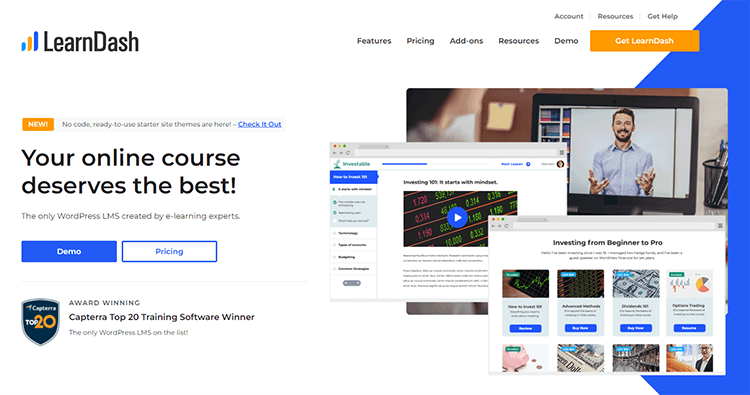
LearnDash is a self-hosted LMS plugin for WordPress. You install it on your own site, so you control your content, design, and learner data.
Courses follow a clear structure: course, lessons, topics, and quizzes. You can sell courses, track learner progress, award certificates, and extend the plugin with integrations.
LearnDash is now part of Liquid Web’s WordPress software lineup, alongside Kadence, The Events Calendar and Give. It suits people who want to run an LMS inside WordPress rather than on a hosted platform. That control comes with responsibility. You manage hosting, updates, and security yourself.
Who Is LearnDash Best For?
LearnDash fits best when you want structure, control, and room to grow. It is a weaker fit when budget or simplicity comes first.
If you are still planning your course business, our guide on building an online course platform can help you map the basics first.LearnDash is a good fit if… Think twice if… You already use WordPress You need a free LMS You need structured courses with quizzes and certificates Your budget is very limited You want to sell courses, memberships, or group seats You want the simplest possible setup You run training or education programs with several instructors You do not want to manage hosting and plugin updates You value a long-established plugin with many integrations You need a multisite setup, which LearnDash does not support
LearnDash Key Features
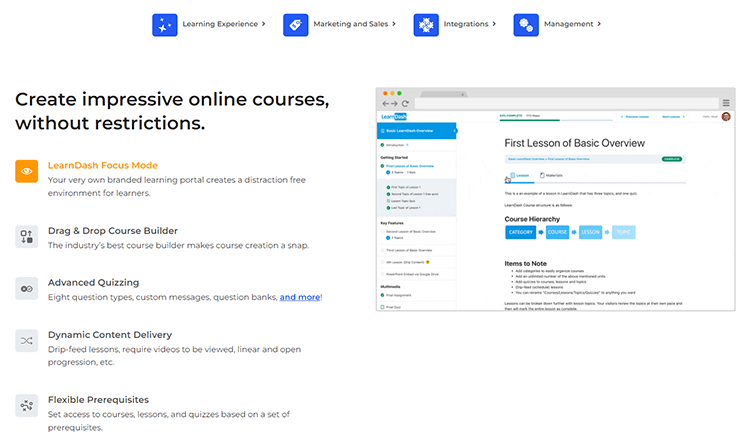
LearnDash WordPress LMS comes packed with powerful features that will help you take your online courses to the next level.
Course Builder
What it does: The course builder lets you add, reorder, and organize lessons, topics, and quizzes with drag and drop. LearnDash also offers an AI course builder. You describe a topic, and it drafts a structured outline you can edit before publishing.
Why it matters: Large courses stay easy to manage. You can change the order of content without rebuilding pages.
Best for: Academies, training teams, and creators with multi-module courses.
Lessons, Topics and Shared Course Steps
What it does: A course contains lessons. Lessons can contain topics and quizzes. With Shared Course Steps, you can reuse the same lessons, topics, or quizzes in more than one course.
Why it matters: You write a piece of content once and use it in several places. Learner progress is still tracked separately for each course.
Keep this in mind: Shared Course Steps needs the Course Builder. It also changes your URLs to a nested structure. LearnDash warns that you should not turn it off casually, because that can break the links between shared steps and courses.
Best for: Teams that sell bundles or build several courses from the same material.
Quiz Builder
What it does: The quiz builder offers eight question types. These include multiple choice, essay, sorting, and fill-in-the-blank. You can reorder questions with drag and drop.
Why it matters: Quizzes show whether learners understood the lesson. Quiz results also feed the reporting dashboard, so you can see where learners struggle.
Best for: Training programs, exam preparation, and any course that needs graded assessments.
Course Progression and Drip Content
What it does: LearnDash has two progression modes. Linear progression is the default. Learners must finish steps in order. Free-form progression lets learners move through steps in any order. Linear progression does not apply when a course uses the Open access mode. LearnDash also supports scheduled content release, often called drip content.
Why it matters: You decide how learners move through your material. Structured programs usually use linear mode. Reference-style courses often work better as free-form.
Best for: Cohort programs, compliance training, and paid courses that release lessons over time.
Certificates
What it does: You create a certificate and attach it to a course or a quiz. Learners earn it when they complete that step.
Why it matters: Certificates give learners proof of completion. They also give your course more perceived value.
Best for: Professional training, workshops and corporate learning programs.
Video Learning
What it does: Video progression requires learners to watch the full video before they can mark the content complete. You can add videos with a watch URL or an embed shortcode.
Why it matters: Learners cannot simply skip ahead. This helps when completion has to be genuine, such as in compliance or certification courses.
Best for: Video-first courses and training that must be completed in full.
Reporting, Groups and Multiple Instructors
What it does: LearnDash’s official page lists a reporting dashboard for enrollments, completion rates, quiz performance, and at-risk learners. LearnDash’s documentation describes ProPanel as a reporting add-on, so confirm which reporting tools your license activates.
Group seats let one sale enroll a whole company. They come from the Groups Plus add-on. Multiple instructors come from the Instructor Role add-on. It adds an instructor role and dashboard, with optional front-end tools. You can set a commission percentage for each instructor, view commission reports, and export them.
The Pay button only records a payment. It does not send money, so payouts stay manual unless you set up PayPal Payouts.
Why it matters: These tools turn a course site into a training operation. You can sell to organizations and let team leaders manage their own people.
Best for: Training businesses, schools and companies that sell to teams.
Add-ons and Integrations
What it does: LearnDash connects to many tools. Official integrations include WooCommerce, Zapier, Gravity Forms, bbPress, MemberPress and Paid Memberships Pro. Memberships are built directly into LearnDash through MemberDash. If you compare membership tools, see our list of the best WordPress membership plugins.
Why it matters: You can add payments, automation, community features, and email tools without rebuilding your site.
Keep this in mind: Some workflows still need extra plugins or paid products. Judge the total LMS stack, not just the base plugin.
Best for: Sites that need to connect their LMS to payment, email, community or automation tools. For other useful tools, see our guide to the best WordPress plugins for educational websites.
Core features, add-ons and extra setup
LearnDash splits its features between the core plugin, add-ons and integrations. This table shows where each one sits. Liquid Web’s package page says every plan includes all premium features, but add-ons still need to be installed and set up. Confirm the details at checkout.Feature How it is delivered Setup needed Course Builder, lessons, topics and quizzes Core plugin Standard course setup Shared Course Steps Core plugin Needs the Course Builder and changes your URLs Course progression, video progression and certificates Core plugin Settings for each course Memberships MemberDash, built into LearnDash Set up tiers and access rules Reporting dashboard Listed on the official page. ProPanel is documented as a reporting add-on Confirm which tools your license activates Group seats Groups Plus add-on Install and configure Multiple instructors and commissions Instructor Role add-on Install it, then set a commission for each instructor Instructor payouts through PayPal Optional part of Instructor Role Needs a PayPal business account with Payouts enabled WooCommerce selling Free official add-on Needs WooCommerce active Elementor templates and widgets Free compatibility add-on Needs Elementor Pro
Understanding in a variety of ways. Plus, the questions and answers support a variety of media types, so you can create even more engaging quizzes.
LearnDash Pros and Cons
No LMS is perfect. Here is a balanced view of the LearnDash LMS plugin.
Pros
- Clear course structure with lessons, topics, and quizzes.
- Drag-and-drop course builder, plus an AI outline tool.
- Eight quiz question types.
- Linear or free-form progression, plus drip content.
- Certificates for courses and quizzes.
- Reporting, memberships, group seats and instructor tools, some delivered as add-ons.
- Free WooCommerce integration and many other integrations.
- Liquid Web lists zero per-student fees.
Cons
- It is paid software, with no free plugin.
- The entry price is higher than the plans older reviews list.
- Every plan bundles Kadence, The Events Calendar, and Give, which you may never use.
- Many settings create a learning curve for complex setups.
- Hosting, updates, and security are your job.
- Multisite is not supported.
- It works only on WordPress.
- Moving to another LMS later needs careful planning.
- The Elementor integration requires Elementor Pro.
Does LearnDash Work With Elementor?
Yes, but you do not need Elementor to use LearnDash. LearnDash has its own course builder. Every LearnDash plan also includes Kadence, a block-based design tool. Elementor is optional.
If you already design with Elementor, the integration lets you style LearnDash pages visually. You need two things:
- Elementor Pro
- The LearnDash Elementor add-on
The add-on is a free compatibility add-on. You can find it in your LearnDash account under LearnDash LMS > Add-ons. It adds templates for courses, lessons, topics, and quizzes. It also adds widgets for items such as login, profile, course content, and certificates.
Two plugins now depend on each other, and they update on separate schedules. Test updates on a staging site first. If you want more design control, browse our list of the best Elementor addons.
LearnDash Technical Requirements
Check your hosting before you buy. LearnDash lists these minimum requirements in its official documentation:Requirement Current minimum WordPress 6.6 or higher PHP 7.4 or higher (WordPress recommends 8.3) Database MySQL 5.6 or higher, or MariaDB 10.1 or higher HTTPS Required PHP memory limit 128 MB or more Multisite Not supported
LearnDash supports the current WordPress version and the two versions before it. Keep WordPress updated to stay inside that range.
How Much Does LearnDash Cost?
LearnDash pricing has changed over time. Older reviews may show plans and prices that no longer exist. LearnDash now sells through Liquid Web, so always check the official page before you buy.
Current LearnDash Pricing
As of October 2026, Liquid Web prices LearnDash by the number of sites. Every plan includes the full package: LearnDash, Kadence, The Events Calendar and Give. Plans renew yearly.Plan Price per year Cost per site 1 site $350 $350 10 sites $599 $59.90 25 sites $799 $31.96 50 sites $899 $17.98 100 sites $999 $9.99
Most course creators with one site will start with the first plan. Agencies and networks get a much lower cost per site as the count grows.
License basics before you buy:
- Each site counts toward your plan, including subdomains.
- Plans renew yearly. Check the renewal price shown at checkout.
- If your license lapses, LearnDash keeps working, but you lose updates, security patches and support. See Liquid Web’s license guide.
- Refund terms differ between sources. Read the refund terms at checkout before you pay.
Liquid Web also offers a free 48-hour trial with no credit card. You can check the current LearnDash pricing and trial before you decide. The official pricing page is on Liquid Web.
Additional Costs to Consider
The license is only part of the cost. Before you buy, plan for:
- Hosting: LearnDash runs on your own hosting. Course sites with many learners need reliable hosting.
- Theme and design: You need a theme that works well with course pages. See our list of the best education WordPress themes.
- Elementor Pro: Required only if you use the Elementor integration.
- Extra integrations: Email, automation and community tools may have their own fees.
- Payment processing: Payment providers charge their own transaction fees.
- Renewals: Updates and support continue only while your license is active.
- Your time: Setup, testing and maintenance take real hours.
If you are building a full site from scratch, our guide on how to create an educational website covers the wider picture.
Is the LearnDash LMS Plugin Easy to Use?
It is easier than many LMS tools, but it is not effortless.
What feels easy:
- The drag-and-drop builder makes course structure simple to arrange
- The AI course builder gives you a starting outline
- You do not need to write code to create courses
What takes more effort:
- Many settings control access, progression and display
- Features such as Shared Course Steps need careful planning
- You handle hosting, backups and updates yourself
- Integrations add extra setup steps
A WordPress user who is comfortable with plugins will get started quickly. A complete beginner should expect a learning curve. Build one small test course first, then expand.
When Should You Consider a LearnDash Alternative?
LearnDash is a strong fit for many sites. It is not the right fit for every project. Consider an alternative when:
- Budget matters. The entry price may be too high for a first course.
- You want a free core plugin. LearnDash does not have one.
- You want a simpler setup. A lighter LMS may be enough for a few courses.
- You will not use the bundled products. Every plan includes Kadence, The Events Calendar, and Give.
- You need instructor revenue sharing. LearnDash can track instructor commissions, but sending the money may still be manual. Check your payout process first.
- You are starting fresh. If you have no LearnDash content yet, you are free to compare options.
One warning applies to existing sites. If you already run LearnDash with live students, plan any switch carefully. Migration may need manual data mapping, rebuilt course structures, and careful handling of learner records. Check the available export and import options before you decide.
CourseGlade as an Alternative to Compare
CourseGlade is our own plugin, so treat this as a disclosure, not a push to switch.
If you are still choosing an LMS, CourseGlade is another WordPress LMS worth comparing. It offers a free plugin on WordPress.org and a paid Pro version. Compare the two on features, pricing model, instructor workflows, and the tools your courses need. For a detailed side-by-side view, see Compare CourseGlade vs LearnDash.
If you already run a LearnDash site with live students, staying is usually the safer choice. CourseGlade states that it has no automated migration path from LearnDash.
For more starting points, see our guide to the best free WordPress LMS plugins.
Is LearnDash Worth It?
LearnDash is worth it if you need a mature, self-hosted LMS inside WordPress. It makes the most sense when you need structured courses, quizzes, certificates, reporting and integrations, and you accept a yearly license cost.
Choose LearnDash if you:
- Run or plan a serious training or education business
- Want full control over your content and learner data
- Need group sales, memberships, or multiple instructors
- Already have the WordPress skills, or a developer, to maintain the site
Compare alternatives if you:
- Are testing your first course idea on a small budget
- Want a free core plugin
- Prefer the simplest setup possible
- Are starting a new LMS and are not tied to any ecosystem
Frequently Asked Questions
Is LearnDash free?
No. LearnDash is paid software, and Liquid Web does not list a free plan. It does offer a free 48-hour trial with no credit card. If you need a free core plugin, compare free WordPress LMS plugins before you buy.
How much does LearnDash cost?
As of October 2026, LearnDash costs $350 for one site, $599 for 10 sites, $799 for 25 sites, $899 for 50 sites, and $999 for 100 sites. Every plan includes LearnDash, Kadence, The Events Calendar, and Give, and plans renew yearly. Check Liquid Web’s pricing page before buying.
Is LearnDash good for beginners?
It can be, with realistic expectations. The drag-and-drop builder and AI course builder help you start quickly. But LearnDash has many settings, and you manage your own hosting and updates. Beginners who are comfortable with WordPress will manage well. Complete beginners should expect a learning curve.
Does LearnDash work with Elementor?
Yes, with conditions. You need Elementor Pro and the free LearnDash Elementor add-on, which is available inside your LearnDash account. The add-on provides templates and widgets for courses, lessons, topics, and quizzes. You can also use LearnDash without Elementor.
Can you sell courses with LearnDash?
Yes. LearnDash is built for selling courses. It supports memberships through MemberDash and a WooCommerce integration. Group seats use the Groups Plus add-on. You can sell single courses, bundles, or subscriptions. Payment providers still charge their own fees, but Liquid Web lists zero per-student fees.
Does LearnDash work with WooCommerce?
Yes. The WooCommerce for LearnDash add-on is free. It links courses and groups to WooCommerce products and works with any WooCommerce payment gateway. It also supports WooCommerce Subscriptions and can remove access after a refund or cancellation. You need both plugins active.
Conclusion
The LearnDash LMS plugin is a mature choice for course creators and organizations that want full control inside WordPress. Its main strengths are structured courses, flexible quizzes, certificates, reporting, and a wide integration ecosystem.
It suits training businesses, schools and teams that sell courses seriously. It is a weaker fit for a quick, low-cost test. Its limits are cost, setup effort, and the work of managing your own hosting.
Alternatives make sense when budget, a free core plugin, or a simpler setup matters most. Still comparing your options? See how CourseGlade compares with LearnDash before choosing your WordPress LMS: Compare CourseGlade vs LearnDash.