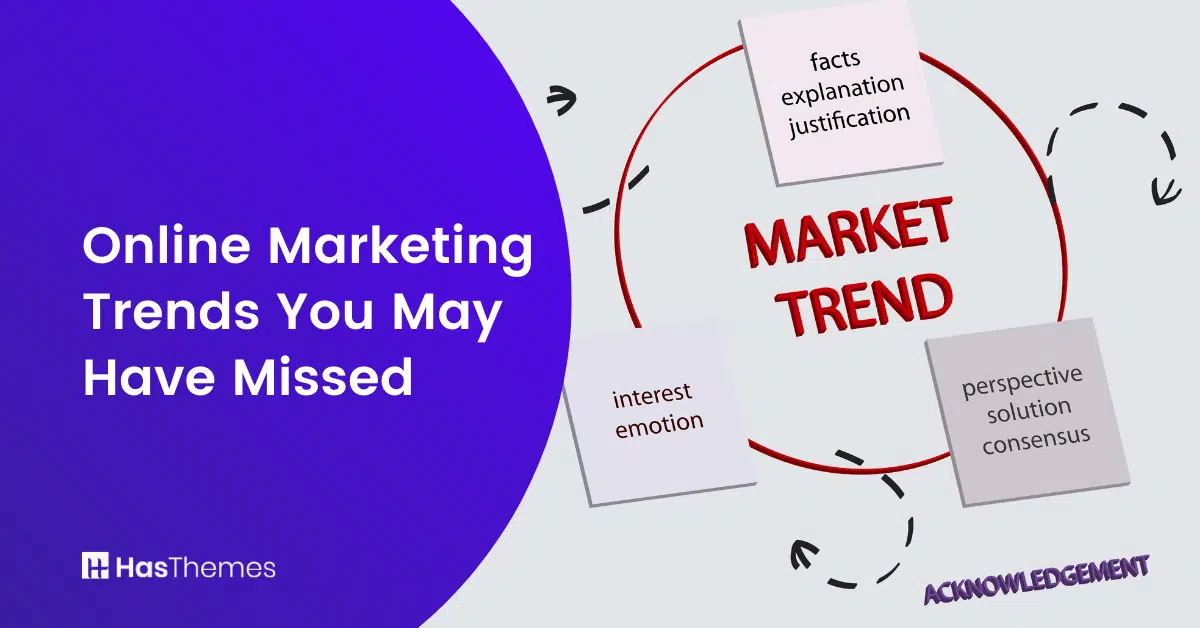
8 Online Marketing Trends That Actually Matter for eCommerce Stores in 2026

Quick Answer
The most important online marketing trends for eCommerce in 2026 are: AI-powered personalization, short-form video content, user-generated content (UGC), first-party data collection, social commerce, storytelling, meme marketing, and virtual events. Together, these trends help store owners attract new customers, build trust, and increase repeat purchases without relying on expensive paid ads.
Running an eCommerce store in 2026 feels different from even two years ago.
Customer attention is harder to earn. Ad costs are higher. Third-party data is gone. And AI has changed how people search for products — not just on Google, but on ChatGPT, Perplexity, and AI Overviews built into search results.
This is not the time to rely on what worked in 2022.
The good news: the marketing trends shaping 2026 all point in the same direction, toward more authentic, more personalized, and more direct relationships with your customers. That favors smaller stores that can move fast.
This guide covers 8 online marketing trends that actually move the needle for eCommerce businesses. Each section explains what the trend is, why it matters for your store, and what you can do about it today.
8 Online Marketing Trends for eCommerce Stores in 2026
1. AI-Powered Marketing: From Nice-to-Have to Necessary
AI has crossed the line from experiment to everyday tool for eCommerce marketers.
What does that mean in practice? AI is being used to write and test product descriptions at scale, generate personalized email subject lines, predict which products a returning customer is most likely to buy, and optimize ad bids in real time.
According to Statista, the AI marketing market is projected to reach $107 billion by 2028. Adobe found that AI-driven revenue per visit increased 84% between January and July 2025. And 73% of consumers are already using AI in some part of their shopping journey.
What this means for your store:
- Use AI tools to generate and A/B test product descriptions faster. Not to replace your voice, but to scale it.
- Set up AI-driven product recommendation blocks on your store pages — tools like ShopLentor make this possible directly inside your Elementor-built WooCommerce pages without custom code.
- Use AI-powered email segmentation to send the right offer to the right customer at the right time, rather than blasting your whole list with the same message.
The biggest mistake store owners make here is waiting until they fully understand AI before using it. You do not need to understand how it works. You need to start using it.
2. First-Party Data and Privacy-First Marketing
This is the structural shift that every eCommerce marketer needs to understand.
Third-party cookies — the technology that let advertisers track users across the entire web — are gone. Safari and Firefox have blocked them for years. Chrome completed its phase-out in Q3 2024. Eight new U.S. state privacy laws took effect in 2025. The EU AI Act brings additional compliance requirements by August 2026.
The result: the old way of retargeting customers across the web no longer works the way it used to.
What replaces it:
First-party data is data collected directly from your own store — purchase history, browsing behavior, on-site search queries, email engagement. This is the most valuable data you have, and it is entirely yours.
Zero-party data is data customers give you intentionally — through surveys, quiz-style pop-ups, wishlist features, or account preferences. A birthday discount opt-in is a simple example. So is a style quiz that helps customers find the right product. Zero-party data is especially powerful because it reflects intent, not just behavior.
Companies using first-party data see 2.9x better customer retention than those still relying on third-party signals.
What to do now:
- Add a preference center to your store’s account area. Ask customers what categories they care about.
- Use post-purchase surveys with a single question — “What brought you here today?” — to understand your acquisition channels without relying on cookies.
- Make your email list your primary owned channel. It is the most privacy-compliant, highest-ROI direct marketing tool available.
Stores that build strong first-party data systems now will have a real competitive advantage over the next three to five years.
3. Personalization That Goes Beyond “Hi [First Name]”
Personalization in 2026 is not about inserting a customer’s name into an email subject line. Every store does that. It barely registers.
Real personalization means showing different products, different offers, and different messaging based on what each customer has actually done in your store, what they bought, what they browsed, what they abandoned, and how long they have been a customer.
esearch consistently shows that 80% of shoppers are more likely to buy from brands that offer personalized recommendations.
More importantly, personalized experiences reduce the feeling that a customer is just another order number — which is what most eCommerce stores feel like.
Personalization that works for eCommerce stores:
- Product recommendations based on browsing and purchase history (not just “bestsellers”).
- Segmented email sequences: New customers get a different flow than customers who have bought three times.
- Dynamic homepage content: Returning visitors see recently viewed categories or restocked items they looked at.
- Geo-based offers: Customers in certain regions see relevant products or shipping promotions.
If you are running a WooCommerce store, ShopLentor’s product filter and custom checkout features let you build personalized shopping experiences without needing a developer for every change.
The demographic dimension matters too. A 22-year-old discovering your brand through TikTok has different expectations from a 45-year-old who found you through Google. If your analytics show clearly different segments, your marketing messaging should reflect that.
4. Short-Form Video: Still the Highest ROI Content Format
Short-form video is not a new trend — it is now the default content format for product discovery.
73% of consumers say they prefer watching a short video to learn about a product or service. TikTok, Instagram Reels, and YouTube Shorts combined reach billions of users daily. Product demos, unboxing videos, before-and-after transformations, and “how to style/use this” content are consistently among the highest-performing formats for eCommerce stores.
What has changed in 2026 is the bar for production quality. Over-produced videos now feel out of place on TikTok and Reels. The content that performs is authentic, quick, and filmed like a person — not like an advertisement.
What makes short-form video work for product-based stores:
- The first 2 seconds determine whether someone keeps watching. Show the product doing something, not someone talking about the product.
- A 30-second demo with real results outperforms a 90-second brand story every time.
- You do not need a professional video studio. A clean background, decent lighting, and a phone camera are enough.
- The same video can be cross-posted on TikTok, Reels, and YouTube Shorts with minimal editing; you do not need separate content for each platform.
For eCommerce stores specifically, short-form video is one of the most cost-effective ways to drive cold traffic — people who have never heard of your brand — into your store. That makes it especially valuable if your paid ad costs have increased.
5. User-Generated Content (UGC): Your Most Trusted Marketing Asset
Here is an uncomfortable truth: customers trust other customers far more than they trust you.
79% of people say user-generated content — photos, videos, and reviews created by real buyers — significantly influences their purchasing decisions. That is not surprising. When someone sees a real person using a product in a real context, the skepticism that normally filters out advertising disappears.
Brands like GoPro built their entire content strategy around UGC. Glossier reposts customer selfies on Instagram as a core part of their marketing. Neither of these approaches requires a large budget. They require a system for collecting and surfacing what customers are already creating.
How to build a UGC system for your store:
- Include a post-purchase email that asks customers to share a photo or video in exchange for a small discount on their next order. Frame it as joining a community, not completing a transaction.
- Create a branded hashtag and mention it in your packaging and order confirmation emails.
- Feature the best customer content on your product pages — not just in a review section, but as actual product photography.
- Respond publicly to the content customers create. A comment or a repost signals to other customers that you are paying attention.
The compounding effect of UGC is significant: the more customer content you feature, the more new customers are inspired to create content themselves. Over time, this builds a content system that runs largely without you.
6. Virtual Events and Live Commerce
Since 2020, virtual events have moved from emergency substitute to legitimate marketing channel — and the format has evolved significantly.
For eCommerce stores, the most commercially relevant evolution is live commerce: selling products through live video streams where viewers can ask questions, see products demonstrated in real time, and purchase without leaving the stream. In China, live commerce accounts for a significant portion of total eCommerce sales. Western markets are catching up fast.
Beyond live shopping, virtual events work well for:
- Product launches – a live stream is faster, cheaper, and more engaging than a static email announcement
- Q&A sessions – especially effective for stores with higher-consideration products (supplements, electronics, home goods) where customers have real questions before buying
- Community building – regular virtual touchpoints keep customers connected to your brand between purchases
The barrier to entry is low. You do not need a dedicated platform or special equipment. A live stream on Instagram, TikTok, or YouTube, or a Zoom webinar for an email list, is enough to start.
What matters more than the platform is the regularity. One-off events have limited impact. A monthly live session builds audience habit and expectation.
7. Storytelling: The One Marketing Skill That Never Goes Out of Style

Every trend in this article has a shelf life. Storytelling does not.
The human brain is wired to process and remember stories more effectively than facts or features. This is why a product testimonial from a real customer consistently outperforms a feature list in conversion rates — even when the feature list is technically more informative.
For eCommerce stores, the most effective storytelling formats are:
- Customer transformation stories — someone who had a problem, found your product, and experienced a specific improvement. The more specific the detail, the more believable and effective the story.
- Founder or brand origin stories — why the store was started, what problem the founder was trying to solve, and what they learned along the way. This works especially well for stores with a clear point of view or mission.
- Product backstory content — where the product came from, how it is made, or what makes it different. This is particularly effective for handmade, sustainable, or locally sourced products.
What does not work is the classic cliché structure: problem → gray world → product appears → everything is colorful now. Consumers recognize this formula immediately and scroll past it.
What works is specificity. Real names. Real numbers. Real before-and-afters.
Do not wait for customers to leave reviews and hope they surface somewhere useful. Collect them systematically, and build them into your product pages, email sequences, and social content.
8. Meme Marketing: High Upside, Real Risks
Memes occupy a unique place in the marketing toolkit. They spread fast, cost almost nothing to produce, and can make a brand feel instantly relatable — but they can also make a brand look desperate, out of touch, or unprofessional if done badly.
The core appeal of meme marketing is that it does not look like marketing. A meme scrolls through a feed looking like content. If it is genuinely funny or relatable, people share it without thinking of it as brand promotion.
When meme marketing works well:
- Brands targeting younger audiences (Gen Z, younger millennials) on platforms where meme culture is native — TikTok, Instagram, Reddit, X
- Brands in categories where humor fits the product — food, energy drinks, gaming accessories, casual apparel, pets
- Brands that are willing to be self-deprecating or acknowledge their own flaws honestly
When meme marketing backfires:
- When a brand tries to use a meme template that is already outdated (memes have extremely short shelf lives — what is funny this week may be cringeworthy next month)
- When the humor does not match the brand’s actual identity — forced humor reads immediately as forced
- When the category does not support it — a law firm or medical supplier using memes is almost always a mistake
The practical test: if your team had to explain why the meme is funny, it will not land. Meme marketing requires instinctive cultural fluency, not strategic analysis.
If your store already has a personality that naturally leans toward humor, meme content is worth testing systematically. If it feels like a stretch, invest that energy in storytelling or UGC instead.
How to Prioritize These Trends for Your Store
Not every trend applies equally to every store. Here is a practical framework:Trend Best for Quickest win AI-powered marketing Stores with 500+ SKUs or large email lists Product recommendation blocks First-party data Every store Post-purchase survey Personalization Stores with repeat buyer segments Segmented email flows Short-form video Stores with visually demonstrable products 3 Reels/TikToks per week for 30 days UGC Every store Post-purchase photo request email Virtual events Stores with an engaged email list Monthly live Q&A Storytelling Every store 1 customer story per month on email and social Meme marketing Stores targeting under-35 audiences Test 2-3 posts, measure engagement vs standard content
Start with the trends that match your current audience and resources. Master one before adding another.
Frequently Asked Questions
What are the most important online marketing trends in 2026?
The most impactful trends for eCommerce in 2026 are AI-powered personalization, first-party data collection (replacing cookies), short-form video for product discovery, and user-generated content. These four have the clearest evidence of driving measurable results for store owners.
How can a small eCommerce store compete using these trends?
Small stores actually have an advantage with trends like UGC, storytelling, and meme marketing — because authenticity is easier when you are not a faceless corporation. Start with one owned channel (email or a single social platform), build a real relationship with your audience, and collect customer content systematically.
Is AI replacing human marketers in eCommerce?
No, but it is changing what human marketers spend their time on. AI handles repetitive execution tasks (writing variations, segmenting lists, testing subject lines). Human judgment is still required for brand direction, strategy, and identifying what actually resonates with your specific audience.
What happened to third-party cookies, and what replaces them?
Chrome completed its phase-out of third-party cookies in Q3 2024. This means cross-site behavioral retargeting no longer works the way it did. The replacement is a combination of first-party data (collected from your own store) and zero-party data (information customers share with you voluntarily). Stores that built email lists and on-site data collection systems early are in a significantly stronger position.
How do I start collecting first-party data for my WooCommerce store?
Start with three things:
(1) a post-purchase survey asking how customers found you,
(2) a preference center in your customer account area, and
(3) a pop-up with a genuine value offer (discount, early access) in exchange for an email and category preferences.
These require minimal technical setup and start generating useful data immediately.
Does short-form video work for B2B eCommerce?
Yes, but the format changes. B2B audiences on LinkedIn and YouTube respond well to short explainer videos, use-case demonstrations, and behind-the-scenes content, less to entertainment-style TikTok content. The principle is the same: show the result or the process; do not just describe it.
What is the difference between UGC and influencer marketing?
UGC comes from regular customers who bought and used your product — it is unprompted or minimally prompted. Influencer marketing involves paying or gifting to someone with an existing audience to promote your product. UGC is typically more trusted because it comes without a commercial arrangement. Both have a place, but UGC scales better and costs less at the store level.
Conclusion
The online marketing landscape in 2026 rewards stores that invest in real relationships with their customers through personalization, transparency, authentic content, and direct communication channels that do not depend on third-party platforms.
The trends in this guide are not equal in their complexity or cost. Start with what you can implement this week: a post-purchase survey, a UGC request email, or three short product videos. These have no meaningful cost and generate both data and content.
Build from there.
If you are running a WooCommerce store and want to make personalization and custom product experiences easier to manage, explore how a WooCommerce page builder can reduce the gap between what you want your store to do and what it actually takes to build.
For more on building effective eCommerce marketing, read our guide to mobile app marketing strategies and our deep dive into user experience and content marketing.